Predicting community coalescence with GNNs
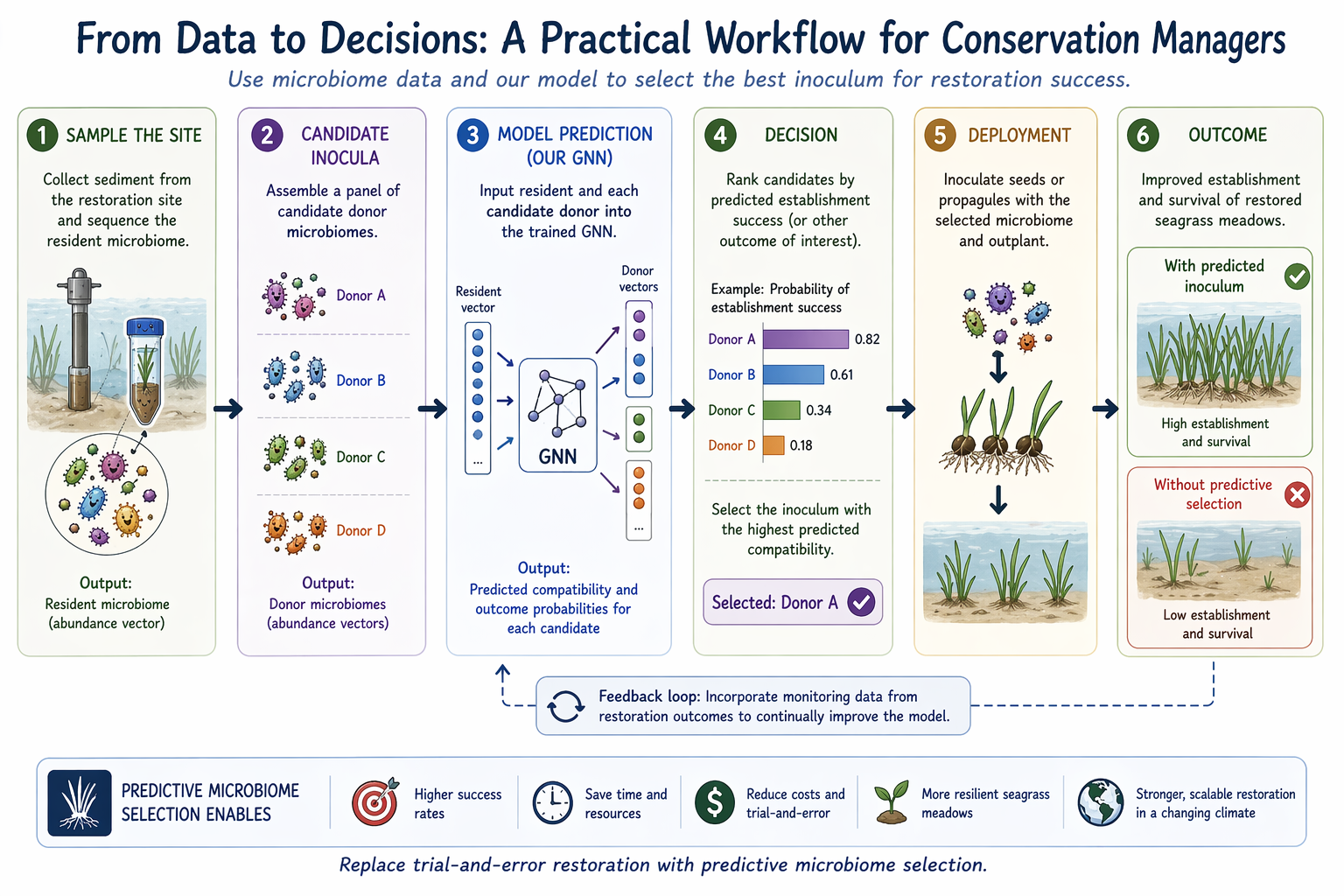
Can a model learn high-order contextual species interactions to predict community coalescence outcomes?
People
Day 1 task
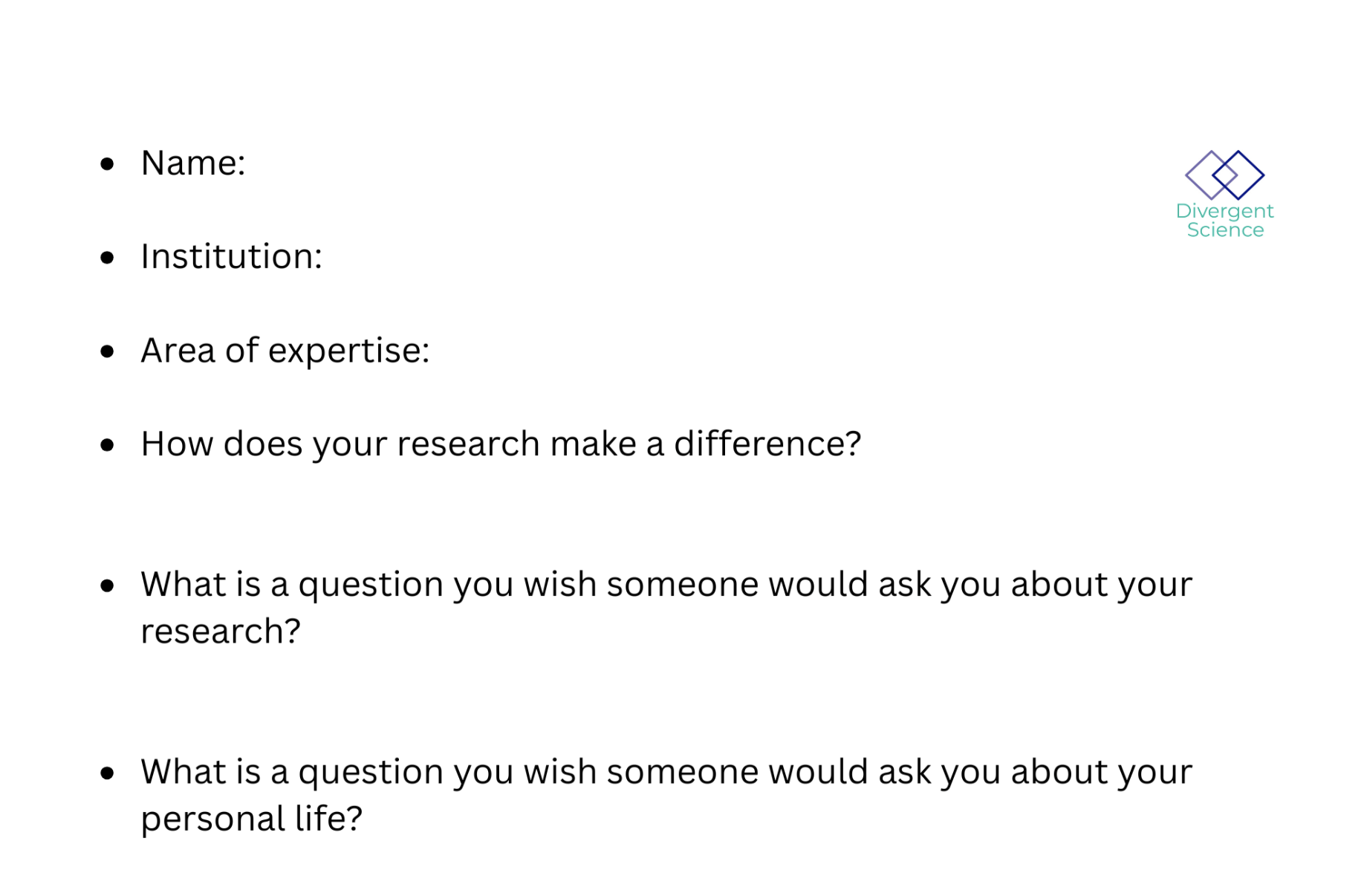
Get to know your team: share your cards (5-7 mins). Update your team roster (2-3 min).
Use the in-person name cards to guide quick introductions.
| Name card prompts | Follow-up notes |
|---|---|
 |
 |
| Name | Affiliation | Contact | Github |
|---|---|---|---|
| Geoff Zahn | William & Mary | gzahn@wm.edu | gzahn.github.io |
| Manish Sarkar | Case Western Reserve University | manish.sarkar@case.edu | manishNsarkar |
| Cooper Kimball-Rhines | University of Massachusetts Boston | c.kimballrhines001@umb.edu | coopermkr.github.io |
Team Norms and Decision Making
Day 1 task
Suggested Self-Facilitation Instructions:
-
Round Robin: Everyone shares 1 norm that they think will be important for their team during the Summit and perhaps following the Summit (2 min).
-
After everyone has shared, make a list with as many norms as possible in GitHub (5–7 min).
-
Vote on your top 3 ideas. (Each person gets 3 votes; you can use all your votes on 1 idea or spread them out) (2 min).
-
In GitHub, move all team norms with votes to the top of the list.
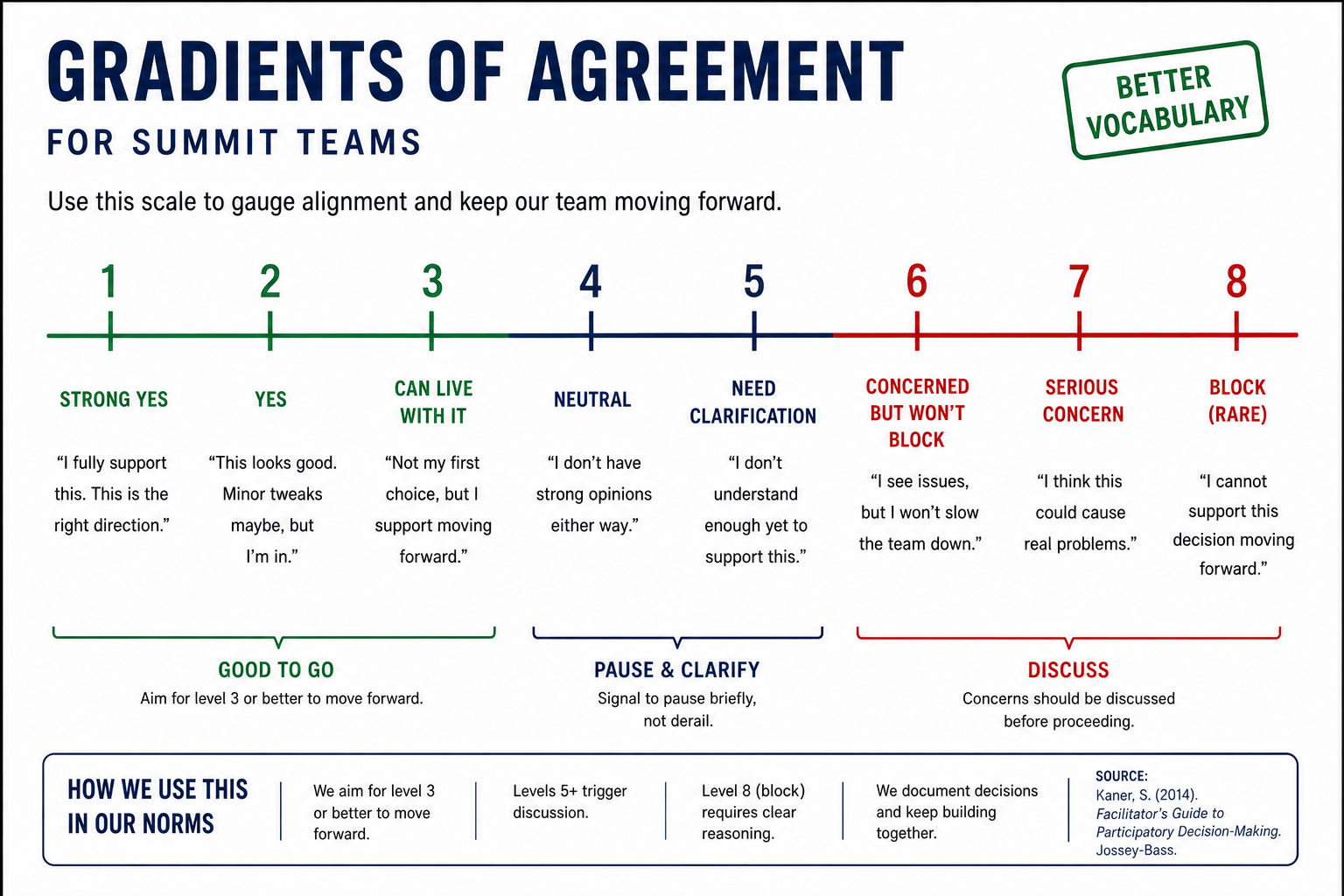
| Gradients of agreement |
|---|
 |
Our team norms:
- Have good github hygeine (Pull often!)
- Use slack for communications
- Log all AI agent prompts and metadata
Our decision making strategy:
We are a small group, so we want everyone to agree with major decisions that affect the direction of the project.
Our product(s) 📣
Day 2 Tasks
Morning Focus: questions, hypotheses, context; add at least one visual (photo of whiteboard/notes)
Afternoon Focus: try a few datasets and analyses. Keep it visual, keep it simple. Update the site to reflect what you test.
Short term:
- A trial GNN so we can figure out what we need to know/who we need to recruit
Long term:
- A publication for the model and framework approach
- A Big and Fancy later publication applying the model to a new research system with public data
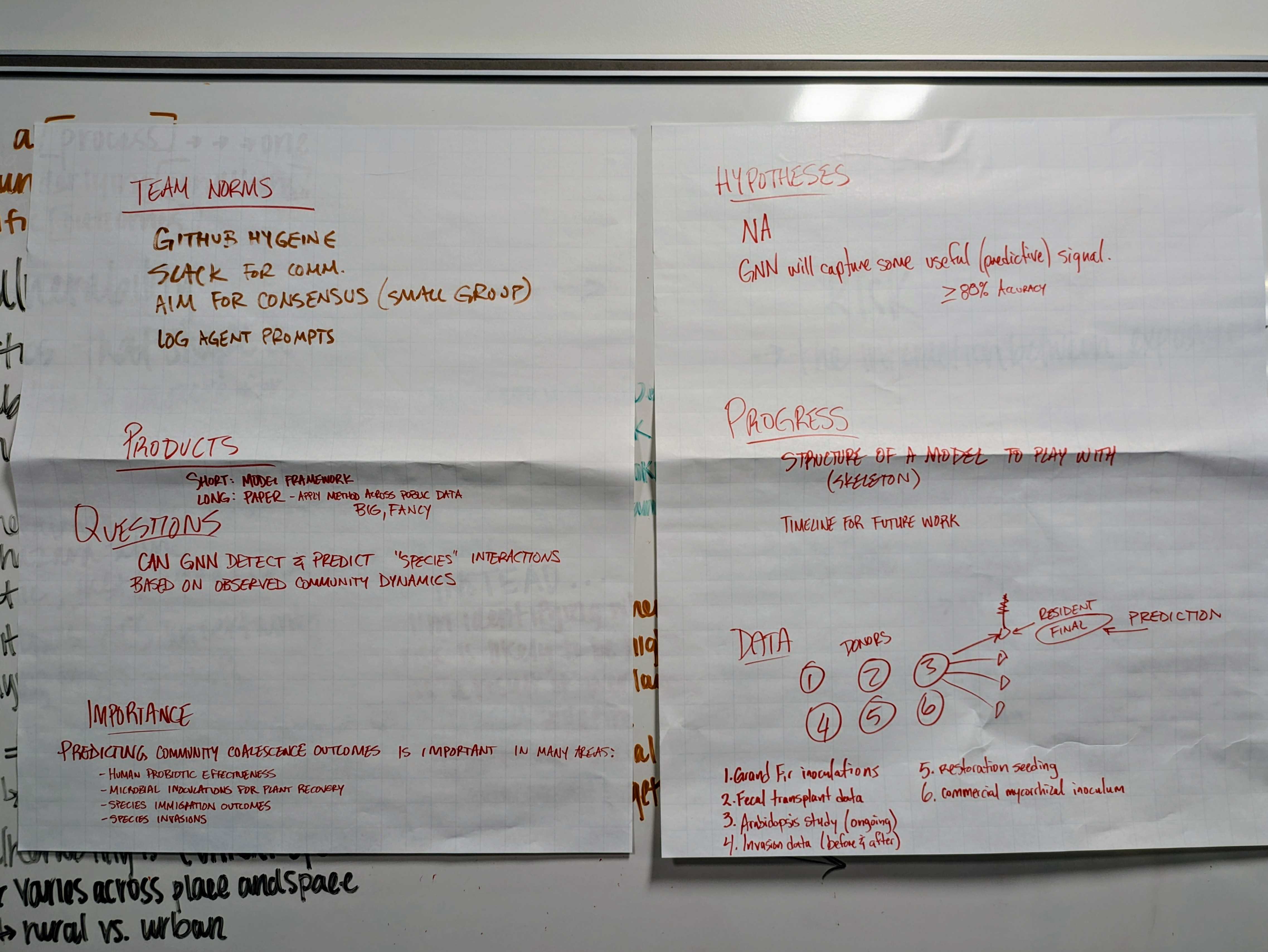
Morning whiteboard or notes showing the question, hypotheses, and context we used to start Day 2.
Our question(s) 📣
Our working question:
- Can we predict a coalescent community from known resident and donor communities?
What would count as progress:
- Getting data ready to input into a model
- Developing a model structure
- Having a timeline for future work
Hypotheses/Intentions
- We hypothesize that a Graphical Neural Network will adequately (>80%) predict community coalescence from resident and donor community compositions.
Why this matters (the “upshot”) 📣
This matters because:
- It applies a novel framework and approach to a simple ecological question: when you combine two communities, who stays?
- A working model would be highly generalizable to many biological systems, both micro and macro.
People who could use this:
- Restoration managers, agriculturalists, human microbiome community, probiotic researchers
Data sources we’re exploring 📣
data exploration
Provide a snapshot showing some initial data patterns.
Add 2-4 promising data sources (links +1-line notes)
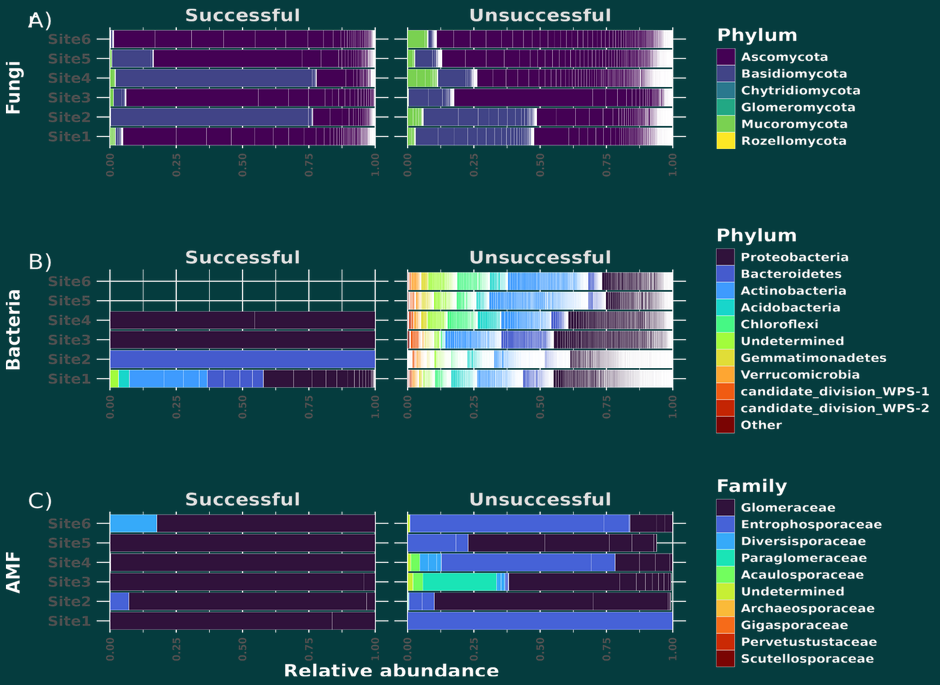
"Success" of various taxonomic groups at establishing after coalescence.
Promising data sources:
- Great Fir Innoculations: Soon to be published data on a controlled seed innoculation experiment
- Fecal Transplant Data | Related publication
- Seed mix restorations (NECASC/RISCC?): After management or removal of invasive species, managers often plant commercial "native plant" seed mixes.
Methods/technologies we’re testing 📣
methods
Add 2-4 methods/technologies we're testing (stats, models, viz).
Methods/technologies we are testing:
| Method or technology | What we tested | Early note |
|---|---|---|
| PyTorch | Deep Learning Library | Working on data reformatting and getting the model to run |
| TensorFlow | Deep Learning Library | Might transition to this later to use in R using Keras, Reticulate |
Challenges identified
- We have not coded our own GNNs before
- We lack python skills, but are searching for workarounds in R
Next Steps
**Short term: **
- Finalize initial case study data set preparation
- Initial draft model code completed
- Identify other collaborator(s) as needed
**Long term: **
- Build literature base
- Test & improve model architecture
- Run 3-4 different cases through model
- Publish the greatest paper of all time!
Day 3 Tasks
Sythesis: highlight 2-3 visuals that tell the story; keep text crisp. Practice a 6-minute walkthrough of the homepage. Why -> Questions -> Data/Methods -> Findings -> Next
Team Photo
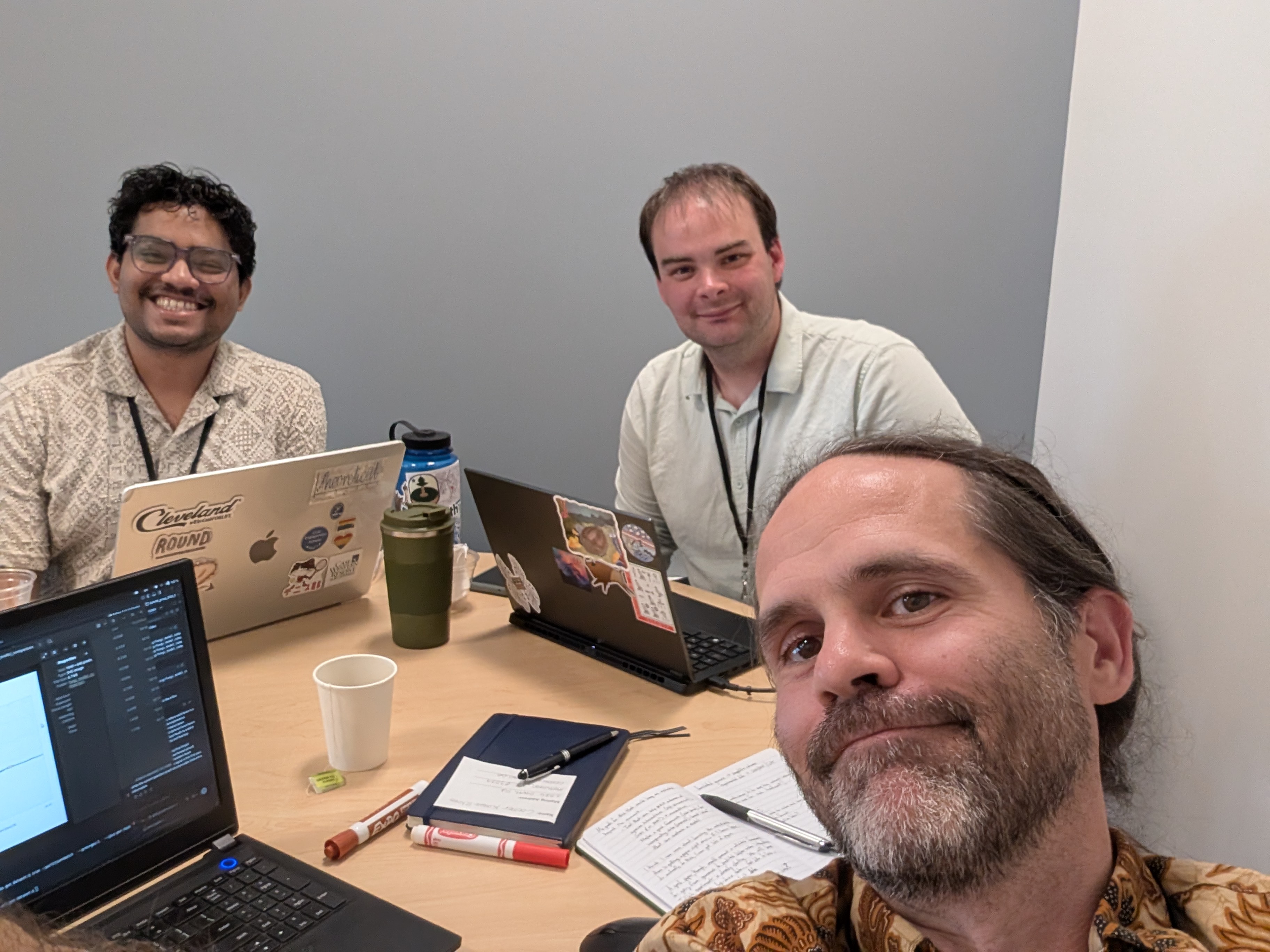
Team members and collaborators who contributed to this project.
Findings at a glance 📣
Headline 1 — This type of data is adequate to successfully compile a GNN.
Headline 2 — The GNN performs better on presence/absence data than on abundance data, but the predictive capacity on our initial dataset is still poor.
Headline 3 — Looking at a different dataset (See fecal transplants above) will both broaden applicability into the medical field and might provide cleaner data to train the GNN on.
Visuals that tell a story 📣
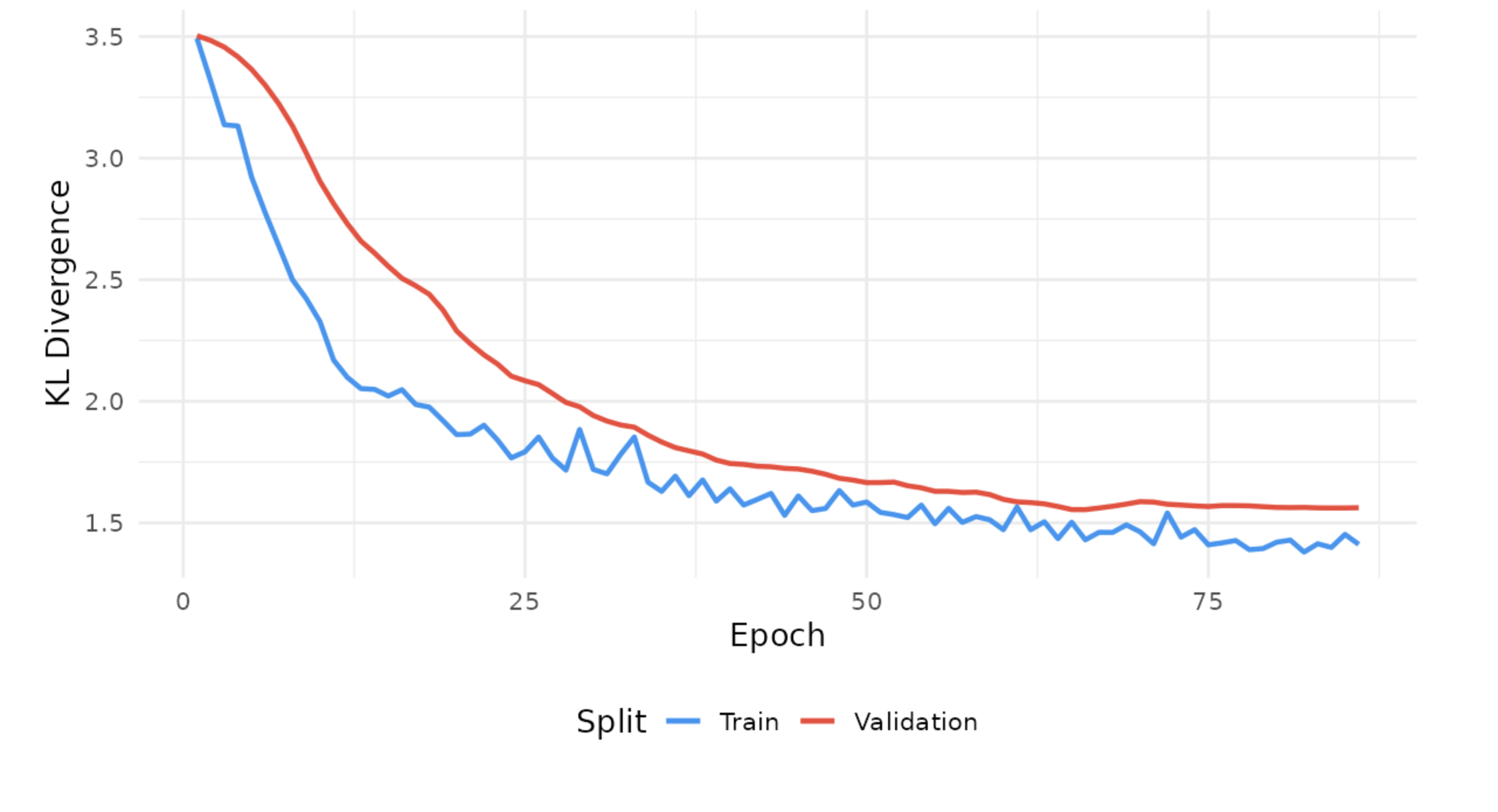
Visual 1: Model loss showing convergence
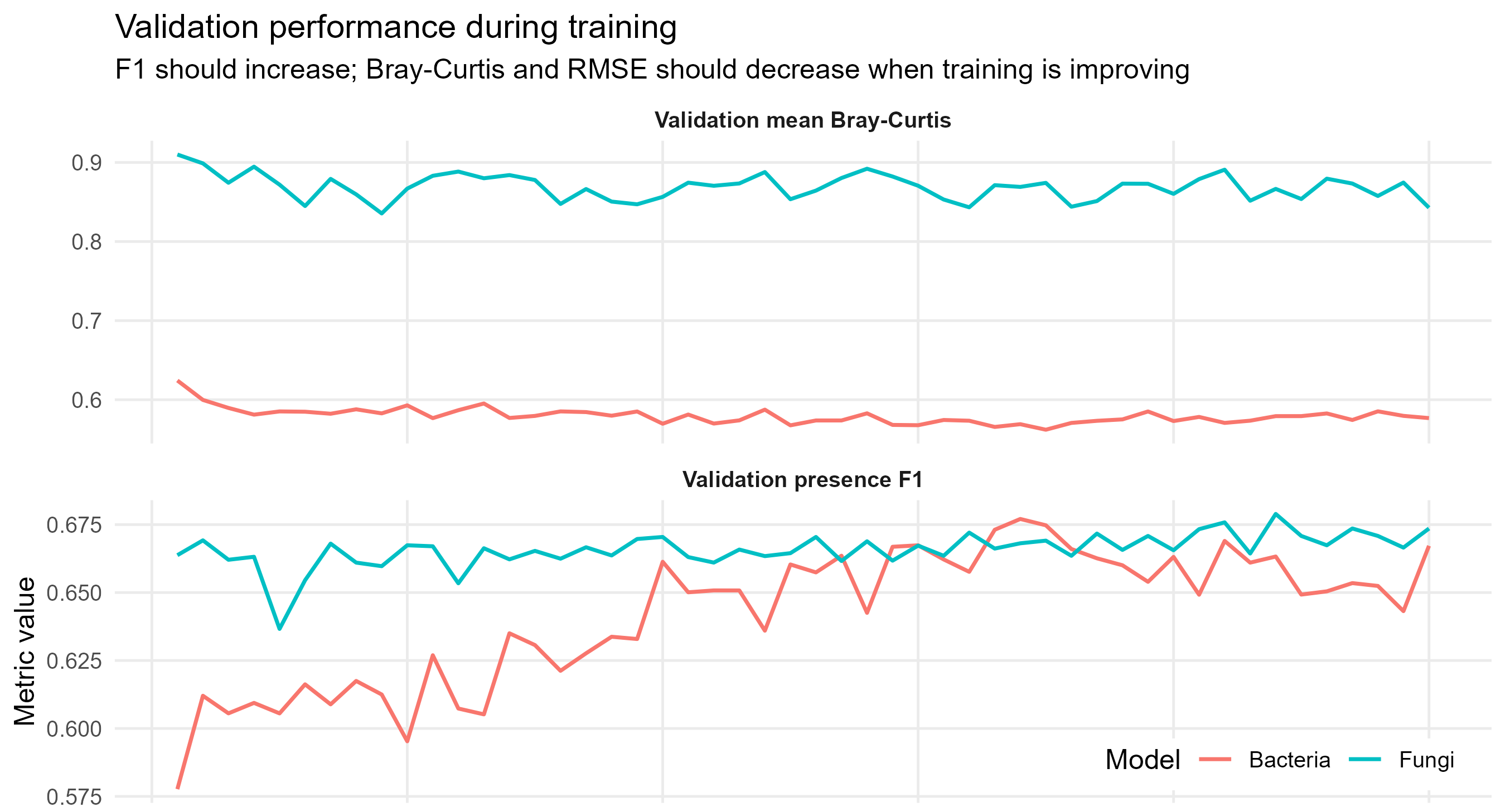
Visual 2: The GNN performs poorly on community abundance data, but still performs slightly better than random chance on presence/absence.
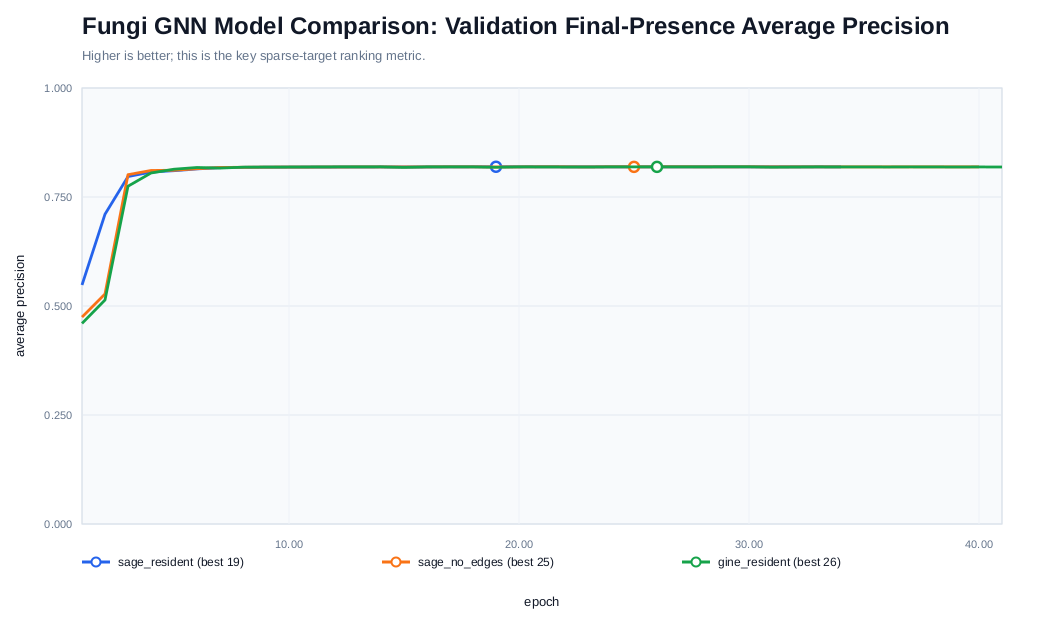
Visual 3: PyTorch_Geometric model performed well on predicting final fungal community member presence Here, we trained one graph per microcosm, where each taxon is a node with donor and resident abundance/presence features. A 2-layer GraphSAGE model learns taxon embeddings from these features and optional taxon-taxon association edges, then uses two output heads to predict each taxon’s final presence probability and final log-abundance.
What’s next? 📣
Short term:
- Prepare a cleaner dataset to determine if the issue is with the data or the model architecture.
Long term:
- Finalize a model architecture and test it with multiple types of data including medical, restoration, and agricultural community coalescence experiments.
Who should see this next
- Someone who understands GNNs better than we do.
Cite & Reuse
If you use these materials, please cite:
Summit Team. (2026). Summit Group 2026 Team 8 — Innovation Summit 2026. https://github.com/CU-ESIIL/Summit_group_2026_8
License: CC-BY-4.0 unless noted.