Implications for remote sensing
Satellite data often appear to offer a straightforward way to map the Wildland–Urban Interface. One assembles a representation of settlement, a representation of vegetation, and a rule for determining where the two come into meaningful contact. The resulting map can then be interpreted as a measurement of where development meets flammable landscape. Yet the apparent simplicity of this workflow conceals a deeper geometric problem. Satellite data do not merely record the WUI boundary. They help determine the scale at which that boundary can exist as a measurable object.
Every remotely sensed representation of the WUI carries an implicit spatial grain. Buildings may be mapped as fine footprints, as coarser settlement surfaces, or as gridded density estimates. Vegetation may be classified at one resolution and then aggregated or thresholded at another. Adjacency may be defined through immediate contact, through moving windows, or through neighborhood radii that smooth local irregularity into broader patterns of connectivity. Each of these choices contributes to the delineation of the boundary itself. In the notation used throughout this project, these choices belong to the term (d): the definition of the boundary object before its length is measured.
A second scale enters through the act of measurement. Once a boundary has been delineated, its reported length still depends on the effective ruler used to trace it. In raster data, pixel size plays much of this role. Coarse pixels smooth over indentations, narrow corridors, and small pockets of vegetation or development. Finer pixels begin to resolve these features and, in doing so, reveal a longer and more intricate interface. The consequence is the remote-sensing analogue of the coastline paradox: the measured WUI boundary length depends on the scale of observation.
This means that satellite resolution should not be treated as a neutral technical detail. It is part of the scientific meaning of the measurement. A perimeter derived from a coarse product and a perimeter derived from a finer product are not simply two estimates of the same number, one good and one bad. They are measurements of the interface under different effective ruler lengths. In the language of this project, they are different evaluations of the same general quantity, (L_d(\varepsilon)), where (\varepsilon) represents measurement scale.
The implications are substantial. An apparent increase in WUI perimeter may reflect a genuine change in settlement pattern, vegetation pattern, or interface structure. But it may also reflect a change in sensor resolution, classification workflow, or spatial aggregation rule. Time series assembled from different sensor generations therefore contain an interpretive hazard: some of the observed change may belong to the evolution of the measurement system rather than to the evolution of the landscape itself.
The same caution applies to comparison across studies and regions. Two analyses may appear to disagree about the extent or complexity of the WUI not because the underlying landscapes differ fundamentally, but because the boundary objects were constructed differently or because those objects were measured at different effective scales. Without explicit attention to these choices, methodological variation can take on the appearance of ecological truth.
The purpose of the figure on this page is not to claim a final empirical law for all WUI boundaries. Rather, it is to make visible a principle that should accompany any remote-sensing analysis of the interface: boundary length is a scale-conditioned quantity. Satellite imagery is not merely a window onto that interface. It participates in defining the scale at which the interface can be seen, constructed, and measured.
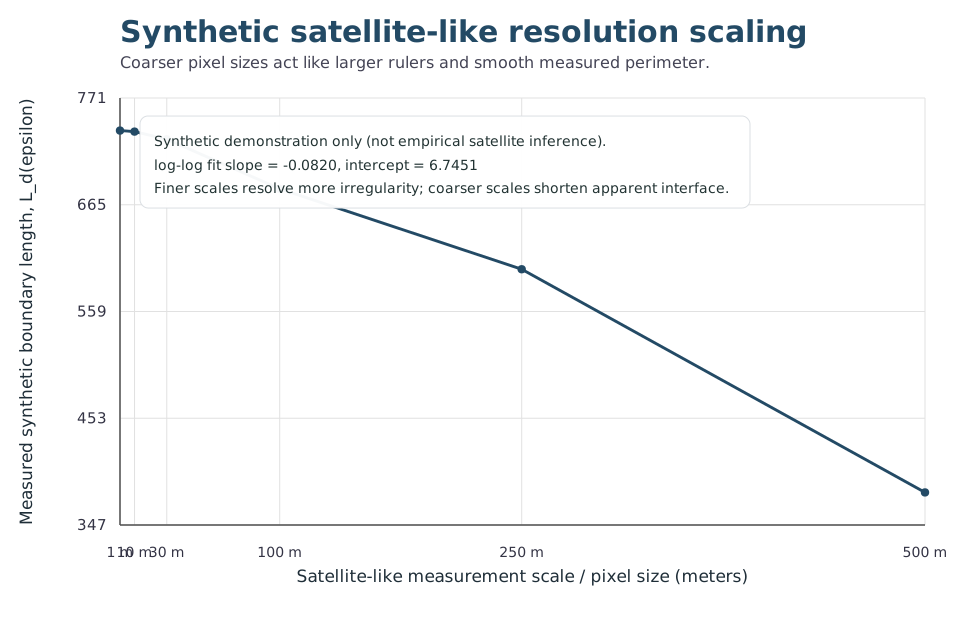
Figure. Conceptual scaling curve using synthetic boundary geometry, showing measured interface length across effective ruler lengths analogous to 500 m, 250 m, 100 m, 30 m, 10 m, and 1 m remote-sensing products. Coarser resolution smooths boundary detail and shortens measured perimeter, while finer resolution resolves additional structure and increases measured perimeter.
A tabular summary of the conceptual figure is available at docs/assets/data/satellite_resolution_scaling_summary.csv.
A corresponding empirical bridge implementation, based on open OSM building footprints and streamed NLCD vegetation subsets, is documented in Real-data experiments.