Quantum Emulator for Environmental Data Science
Turn environmental data into site-selection experiments you can run locally.
Harmonized layers become a decision table. The decision table becomes a QUBO. The emulator selects sites, compares against a classical baseline, and maps the tradeoffs back to geography.
Harmonize Build QUBO Emulate Compare Map
Actual Demo Result
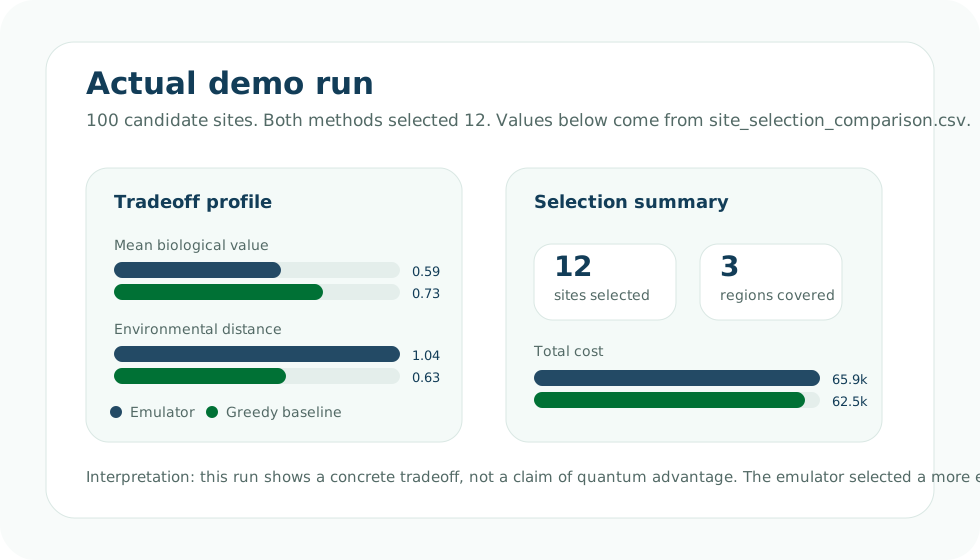
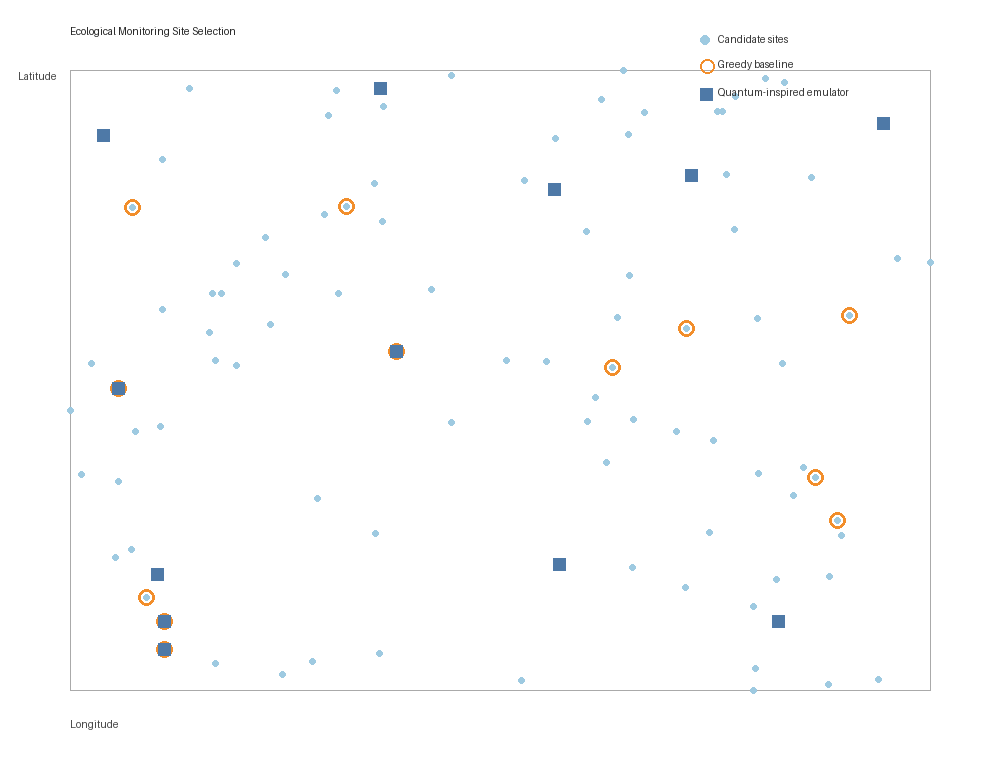
These figures come from the checked-in ecological monitoring demo run, not a mockup. The emulator and greedy baseline each selected 12 sites from 100 synthetic candidate monitoring locations.
What changed between methods?
| Metric | Emulator | Greedy baseline |
|---|---|---|
| Sites selected | 12 | 12 |
| Mean biological value | 0.59 | 0.73 |
| Total cost | 65,913 | 62,529 |
| Environmental distance | 1.04 | 0.63 |
| Regions represented | 3 | 3 |
The emulator run selected a more environmentally spread-out network. The greedy baseline selected a lower-cost network with higher mean biological value. That tradeoff is the point of the exercise: compare candidate decisions, then decide which tradeoff makes scientific sense.
What Emulation Means Here
The emulator is a local training stand-in for quantum-ready optimization. It does not run on quantum hardware. It takes the same kind of binary decision model that quantum-inspired or hybrid solvers can use, then explores solutions on classical hardware so researchers can learn the workflow now.
For EDS scientists, the useful part is the experiment loop: change the site selection objective, rerun the emulator, compare against a baseline, and inspect how the selected monitoring network changes. That makes tradeoffs visible before anyone commits to a sampling design, conservation priority, or working-group scenario.
This sits in a familiar scientific tradition. Conservation planning tools such as Marxan and prioritizr already use optimization to compare spatial decisions under cost, representation, and constraint tradeoffs. This repo adds a quantum-ready version of that habit: formulate a small binary model, run it locally, compare it with a baseline, and keep the results inspectable.
What You Will Practice
- Turning environmental layers into candidate monitoring sites.
- Representing a yes/no site choice as a binary variable.
- Rewarding biological value and environmental coverage.
- Penalizing redundant sites and high implementation cost.
- Running a local quantum-inspired emulator on classical hardware.
- Comparing results with a transparent greedy baseline.
Honest Framing
This project does not claim quantum advantage. It is about learning how ESIIL working groups, ecologists, geospatial analysts, and environmental data scientists can prepare decision problems in forms that are quantum-ready.
AI agents still matter here: they can help harmonize and prepare environmental data. Quantum-inspired optimization then helps explore the decision space that comes after harmonization.
For the technical and conservation-planning references behind this framing, see Scientific Grounding.