AI for Whom? Empowering Communities to Shape the Impact of AI (working)

People
| Name | Affiliation | Contact | Github |
|---|---|---|---|
| Rosana Aguilera | University of California San Diego | r1aguilerabecker@ucsd.edu | raguilbeck |
| Chamisa Edmo | University of Kansas | chamisa@ku.edu | ChamisaE |
| Rachel Mador-House | NA | rachelmador@gmail.com | rachelmador |
| Alexis O’Callahan | University of Arkansas | aocallah@uark.edu; ocallahana@gmail.com | ocallahana |
| Julie Peeling | Cornell University | jap479@cornell.edu | JuliePeeling |
| Foster Sawyer | Oglala Lakota College | jfsawyer@olc.edu | johnfostersawyer |
| Alicia Swimmer | Sicangu Climate Center | aliciaswimmer@gmail.com | ZuyaTawa |
| Jennifer Martel | Sicangu Climate Center | jennifer.martel@petaomniciye.org | TwoLanceWoman |
| Phil Two Eagle | Sicangu Climate Center | phil.twoeagle@rst-nsn.gov | pd2eagle |
| Ed Hackett | Arizona State University | ehackett@asu.edu | TBD |
Team Norms and Decision Making
Our team norms:
- Clear communication of bandwidth
- Respect and comfort with individual boundaries
- Team check-in (quick numerical check in before meetings surrounding bandwidth and current state; or pick a color)
- Open to iteration and consensus-based decision making (can walk things back)
- Take pause; work in pauses to make sure all voices have a chance to participate
Our decision making strategy: Debate and commit, voting. ...
Our product(s) 📣
Short term:
- Conceptual Map/Mind Map of AI Domains (what are our societal and environmental concerns?)
- Table of ethical domains related to AI + resources for understanding impacts
- Team building
- Seminar hosted at Oglala Lakota College
- Better define the issues and effective approaches
Long term:
- Website + storymap
- AI guidelines for governance
- Educational role play
- Develop an LLM for people to consult with AI ethics questions
- Keep evolving the project!
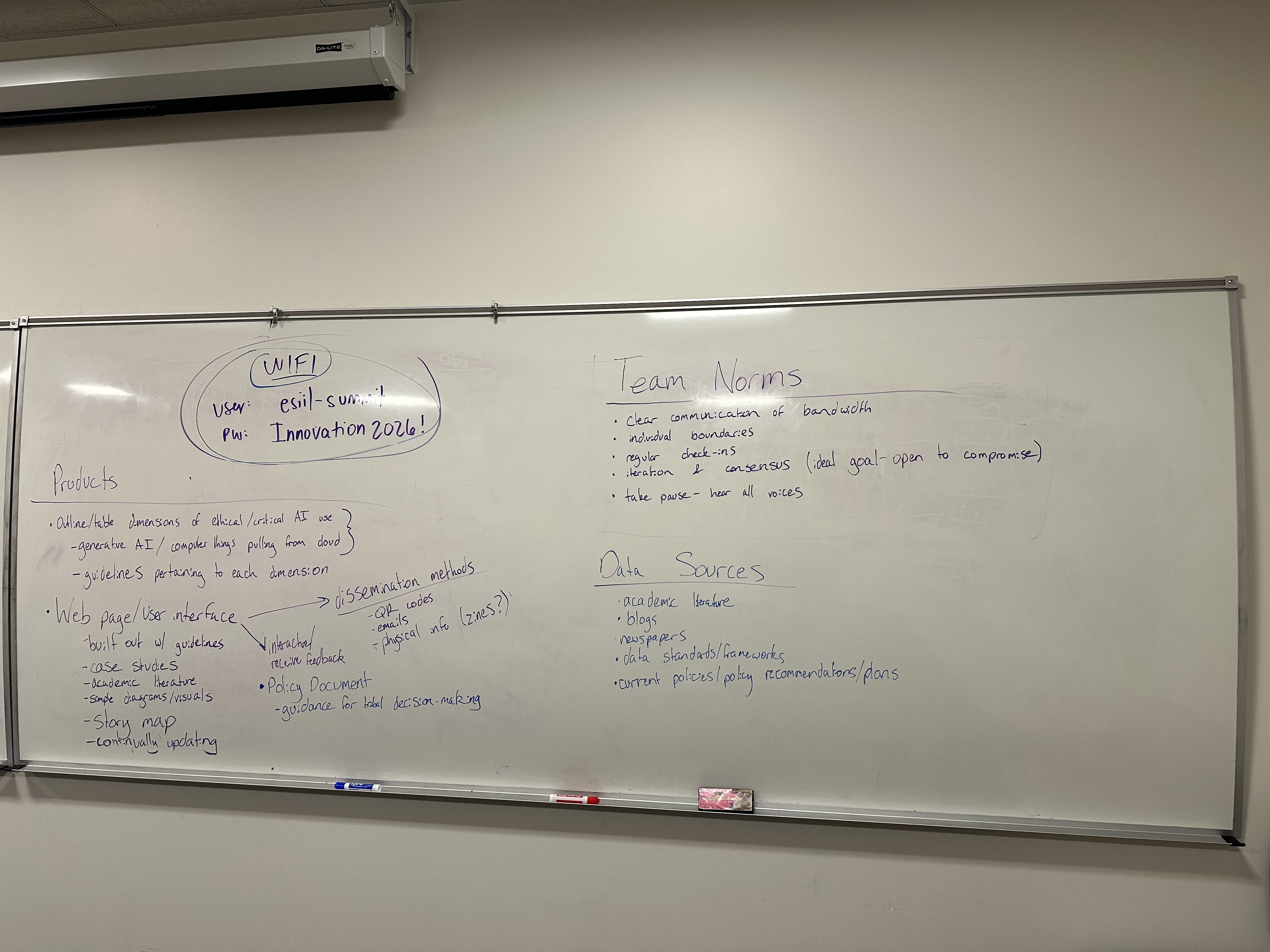
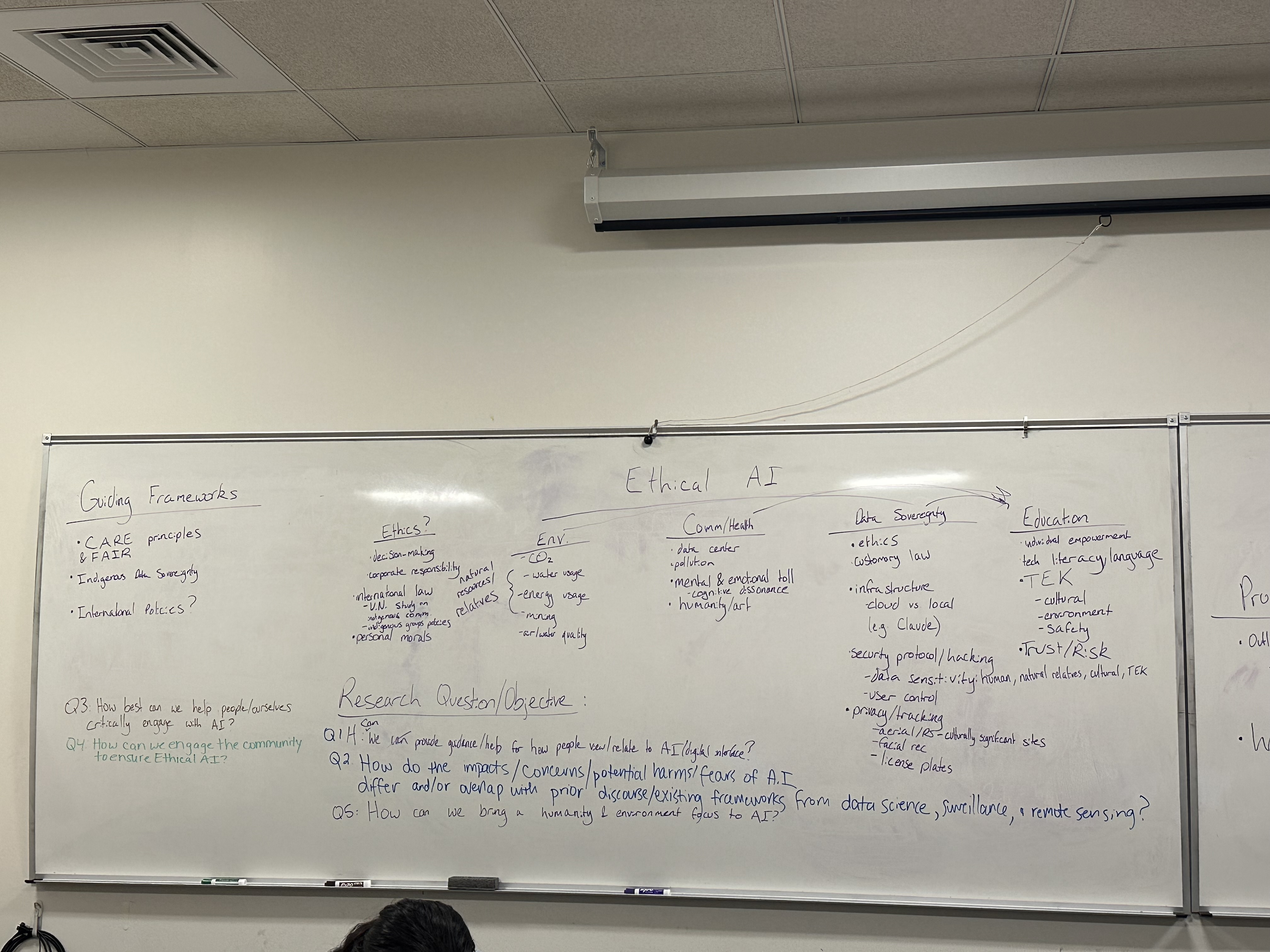
Morning whiteboard or notes showing the question, hypotheses, and context we used to start Day 2.
Our question(s) 📣
Our working questions:
- How can we engage and educate communities to make ethical and critical decisions regarding AI usage?
- Can we apply existing frameworks such as the CARE principles to ensure awareness of environmental considerations, indigenous data sovereignty, and community health?
- How do the impacts/concerns/potential harms/fears of AI differ and/or overlap with prior discourse and existing frameworks from data science, surveillance, and remote sensing?
Intentions
- To create a table that enumerates the domains that A.I. has/can impact to help orient conversations on ethics
- To develop a web/digital interface matching domains with resources (case studies, academic literature, news pieces, blogs) and enriching it with diagrams and visuals
- Ultimately: leverage our table + story map 1) to help guide the use of A.I. by environmental scientists and 2) to aid in policy formulation for Tribal decision-makers and in other governance structures
Why this matters (the “upshot”) 📣
This matters because:
- Societal and environmental consequences
- Conversations are difficult (we hope our table helps orient and guide discussions)
People who could use this:
- Scientists, especially environmental data scientists
- The public
- Local communities
- Tribal nations
- Policymakers
Resources we’re exploring 📣
Promising resources:
- FAIR + CARE Principles
- Looking across disciplines (STS studies, critical remote sensing, etc)
- News articles + personal testimonies about the socio-ecological impacts of A.I.
- [Group Bibliography](https://www.zotero.org/groups/6552612/esiil_2026_team_3_ethical_ai)
Platforms/Technologies we’re exploring 📣
Methods/technologies we are exploring:
| Method or technology | What we tested | Early notes |
|---|---|---|
| Resource Wiki | Brainstorm | ... |
| Multimedia/digital product | Brainstorm | ... |
| Document Hub | Brainstorm | ... |
| Ask an AI Expert Hotline | Brainstorm | ... |
| NAS Report | Brainstorm | ... |
| Regulations for Government | Brainstorm | ... |
| Prepare materials for educating ESIIL about AI, e.g., ESIIL stars | Brainstorm | ... |
| Fostering Conversations (Collaborative Seminar) | Brainstorm | ... |
Challenges identified
- Personal: bandwidth, personal feelings regarding AI use may not be consistent between team members, learning curve, people need/want different types of outputs or deliverables, interest areas may not be consistent across all team members
- Group: lacks some expertise needed for execution, difficult conversations due to sensitive topic, logistics of continued engagement, representing diverse concerns wihtin a relatively small group (room to increase inclusion)
- Topic: sensitive conversations, many groups and stakeholders have deep assumptions about AI and so communication can be challenging, a very broad topic that can lead in many directions, a new field so not as much data or frameworks already published to pull from, conversations regarding the intersectionality of complex and broad topics
Visuals
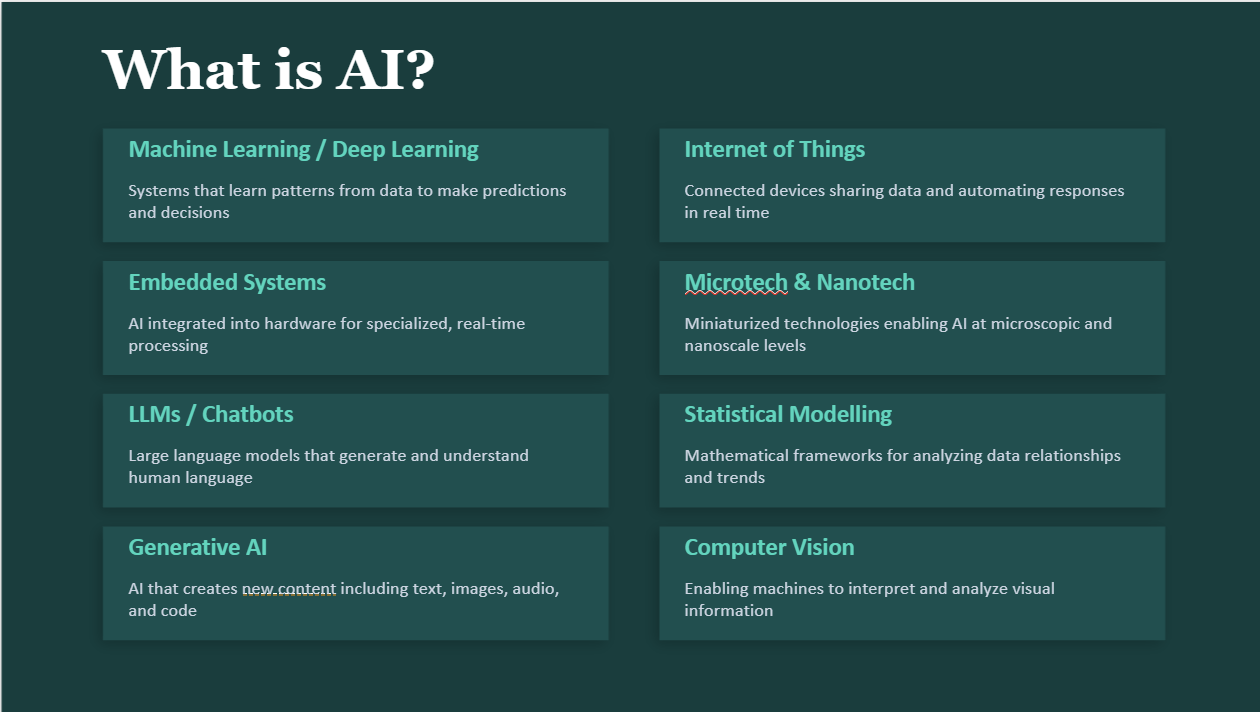
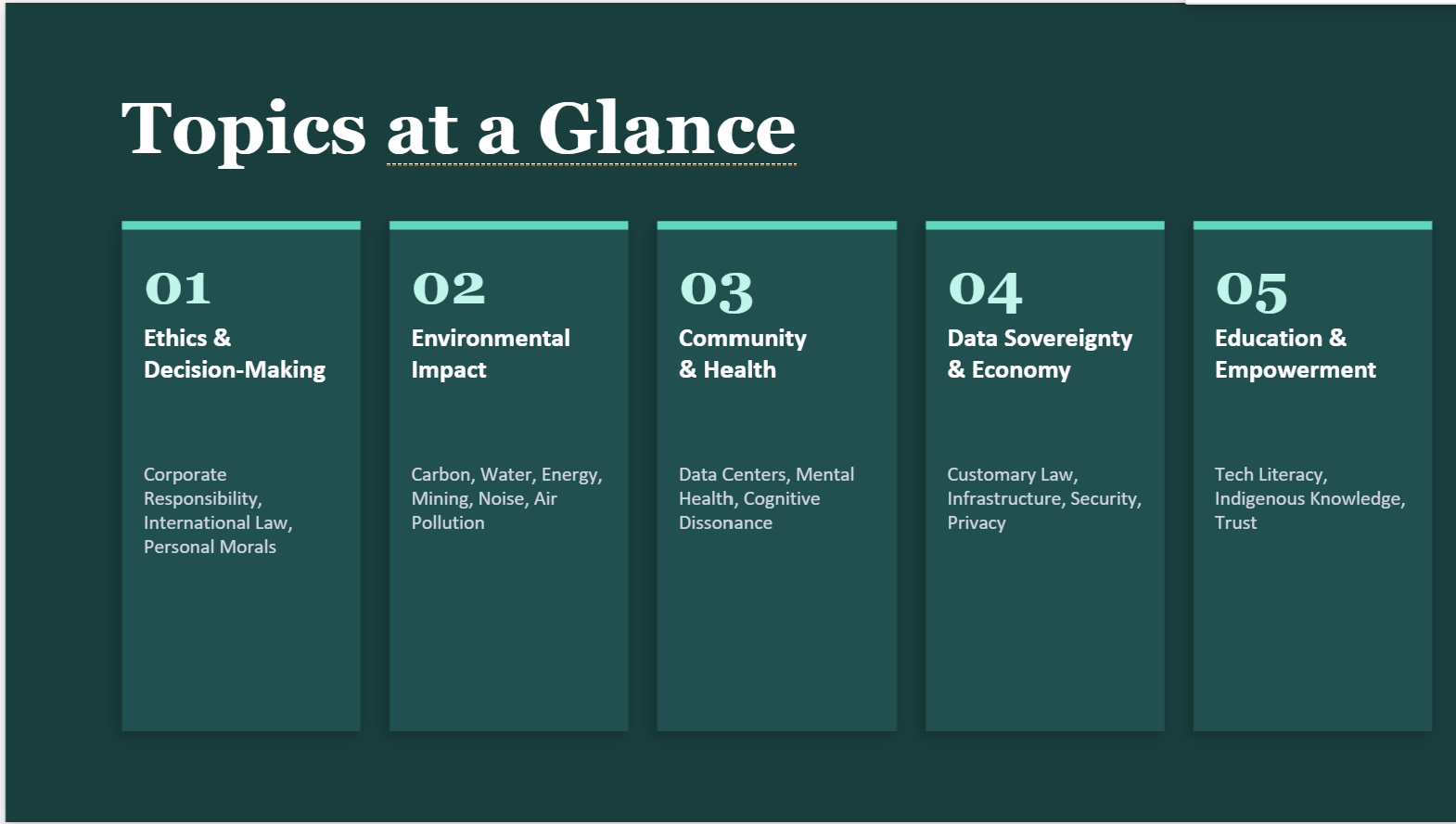
Team Photo
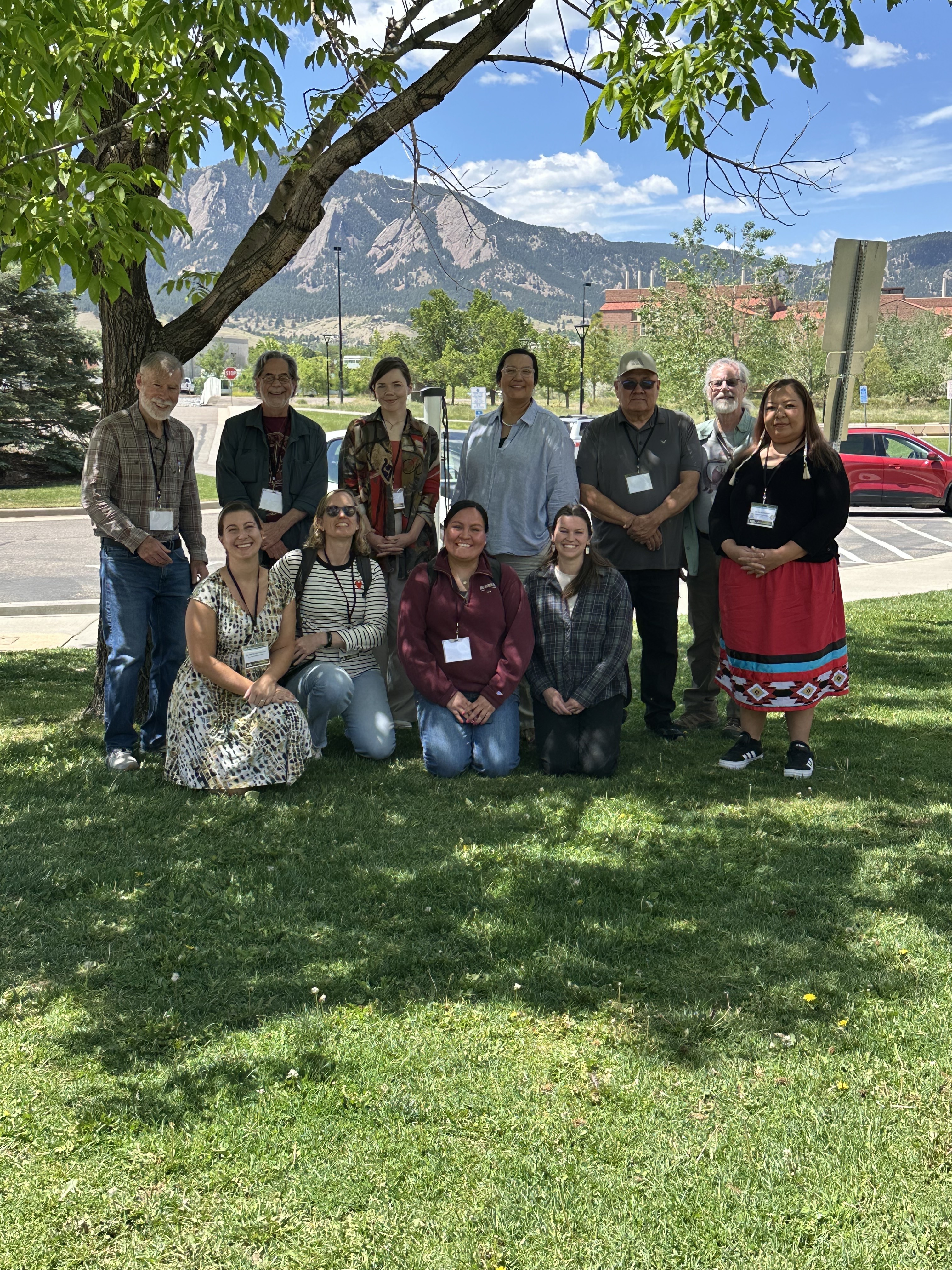
Team members and collaborators who contributed to this project.
What’s next? 📣
Short term: - Create recurring meeting in our calendars to continue the conversation - At meetings make sure we have an output scheduled for each week
Long term: - Zoom seminar for TCUs and other interested entities to share information and ideas (hosted by Oglala Lakota College and KU) - Prepare an ESIIL working group proposal - Develop a model/LLM that people can ask questions to - Develop R1-TCU partnerships and foster cross-sector partnerships
Who should see this next: - No one, and everyone - Everyone, Everywhere, All At Once, Later
Collected Resources
Cite & Reuse
If you use these materials, please cite:
Summit Team. (2026). Summit_group_2026_3 — Innovation Summit 2026. https://github.com/CU-ESIIL/Summit_group_2026_3
License: CC-BY-4.0 unless noted.