AI and Education in Environmental Science
Principal Investigators
| Name | Affiliation | Contact | Github |
|---|---|---|---|
| Jennifer Kovacs | Agnes Scott College | jkovacs@agnesscott.edu | echinodermatamata |
| James Watling | John Carrol University | jwatling@jcu.edu | jwatling |
Project Overview
We are a small team of teacher-scholars at Primarily Ungergraduate Institutions (PUIs) in the United States who share a few common values: the belief that, as educators, we need to continually upskill in AI so that we can prepare students for the AI workplace; the need to critically engage with the range of issues related to AI (ethical, environmental, and otherwise); and the importance of centering humans in the AI collaboration.
As AI reshapes the education and industry landscape, we have two overarching goals: (1) teach students best practices for effective collaboration with AI, and (2) integrated and organic use of AI to teach subject matter content. At the ESIIL Innovation Summit in May 2026, we created a framework for developing assignments that meet those goals, which we describe in detail below. Currently (Summer/Fall 2026), we are focused on developing additional assignments that meet our twin goals goals, and piloting them in our classrooms.
Our teaching interests are rooted in environmental biology, but we welcome collaborators from across the environmental field. If you have suggestions for improvement, are interested in developing an assignment using our framework, or want to expand the ways we integrate AI into our classrooms, please reach out to Jen and James to start a conversation.
Our Framework
Inspired by other inquiry-based, student-centered approaches to active learning, including Project EDDIE and BCEENET, we are guided by several core principles:
1. Question-driven inquiry: Each module begins with an environmental question that is scientifically meaningful and suitable for student investigation using available data.
2. Authentic data use: Students work with real environmental data rather than toy examples so that they experience uncertainty, variation, and limits of interpretation.
3. Scaffolded independence: The module should move from guided work to greater student independence, following the EDDIE logic that early activities provide structure and later activities increase student choice and responsibility.
4. Human oversight of AI: AI use must never stand alone; students should document prompts, inspect outputs, verify claims, and revise work based on disciplinary evidence.
5. Communication as synthesis: The end point of the module is not only analysis, but communication of evidence-based conclusions in an audience-appropriate form.
6. Adaptability: Instructors should be able to teach the full module, shorten it, or substitute a local dataset or tool without changing the core learning goals.
These principles ultimately led us to the following five-point framework for the development of AI-enabled, environmentally themed assignments for the undergraduate classroom:
1. An environmental theme, such as carbon cycling, water quality, biodiversity, land-use change, environmental justice, or ecosystem resilience.
2. A data component built around authentic datasets, ideally from open or shared sources that can support cross-course or cross-institution use.
3. An AI-facilitated component in which students use AI to support tasks such as question generation, code drafting, pattern identification, summarization, visualization, or interpretation.
4. A human-in-the-loop structure in which student and instructor judgment are required at each stage, especially when evaluating AI-generated claims, code, or interpretations.
5. A synthesis and communication component in which students explain findings to an audience such as classmates, community members, decision-makers, or other researchers.
Click here for a downloadable pdf of the framework using the A-B-C structure of the EDDIE modules.
If you are interested in developing an assignment using our framework, please Click here for a downloadable template.
Applying the Framework
We used the framework described above to create as assignment called 'Sink or Source? Exploring Forest Carbon Dynamics with NEON Data and AI'
This assignment, intended for use in a 75 minute class, guides students through investigating ecosystem carbon exchange by transitioning from following a standard scientific tutorial to becoming active "Code Editors" with an AI assistant. Using authentic data from the National Ecological Observatory Network (NEON), students collaborate with an AI assistant to modify code, analyze environmental variables like temperature or light, critically validate the AI's output through a human-in-the-loop workflow, and reflect and report on their observations.
Using the Google Colab platform to analyze NEON data, we convert Gemini from a generic chatbot into a grounded scientific collaborator. We connect to the API, then build a context block that packages up everything Gemini needs to give useful answers — the site name, variable descriptions, actual data values, and summary statistics from our NEON dataset. And the student handout explains what we've done and why it is important.
From this point on, every student question to Gemini arrives pre-loaded with that context, so it responds like a knowledgeable colleague who has already read the data, not like a search engine returning textbook definitions.
Click here Student handout
Click here Code file
Everything from here down needs revision/development
Why this matters (the “upshot”) 📣
This matters because:
It keeps human scientific judgment at the center by starting from trusted datasets and using AI tools to explain and modify code, which foregrounds verification, uncertainty, and reproducibility.
Links AI literacy to core disciplinary outcomes (carbon cycling, data skills, communication) and to the environmental footprint of computation itself via prompt/energy tracking, so students learn to treat AI use as a choice with trade‑offs.
People who could use this:
Environmental science, ecology, and sustainability faculty who want to integrate AI into existing data‑rich labs (NEON, flux, water quality, biodiversity) without rebuilding their courses from scratch.
Want to develop a module to add to our collection-- here's a template
AI-Enhanced Environmental Data Inquiry Module Template
An extension of the Project EDDIE A-B-C framework that layers AI tool use into data-driven environmental inquiry. Modules follow standard EDDIE design — authentic public datasets, quantitative reasoning, scaffolded independence — with an added strand for critical AI literacy.
Module Overview
| Scientific question | |
| Dataset | |
| AI tool(s) | |
| Audience | |
| Time | |
| Prerequisites |
Learning Objectives
By the end of this module, students will be able to:
- [Environmental understanding] Explain...
- [Quantitative reasoning] Analyze and interpret...
- [AI literacy] Use an AI tool strategically, evaluate its outputs critically, and document how it supported their work.
- [Communication] Synthesize findings and communicate them for a defined audience.
Part A — Introductory
Instructor-guided. Students build scientific context, explore the dataset, and complete bounded AI-supported tasks with explicit verification.
Students will: - Explore the scientific question and relevant environmental concepts - Orient to the dataset structure, variables, and known limitations - Complete 1–2 guided interactions with the AI tool using provided scaffolds - Verify AI outputs against data or metadata before accepting them
AI addition: Students compare an AI-generated response to the raw data or metadata and note where it was accurate, incomplete, or wrong.
Part B — Exploratory
Increasing independence. Students investigate a self-directed question, use AI selectively, and check reasoning with peers.
Students will: - Refine or choose a research question appropriate to the dataset - Conduct data exploration, visualization, and analysis - Use the AI tool to support selected steps (e.g., code generation, pattern interpretation, literature context) - Review and critique AI outputs before incorporating them - Discuss findings and AI use with peers
AI addition: Students must record a pre-AI observation before using the tool for any analytical step, then compare it to AI output afterward.
Part C — Advanced
Student-driven. Students make independent choices about data, analysis, and communication; reflect explicitly on AI use.
Students will: - Choose a data subset, analysis approach, or comparison site to extend their question - Produce a communication product for a defined audience - Include an AI transparency statement: what the tool contributed and where human judgment was essential
AI addition: Students reflect on how AI shaped their inquiry — what it accelerated, what it got wrong, and what they would do differently.
Required Module Materials
(Consistent with EDDIE module standards)
- [ ] Student handout
- [ ] Instructor guide with answer key
- [ ] Dataset package with metadata and quality notes
- [ ] AI use guide — defines permitted uses and prompt logging requirements
- [ ] Verification checklist — students confirm AI outputs against data before using them
- [ ] Assessment rubric aligned to learning objectives
Notes for Developers
This template is designed to work with any AI tool — large language models, image classifiers, species identification tools, anomaly detectors, or others. The AI literacy strand is tool-agnostic: the core skills (provide context, evaluate output, verify against source, document use) apply regardless of the specific technology.
Modules should meet the EDDIE module rubric before the AI layer is added. If your module doesn't yet work as a standard EDDIE module, start there first.
Next Steps
Short term: We have applied to present a Work In Progress Poster at the upcoming QUBES BIOME Summer Meeting and will recruit for a QUBES Fall Working Group Long term: Apply to an ESIIL Working Group around developing AI-assisted Data-Inquiry Teaching Modules
Day 3 Tasks
Sythesis: highlight 2-3 visuals that tell the story; keep text crisp. Practice a 6-minute walkthrough of the homepage. Why -> Questions -> Data/Methods -> Findings -> Next
Findings at a glance 📣
Headline 1 — Training the next generation of environmental data scientists requires teaching AI as a scientific skill, not a shortcut Students working with authentic environmental datasets — flux towers, water quality sensors, biodiversity surveys — quickly discover that AI outputs are only as good as the context they are given. The same critical habits that make a good data scientist make a good AI user.
Headline 2 — Faculty don't need to rebuild their courses — they need a retrofit A working framework, a shared template, and one worked example show that AI literacy can be layered into existing data inquiry modules without displacing the environmental science. The scaffold stays the same; the AI strand runs through it.
Headline 3 — The next cohort of environmental scientists will use AI whether we teach it or not — the question is whether they'll use it well Building human-in-the-loop habits now — verify outputs, document prompts, trace claims back to data — is the difference between students who are empowered by AI tools and students who are misled by them.
Visuals that tell a story 📣
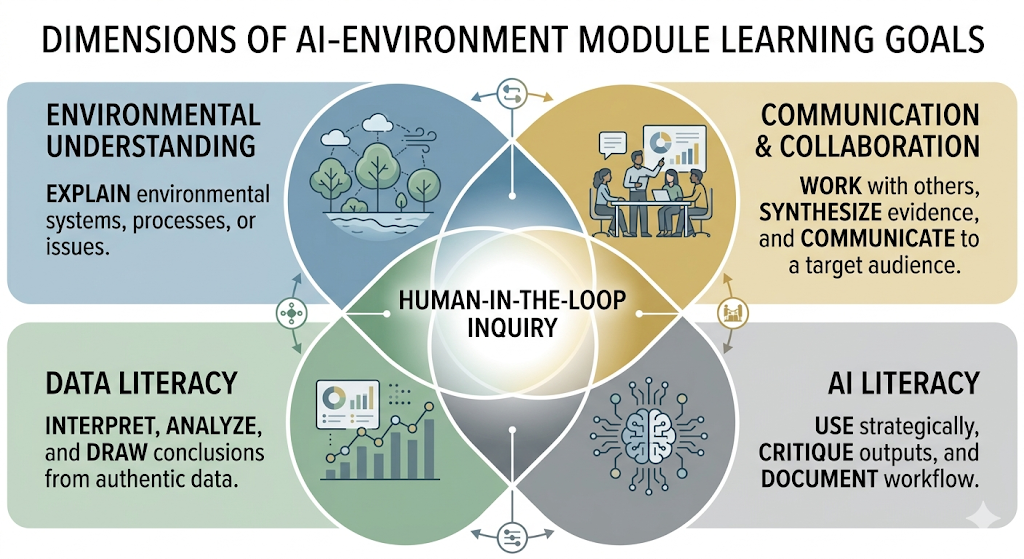
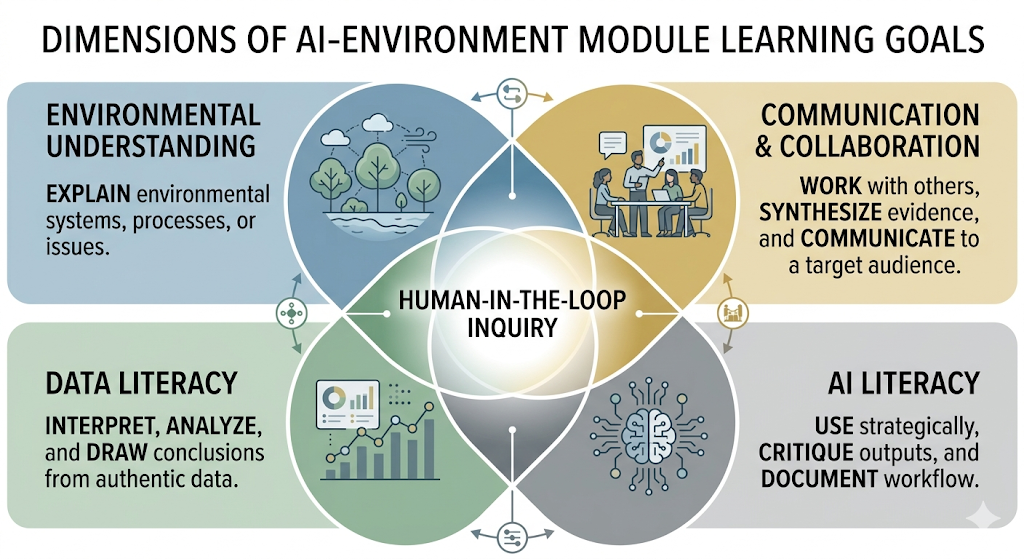 Four learning goals, one module: environmental understanding, data literacy, AI literacy, and communication develop together — not as separate add-ons.
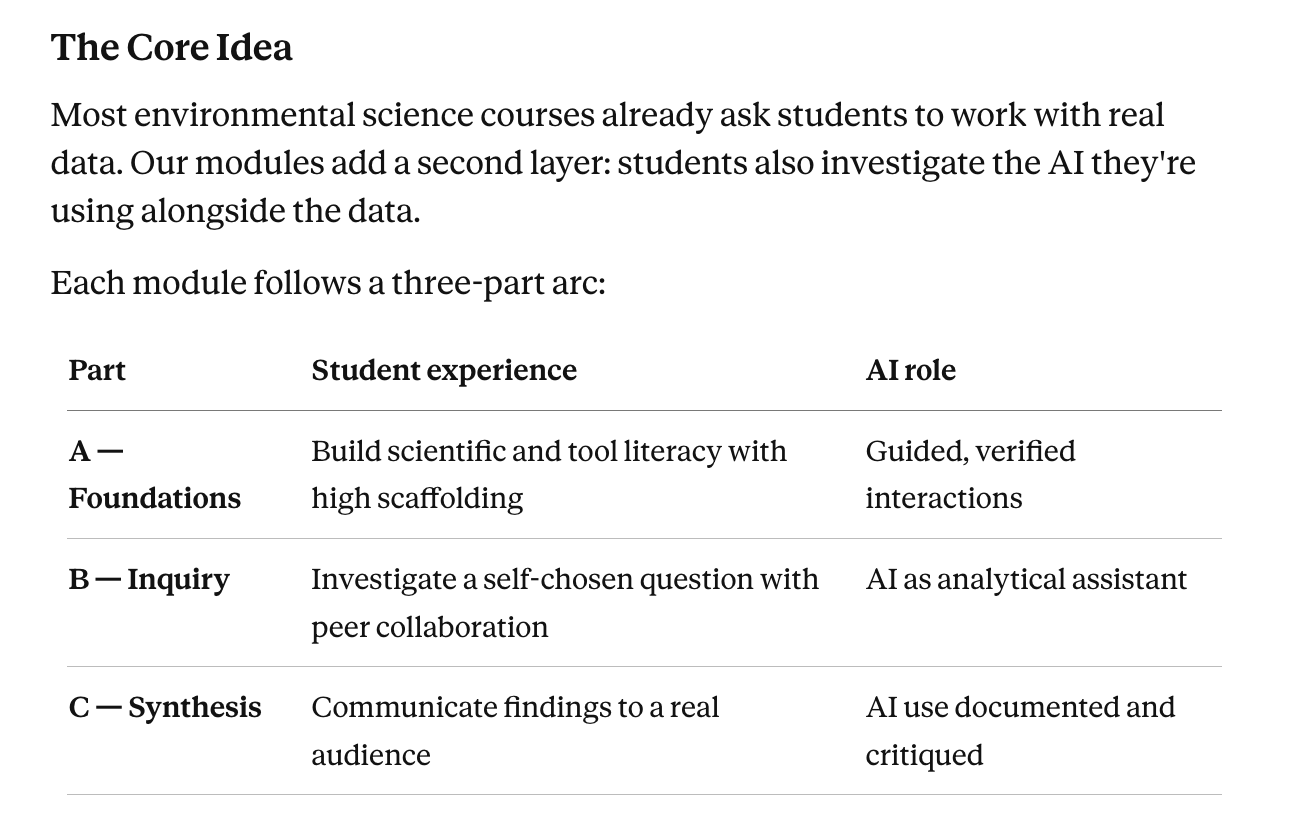 The module arc: environmental theme → guided data and AI inquiry → synthesis and communication. The human-in-the-loop requirement runs through every stage.
What’s next? 📣
Short term: - Present a Work-in-Progress poster at the QUBES BIOME Summer Meeting and recruit for a fall working group - Pilot the Source or Sink? module in a course this academic year and document the student experience
Long term: - Build a working group of PUI environmental science faculty developing and sharing modules across data types and AI tools — not LLM-only - Apply for an ESIIL Working Group to connect faculty with data infrastructure experts and scale module development across institutions
Who should see this next: - Do you have a data-set that you think would be awesome for this kind of teaching module? Let us know! - Environmental and ecology researchers who supervise undergraduates or early-career scientists working with large observational datasets - NEON, LTER, and other open data network education staff
Cite & Reuse
If you use these materials, please cite:
Summit Team. (2026). Summit Group 2026 Team 7 — Innovation Summit 2026. https://github.com/CU-ESIIL/Summit_group_2026_7
License: CC-BY-4.0 unless noted.