Thermo ToleRate
Redefining ectotherm thermal tolerance in a variable climate using big data
An ESIIL Working Group building a time-dependent framework for ectotherm thermal tolerance — one that accounts for both how hot it gets and how long the heat lasts.
Abstract
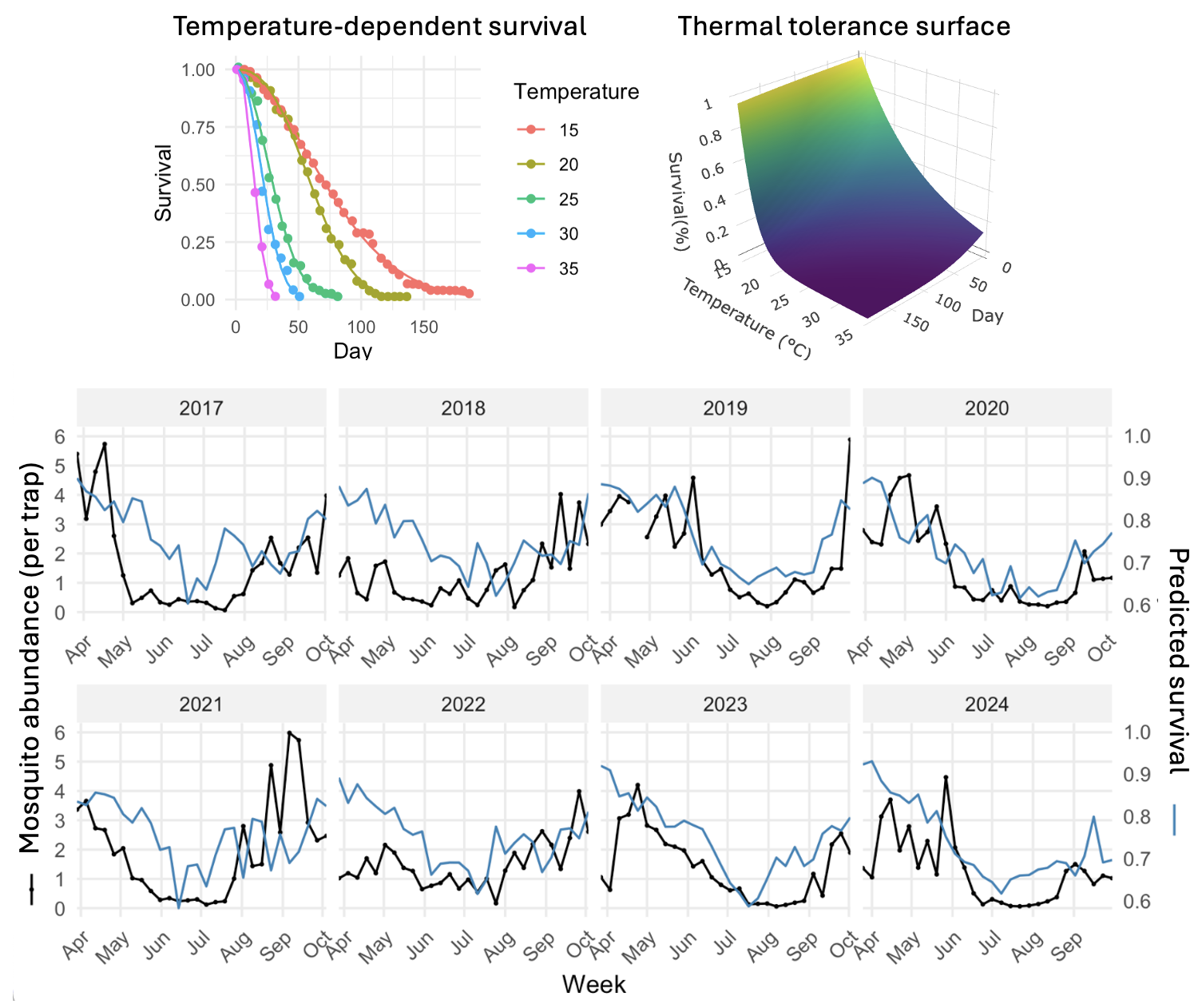
Thermal tolerance determines how ectothermic animals survive climate extremes, but traditional metrics like critical thermal maximum (CTmax) and lethal temperature (LT50) ignore that tolerance depends on both the intensity and duration of heat exposure. This working group redefines thermal tolerance as a time-dependent surface that integrates temperature and exposure time, linking experimental physiology with real-world climate variability.
We will (1) assemble a harmonized, open database of thermal tolerance experiments with duration- and performance-based outcomes, (2) develop Bayesian hierarchical models to estimate continuous tolerance surfaces and compare them across taxa, and (3) simulate expected survival under realistic climate records (ERA5-Land, OISST) and test predictions against observed abundance in NEON terrestrial insects and marine copepods.
Research Question
How can we quantify and model thermal tolerance as a time-dependent surface that predicts ectotherm population responses to real-world heatwave dynamics across taxa and environments?
Goals
- Build a harmonized, open database of ectotherm thermal tolerance experiments that include duration- and performance-based outcomes.
- Develop pipelines that generate thermal tolerance surfaces from physiological data and link them to temporally explicit climate data.
- Test whether these surfaces predict population mortality during heatwaves across terrestrial and aquatic ectotherm taxa.
Planned Outputs
- Database + data paper — a cross-taxon database of heat-tolerance records combining temperature intensity and exposure duration.
- Conceptual paper — general patterns in the shape and scaling of time-dependent survival, and a shared language for comparing tolerance landscapes.
- Reproducible Bayesian workflow — an R pipeline for fitting tolerance surfaces, archived with a DOI.
- Proof-of-concept paper — applying the workflow to NEON mosquitoes and beetles and to marine copepod records.
Core Taxa & Data
- Mosquitoes & beetles — NEON pitfall and CO₂-trap abundance, forced with hourly ERA5-Land temperature.
- Copepods — Helgoland Roads and Western Channel Observatory time series, forced with daily OISST.
- Tolerance compilations — GlobTherm, ThermoFresh, Rezende (2014), plus standardized records from individual studies.
Current Phase
Pre-meeting coordination (Mar–May 2026): establishing communication, compiling datasets, and building metadata templates ahead of Meeting 1 (Boulder, June 2026).
Team
| Name | Role | Institution | Discipline |
|---|---|---|---|
| Kelsey Lyberger | PI | Arizona State University | Quantitative ecology |
| Andrew Villeneuve | Collaboration Lead | University of New Hampshire | Marine ecology |
| Rui Cheng | Tech Lead | Claremont McKenna College | Remote sensing |
| Stephanie Bristow | Member | Michigan State University | Freshwater ecophysiology |
| Lauren Buckley | Member | University of Washington | Physiological ecology |
| Chris Dwane | Member | University of Plymouth | Marine ecototherm ecophysiology |
| Nicholas Galle | Member | University of Notre Dame | Computational ecology / data science |
| Alex Gunderson | Member | Tulane University | Comparative physiology |
| Leah Johnson | Member | Virginia Tech | Statistics |
| Ruby Krasnow | Member | University of Maine | Quantitative marine ecology |
| Alison Robey | Member | Yale University | Theoretical ecology |
| Matt Sasaki | Member | University of Massachusetts Lowell | Evolutionary ecology |
| Emmanuel Tackie | Member | Arizona State University | Thermal ecology |
| Easton White | Member | University of New Hampshire | Theoretical ecology |