Real-data validation
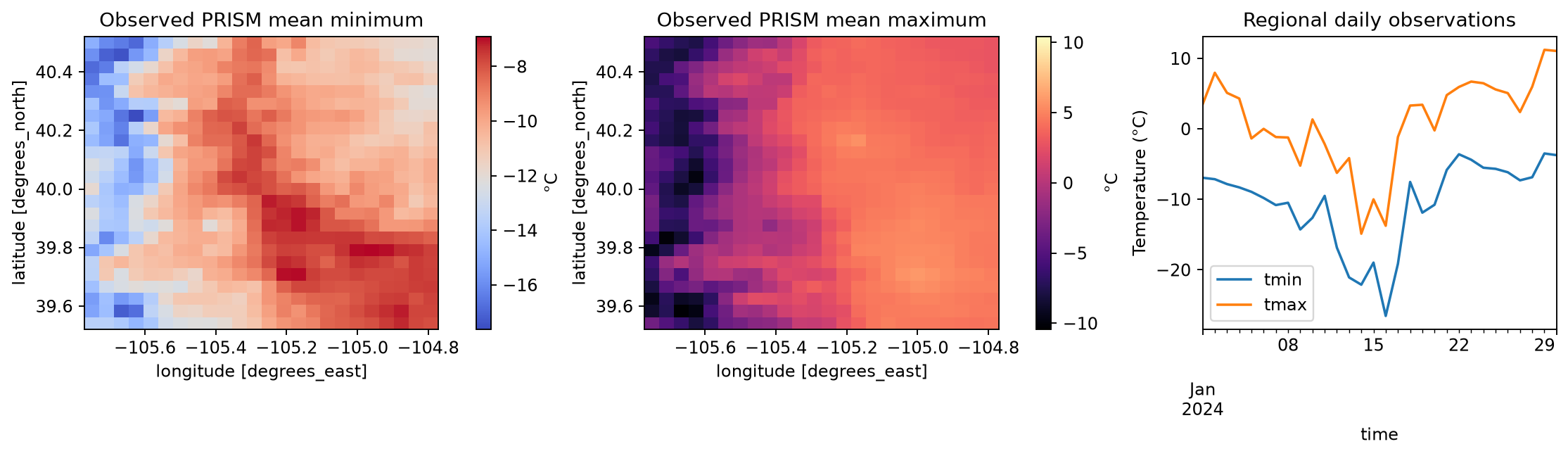
The eight core grammar vignettes use the observational teaching extract:
tests/fixtures/real_data/prism_boulder_january_2024.nc.
| Field | Reviewed value |
|---|---|
| Provider | PRISM Group, Oregon State University |
| Product | AN91d daily 4 km time series |
| Variables | daily minimum temperature, daily maximum temperature, derived daily range |
| Time | 1–30 January 2024, complete daily sequence |
| Bounds | −105.75 to −104.75 longitude; 39.50 to 40.50 latitude |
| Grid | 30 dates × 24 latitude rows × 24 longitude columns |
| CRS | EPSG:4269 |
| Accessed | 2026-08-25 |
Acceptance checks
The validation module rejects the fixture unless:
- its SHA-256 matches the provenance record;
- the provider and non-generated-data flag are explicit;
- dates are complete and ordered, longitude increases, and latitude decreases;
- all 51,840 stored cells are finite;
- minimum temperature never exceeds maximum temperature;
- daily range equals
tmax - tminwithin the float32 storage tolerance; and - all 60 official daily archives have URL, byte-count, and SHA-256 evidence.
The fixture provenance is machine readable at
tests/fixtures/real_data/prism_boulder_january_2024.provenance.json.
Source: PRISM Group, dataset documentation, and terms of use.
Rebuild
python scripts/build_vignette_data.py --download-missing
python scripts/run_validation.py
Downloads are never implicit in the lessons or offline CI. The rebuild flag is an explicit request to retrieve the 60 recorded official archives; each is verified before the extract is written.
USGS source lesson
The streamflow lesson instead replays
real USGS continuous-discharge responses for Boulder Creek, the Potomac, and
Lees Ferry on August 26, 2026. Its manifest at
tests/fixtures/real_data/usgs_streamflow/provenance.json binds every request
record and raw response body to a SHA-256 checksum. Missing, additional, or
modified snapshot files fail the publication input check; replay never downloads
replacement observations.
The loader retains station identity, native units, UTC timestamps, and quality status. Values and statuses were compared with the original provider JSON; NetCDF round trips and pipe reductions were checked. All these samples were provisional. This establishes retained-input integrity and adapter behavior, not hydrologic suitability or broad production certification. See the candidate evidence and limitations.
Terrain and road lessons
The elevation lesson uses a retained
99×99 native 3DEP window. The roads lesson
uses 528 Overture and 611 OSM features from the same Boulder query area. These
serialized loader outputs live in tests/fixtures/real_data/source_lessons/.
Their manifests retain original request/response identities, source metadata,
and extract hashes. Export checks compare native cells, geometries, identifiers,
and provider records before and after serialization.
The fixtures are not simplified, regridded, or class-harmonized. Clipping and projected-length calculations are explicit later transformations. Attribution is retained; Overture and OSM are not independent ground truth.