Home
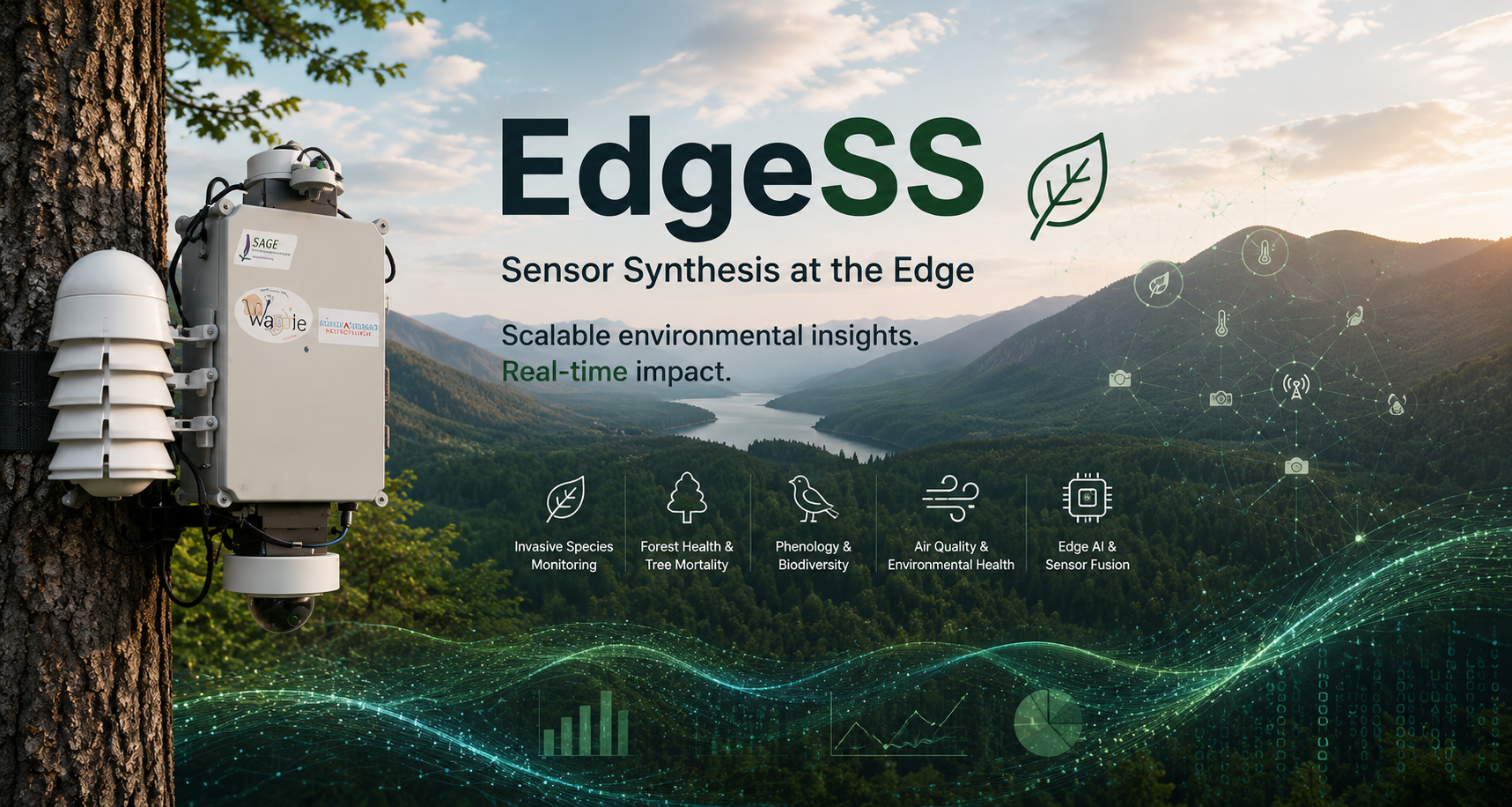
EdgeSS: Sensor Synthesis at the Edge
Scalable environmental insights. Real-time impact.
EdgeSS is an ESIIL working group that brings together environmental scientists, data scientists, AI researchers, and cyberinfrastructure experts to synthesize high-frequency data from Sage edge sensor networks with continental-scale monitoring systems.
Edit this homepage in GitHub Open the GitHub repository
Working Group Abstract
Understanding environmental changes such as the spread of invasive species, shifts in seasonal patterns, and worsening air pollution, requires new ways to gather and analyze information quickly. Today, cutting-edge tools like smart sensors and artificial intelligence are making it possible to track these changes in real time. This project will bring together scientists who study the environment with experts in data and computing to find the best ways to combine different kinds of information from across the country.
We will focus on three real-world problems that affect people and nature: the spread of the Spotted Lanternfly, an invasive insect threatening farms and forests; how wildfires and other disturbances affect bird life and plant seasons; and how pollution levels vary across states and impact environmental and public health. To study these challenges, we will use the growing network of smart sensor continuous data-streaming stations placed across the U.S. These stations can detect insects, sounds, temperature, weather, and pollution in real time—and make decisions right where the data are collected.
Our group will meet three times to develop tools, share knowledge, and design new ways to use these technologies. To build community outreach, we will host webinars and a virtual hackathon to involve computer science students and outside collaborators. All results, tools, and findings will be made freely available online to help scientists and the public make decisions based on real-time environmental insight. This project will help shape the future of how we monitor, understand, and respond as a nation to environmental change.
Research Focus Areas
- Invasive species monitoring — Tracking the spread of the Spotted Lanternfly and related threats using distributed sensing networks and AI-enabled detection.
- Forest disturbance and ecosystem response — Investigating how wildfires and other disturbances affect bird life, vegetation dynamics, and seasonal patterns.
- Air quality and environmental health — Examining spatial and temporal patterns in air pollution using real-time environmental sensing and edge-based analytics.
Cyberinfrastructure: Sage
EdgeSS builds on Sage, a national-scale cyberinfrastructure for AI at the edge. Sage is a network of field-deployable, GPU-enabled sensor nodes that support real-time environmental monitoring across the U.S. Each node integrates visual, acoustic, meteorological, and air quality sensors, and can run AI models on-site to detect fast-changing events and stream processed outputs with low latency.
The working group will synthesize high-frequency data from Sage nodes with existing monitoring data from NEON, AirNow, and citizen science platforms such as iNaturalist. Our three focal systems span the full range of Sage edge-sensing capabilities—from insect and acoustic monitoring to phenology and pollution tracking. Outputs including synthesis protocols, model containers, and reproducible workflows will be shared with the Sage community and published openly.
Plan the work Document data and resources Set community expectations
Working Group Landmarks
How This Repo Is Organized
The repository has two connected layers. Top-level files configure the project and its automation. The docs/ folder contains the website content. mkdocs.yml tells MkDocs how to turn that content into the public site. Analysis folders hold the working scientific materials that generate the results shown on the website.
| Part of the repo | What it does | What usually belongs there |
|---|---|---|
| Top-level files and folders | Configure the project and keep shared repository guidance in one place | README.md, LICENSE, workflows, containers, templates, environment setup, and repo-wide metadata |
docs/ |
Stores the source content for the public website | Homepage text, summaries, methods, community-facing documentation, and website assets |
mkdocs.yml |
Controls how the site is rendered | Navigation, theme settings, plugins, and GitHub edit links |
| Working folders | Hold the science-in-progress | Data references, notebooks, scripts, workflows, figures, outputs, and reproducibility materials |
Repository Side: Do the Science
This image represents the repository side of the working group: data, code, workflows, and reproducibility.
To update: delete the current image in this folder and upload one new square image. Use a flat, minimal, screen-print style graphic with no text.
Delete this note after the site is customized.
Related landmarks: WG-C Data and access; WG-D Methods and workflows.
The repository is the working record of the group: it tracks what changed, why it changed, and how results were produced.
- Data sources and metadata
- Notebooks and scripts
- Workflows and reproducible analysis
- Meeting notes and decisions
- Figures, tables, and other outputs
Website Side: Share the Science

This image represents the website side of the working group: summaries, maps, figures, and public communication.
To update: delete the current image in this folder and upload one new square image. Use a flat, minimal, screen-print style graphic with no text.
Delete this note after the site is customized.
Related landmarks: WG-E Results and synthesis; WG-F Outputs and handoff.
The website turns the working group record into a readable public report.
- Plain-language summaries
- Methods documentation
- Figures, maps, and visualizations
- Meeting outputs and synthesis products
- Manuscripts, reports, or educational materials
How the Two Sides Connect
The repository and website are not separate products. When the group updates data, analysis code, figures, or written summaries in GitHub, those changes can be rendered through the website. Commits are the bridge between doing the science and sharing the science.
When This Working Group Is Live
A working group is live when:
- The research question is stated
- Data sources are linked or documented
- At least one analysis or workflow is runnable
- Outputs are committed to the repository
- The website explains what the group is doing and why it matters
For guidance on turning this scaffold into a public scientific record, see the Public-Facing Site Guide.
Early Process Gallery
Use this section to show how the working group gets started without manually editing image links one by one.

This gallery displays early setup artifacts for the working group.
Add or replace files in this gallery
To update: upload supported files to this folder and commit. The website sorts files alphabetically. Use this folder for kickoff notes, orientation screenshots, starter diagrams, and early planning visuals.
Delete this note after the site is finalized.
Key Links
- Main Working Document: Coming soon
- GitHub Repository: https://github.com/CU-ESIIL/edgess
- Sage (edge cyberinfrastructure): https://sagecontinuum.org/
- Data / Resources: Coming soon
- Outputs / Dashboard: Coming soon
Current Phase
Working Phase: Preparing for Meeting 1 (March 8–12, 2027)
Team Members
Related landmark: WG-A People and roles.

This image represents collaboration, team identity, or a real working group photo.
To update: delete the current image in this folder and upload one new image. A real group photo is welcome here, but an abstract collaboration image also works.
Delete this note after the site is customized.
| Name | Role | Institution | Responsibilities |
|---|---|---|---|
| Matthew Helmus | PI | Temple University | Coming soon |
| Mostafa Javadian | Co-PI | Northern Arizona University | Coming soon |
| Priyanka deSouza | Co-PI | University of Colorado Denver | Coming soon |
| Cibele Amaral | Coming soon | University of Colorado Boulder | Coming soon |
| Pete Beckman | Coming soon | Northwestern University | Coming soon |
| Di Yang | Coming soon | University of Florida | Coming soon |
| Francisco Lozano | Tech Lead | Northwestern University | Coming soon |
| Sydne Record | Coming soon | Coming soon | Coming soon |