On Growth and Form
Wildfires do not only burn; they grow. This project asks whether that growth follows discoverable geometric and scaling laws—and whether learning those laws could change how wildfire models are built, tested, and trusted.
At stake is a scientific gap between ignition-scale fire behavior and broad fire-regime statistics. Satellite-derived event histories now make it possible to study the missing middle: how whole fires spread through space and time as evolving shapes embedded in weather, fuels, and landscape structure.
Choose the path that fits why you are here
This site is designed as a guided scientific argument with deep supporting material behind it. Start with one of the pathways below rather than trying to read the repository in order.
See the proposal case first
Start with the pages that explain the problem, the program fit, and the work plan.
Understand the workspace and decisions
Use these pages to see how the proposal is organized, revised, and maintained.
Follow the conceptual argument
These pages develop the geometric and scaling claims in long form.
Inspect the machinery behind the claim
Go here for data systems, methods, and model architecture.
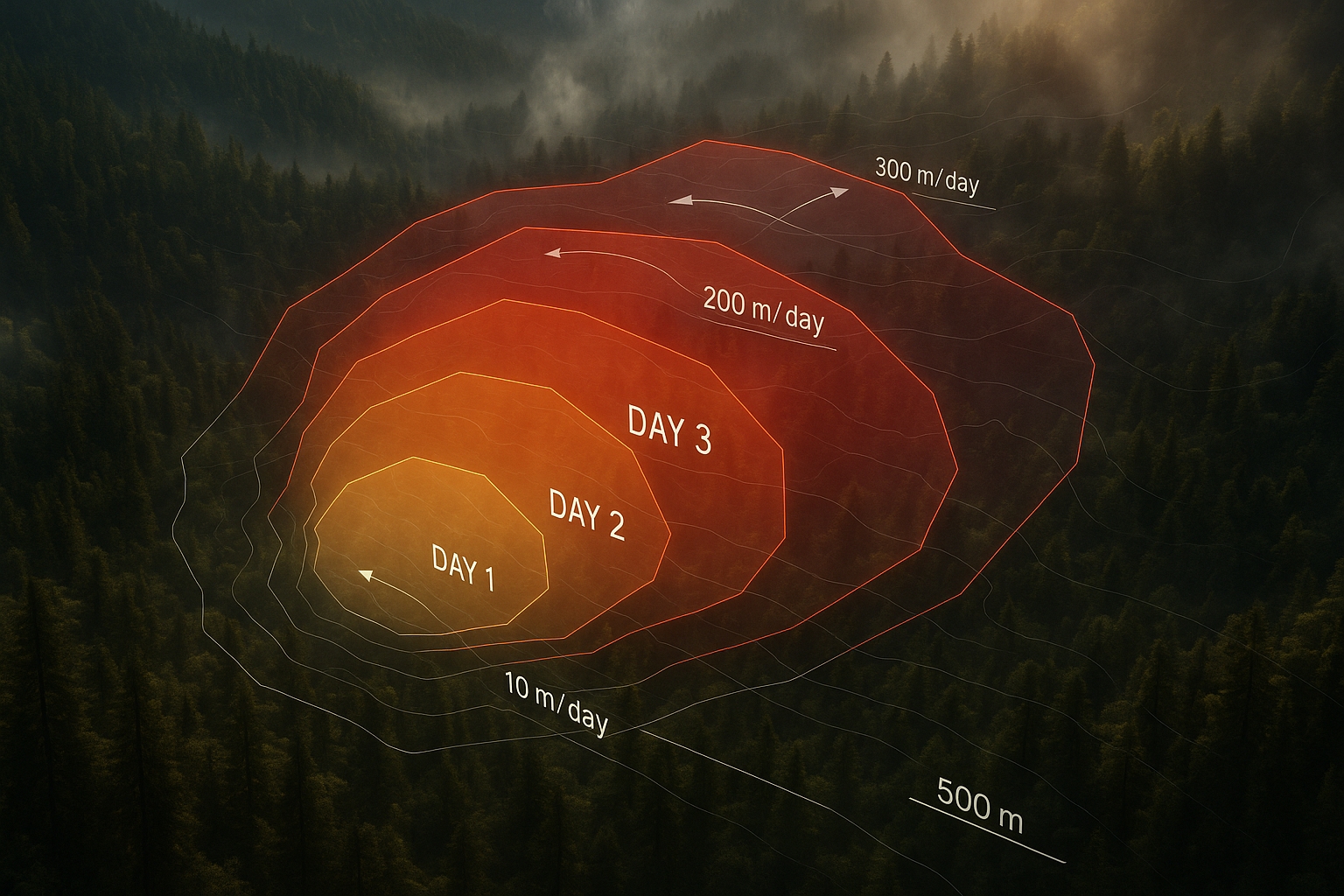
What this project is trying to show
This project develops a theory of wildfire growth in which fire fronts are treated as evolving geometric objects rather than only as burn scars, ignition chains, or aggregate outcomes. The central question is whether perimeter roughness, spatial spread, and growth trajectories reveal lawful structure that can be measured, compared, and modeled across fire regimes.
If that structure is real, wildfire modeling gains a new middle layer between microscale process simulation and coarse statistical forecasting: a generative, event-based account of how fires actually take shape.
What came before, what is missing, and what this adds
Wildfire science already has rich traditions in combustion physics, spread modeling, and fire-regime analysis. What has been less fully developed is the event-scale question: how a single fire grows through space and time as a patterned object whose form may encode mechanism.
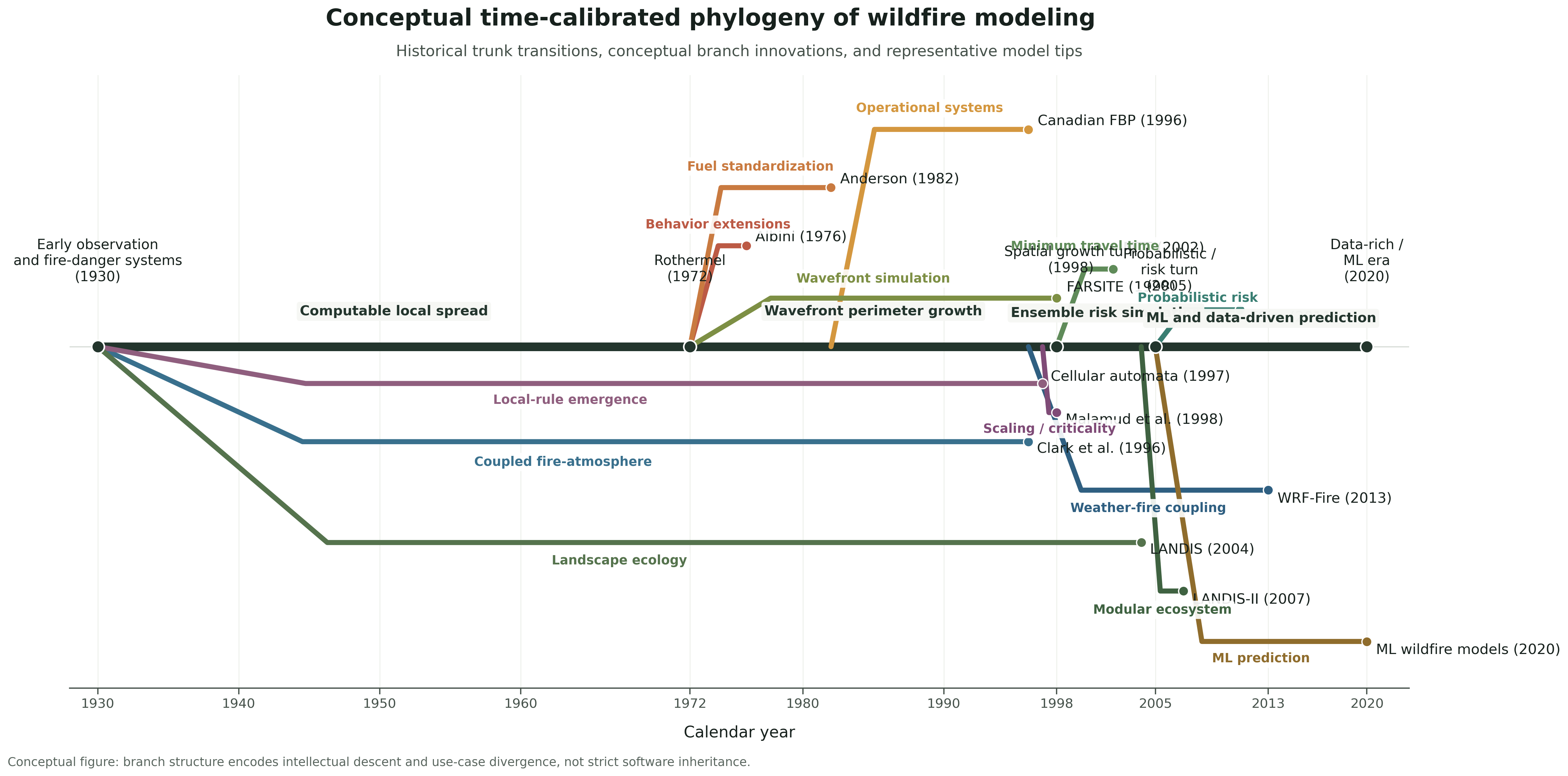
The project's historical arc is explicit. The causal history of wildfire modeling and the wildfire modeling phylogeny show why a geometry-first framework is not a rejection of prior traditions, but an attempt to connect them through measurable scaling signatures and better benchmark design.
Four strong ways into the project
These are the main entry points for first-time readers. Each path leads into long-form material without flattening the argument.
Read the proposal case
See how the project addresses the FIRE-MODEL call, what scientific gap it targets, and how the work is staged for review.
Understand the geometric hypothesis
Follow the argument that wildfire growth may exhibit regime-dependent form, scaling, and dimensional signatures.
Explore methods and models
Inspect how event reconstruction, diagnostics, comparison frameworks, and generative models support the central claim.
Review the work plan
Trace the milestones, deliverables, users, and timeline that turn the concept into an executable research program.
Where to go once you are oriented
The site remains deep by design. These section entry points help readers move from framing into evidence, implementation, and supporting literature.
Project Overview
Program fit, proposal strategy, requirements, and the historical framing behind the submission.
Theory
The main conceptual arc from growth and form through scaling hypotheses, regime shifts, and open questions.
Data, Methods, and Models
The event-reconstruction stack, measurement framework, validation logic, and modeling architecture.
Research Program
The phased work plan, deliverables, audience, and rationale for why this project matters now.
Literature and references
The bibliography and literature map that support the proposal's claims and conceptual positioning.
Why this matters
If wildfire growth has measurable geometric regimes, fire modeling can move beyond asking only whether a model predicts outcomes and toward asking whether it reproduces the forms and transitions that real fires exhibit as they evolve.
Read the wildfire scaling hypothesisWhat is new here
- A geometry-first theory of wildfire growth tied to event-scale observations.
- An explicit bridge from theory to benchmarks, methods, and deliverables.
- A clearer distinction between proposal framing, scientific argument, technical method, planning, and archival workflow.