ESIIL · Research infrastructure prototype
From environmental observations to AI-ready science
Finding data is only the first discovery problem. The second is discovering what the data mean. Scientific traditions describe the living world in different ways. That variety contains information.
We are building a way to discover those meanings, preserve their distinctions, and make the transformations needed for synthesis explicit and reviewable. Specialist agents propose; scientists govern; approved observations stream into machine representations.

Image source and usage
The scientific problem
Data can be accessible and still be difficult to use together
A satellite pixel, a vegetation measurement and a water sample observe different things at different scales. Similar names do not make them interchangeable. Combining them requires evidence about units, methods, spatial support, timing and rights. Those decisions are often hidden in a researcher’s preprocessing code.
Our research question is whether that work can become explicit, repeatable and reviewable, while retaining the distinctions that make observations scientifically useful.
Many ways to describe the living world
Organisms, communities, traits, genomes, experiments, monitoring networks and sensors observe different aspects of reality. A species name, a functional group, a habitat, a measurement and a pixel belong to intersecting systems of meaning. Units, methods, space, time and provenance add further dimensions.
There is no single hierarchy of biological data. A taxonomic rank does not tell us a sampling footprint, and a shared location does not make two observations comparable. The project preserves community definitions, then asks how their meanings relate.
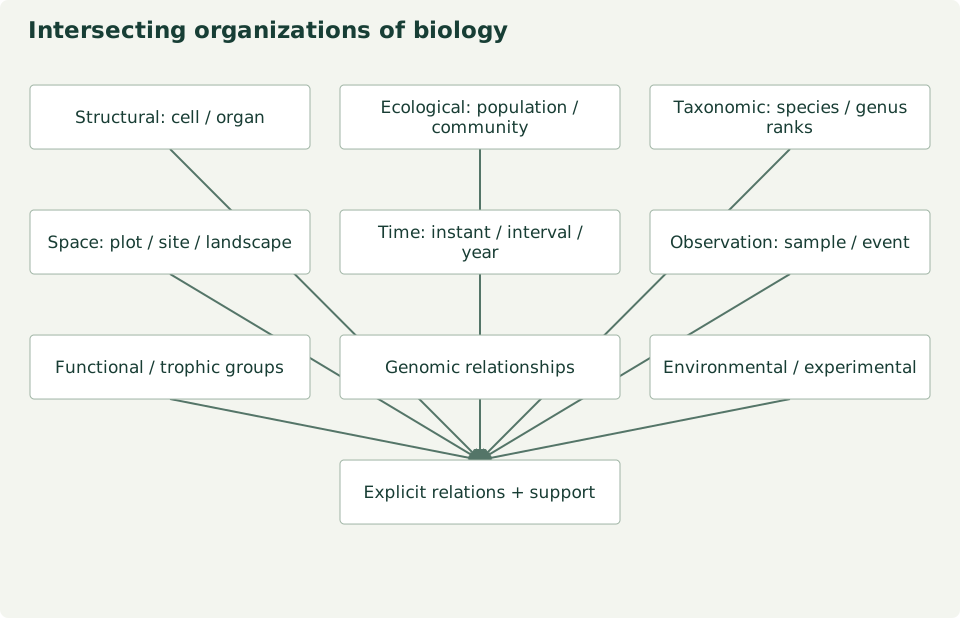
Conceptual perspectives, not a universal ladder or automatic transformation rule. Figure source.
Explore biological organization · Look up a term
Question → discover → understand → harmonize → represent → synthesize
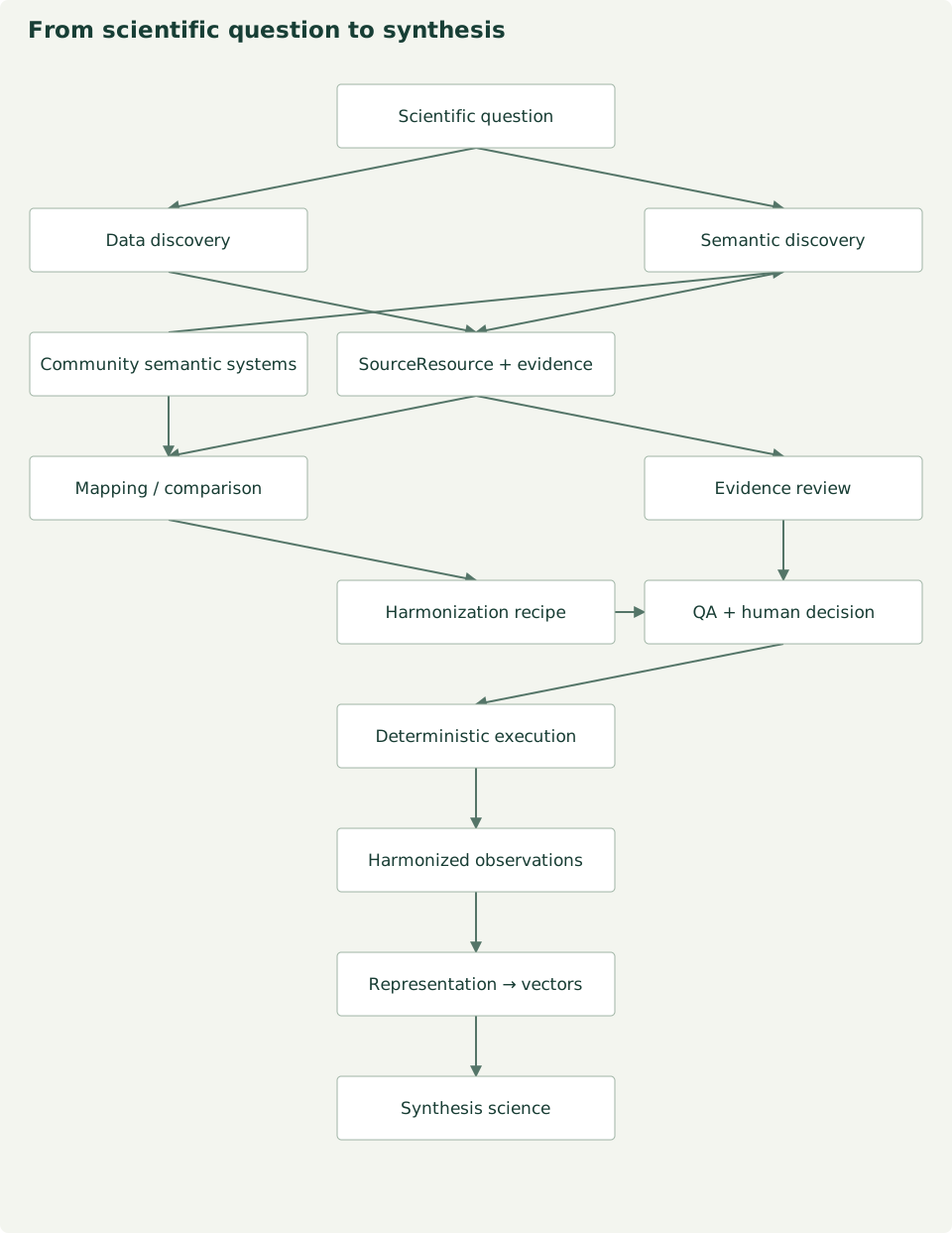
Discovery identifies sources; harmonization establishes supported transformations; representation produces machine features. Figure source.
Discover and understand. Find candidate observations and preserve their native metadata, source versions, access constraints and licenses. A catalog match is evidence to inspect.
Harmonize. Specialists assess a frozen recipe within defined scientific domains. Deterministic checks and human review govern what can execute. Uncertainty or disagreement stops the stream.
Represent. Read bounded windows only after approval. Apply the reviewed recipe in memory, then feed harmonized raster outputs into MOSAIKS. Keep vectors and compact lineage; avoid saving raw or harmonized raster datasets.
Different observations, distinct meanings
Bring data into relation without erasing its context
The architecture accommodates field, sensor and remotely sensed observations. The current real-data work concentrates on Sentinel-2 metadata and bounded access. NEON metadata access is implemented; authenticated observation processing remains unfinished. MESA is an adapter boundary awaiting verified integration.
Discover what the source says its data mean
Sources may already reference an ontology, controlled vocabulary, standard name, protocol, taxon identifier or unit system. The discovery layer preserves that semantic evidence before harmonization begins. The intended semantic profile composes scientific communities’ existing systems while keeping source identifiers and definitions intact. Automated ontology composition remains planned; evidence preservation works today.
Module 1 discovers evidence and candidate concepts. Module 2 interprets their relationships; retrieval is never approval of scientific equivalence.
Explore the semantic landscape and glossary →
A landscape of complementary meanings
Biological resources such as PCO, OBA, PATO and NCBITaxon address different entities and attributes. ENVO and SWEET describe environmental context. OBOE, SOSA and BCO organize observations and sampling. I-ADOPT structures variables; RO supplies relations; GeoSPARQL, OWL-Time and QUDT describe space, time and units; PROV-O records lineage. These are complementary resources, each with limits, rather than interchangeable names for one schema.
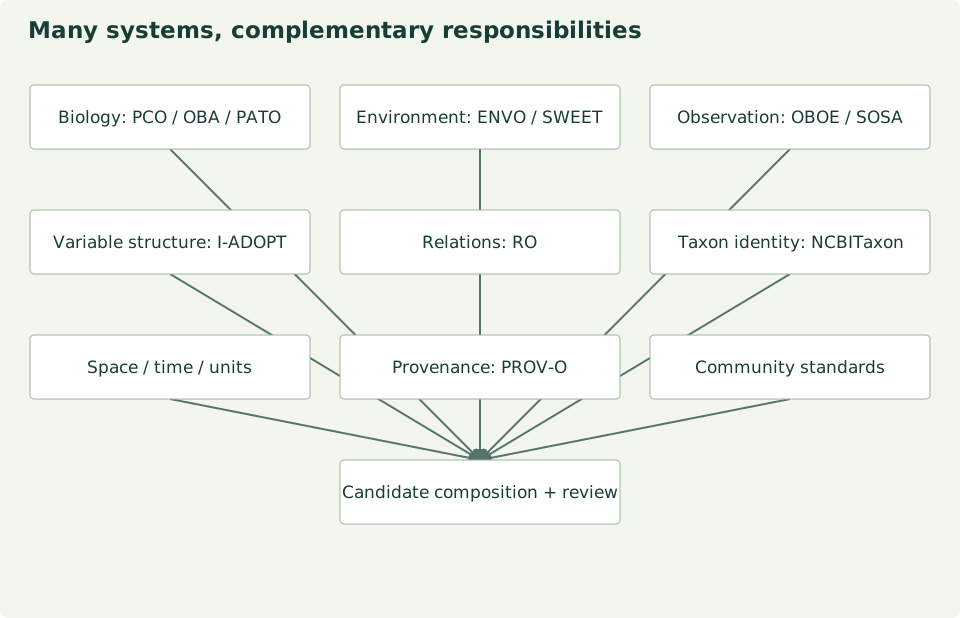
Conceptual semantic families; ontologies, vocabularies, standards and classifications support discovery and harmonization without becoming one universal schema. Figure source.
Explore and filter the semantic landscape →
Which systems and datasets work well together?
Which resources cover broad parts of biological meaning? Which describe narrow areas deeply? Which compose well? Which datasets expose enough evidence to use them? We are developing an evidence-based framework for these questions. The current benchmark measures local inventory assessments and source documentation; deeper ontology and scientific-comparability analysis remains open.
Ontology benchmarking · Dataset potential and candidate pairs
Shared infrastructure, independent scientific questions
Food security and water security are configuration namespaces over a shared core. Their scientific assumptions and products remain separate. A third track stays undefined until scientists specify its question, evidence and reviewed rules. These tracks are research scaffolding; we have not validated food or water outcomes.
A stopped run is a useful result
The Sentinel prototype produced real model-backed proposals and rejected reviews. Specialists repeated concerns outside their domains, including unsupported claims about negative reflectance and licensing. No approved real Sentinel MOSAIKS dataset was produced by those runs.
That evidence motivates scoped reviews, explicit missing-evidence states and a separate integrity reviewer. Generated MOSAIKS tests demonstrate numeric usability, with held-out diagnostics and baselines; they do not establish ecological validity or native language-model understanding.
Read the Sentinel case study →
Toward reusable, inspectable scientific datasets
The intended impact is less repeated data preparation and more visible scientific judgment. Success means that another researcher can inspect a dataset, understand its limits, and trace a vector through its harmonized observation, recipe and review decisions back to the source asset and its rights.
Research goals and limits · What works today · Build and verify the prototype
Stream first, transform only what is needed
Harmonization should not require copying every environmental dataset into one giant local store. The existing bounded readers feed approved windows into scientific operations. An adapter now makes ESIIL’s CubeDynamics available for tested lazy subsetting, transformation, aggregation and alignment. AI may select an approved operation; CubeDynamics performs it. Scientific evidence and review determine whether that operation is appropriate.
Explore the CubeDynamics backend and its current limits →
AI chooses among tested scientific operations
The model can propose what should happen. The validated recipe determines what is allowed to happen. Tested software determines how it happens. Models help interpret scientific language and metadata; deterministic software performs calculations. They do not invent the analysis or write executable scientific code at runtime.
Inspect the model trust boundary →
Trust comes from inspectable decisions
Source semantics and evidence stay attached to their identifiers. Model judgment is labeled; uncertainty and disagreement require review. Deterministic software executes only approved operations, and provenance connects representations to their sources. Inspect the full audit trail.
| Current prototype | Status |
|---|---|
| Typed semantic evidence, local inventory, offline diagnostics and tests | WORKING |
| Sentinel metadata/window access, model-backed reviews and MOSAIKS mechanism | PROTOTYPE; no approved real Sentinel MOSAIKS release |
| Fixture source access and deterministic demonstration agents | MOCKED; explicitly synthetic |
| General ontology-service integration and automated semantic composition | PLANNED |
| Ontology depth, dataset potential/diversity and cross-scale justification | UNDER ANALYSIS |
Scientific validation update — 22 October 2026
The new scientific validation findings retain real graph measurements, canonical requirement diagnostics, scoped dataset/pair assessments and live model results. Earlier unmeasured/planned statements describe the prior architecture snapshot: depth is now measured for three local graphs, while exact scientific mappings, independent ecological validity and the weaker-model hypothesis remain unvalidated. The real Sentinel and NEON–Sentinel cases still require explicit expert decisions; no scientific execution is approved.