Measured semantic-resource and dataset experiments
Resource scope and canonical observations
The new analysis retains 2,408 evidence-linked assertions for 86 resources across 28 requested dimensions. Known legacy scope judgments map to an ordinal rubric; new unsupported dimensions remain null. Zero means not-targeted in the assessed scope, not proven absence of a concept. All scope scores remain PROJECT ASSESSMENT, with provisional confidence and no fabricated expert review.
Twenty-five observations have explicit requirement IDs. Exact best-set enumeration through size three yields size 1: 37.2% (eml); size 2: 52.7% (ebv, eml); size 3: 62.2% (ebv, eml, foodon). The objective counts repeated dimension requirements with at least meaningful assessed scope. It does not measure exact term expressibility, equivalence or ontology quality. Longer accumulation curves are greedy witnesses; they do not prove minimal sets beyond size three.
Exact SOSA term presence is measured separately in canonical_term_witnesses.json.
Presence is a building-block witness, not an approved scientific mapping.
Subdomain accumulation, marginal gain, resource-pair overlap, unknown dimensions,
threshold failures and complete-case exploratory PCA are retained independently.
No missing values are imputed as zeros.
Real graph structure
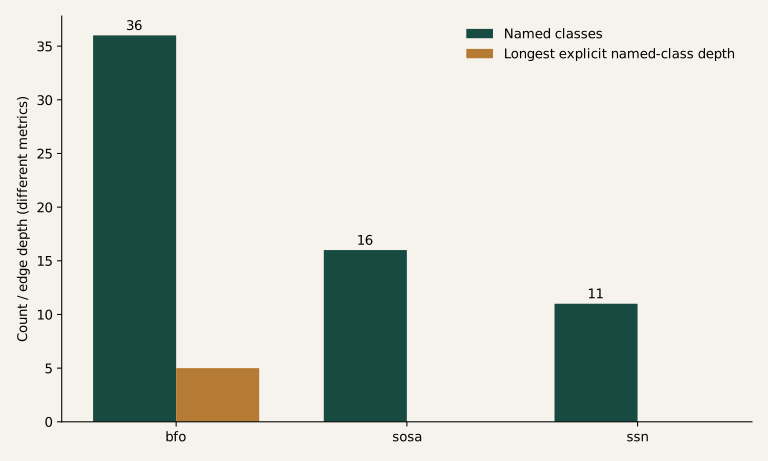
| Local snapshot | Named classes | Longest named-class depth | Median shortest root depth | Restrictions |
|---|---|---|---|---|
| bfo | 36 | 5 | 4.0 | 31 |
| sosa | 16 | 0 | 0.0 | 0 |
| ssn | 11 | 0 | 0 | 73 |
These are explicit local triples, not imported or inferred closures. SOSA/SSN modeling patterns and external superclass references are not summarized by local named-class depth. SSN's explicit SOSA import is verified; other inventory relationships retain their weaker declaration provenance. Identifier resolvability, I-ADOPT compatibility and semantic crosswalk correctness remain unmeasured.
Candidate dataset diagnostics
The 18 records include product/network descriptions, a standard comparator and an unselected climate counterpart. They are not 18 integrated datasets. Each source statement has primary evidence and scope; dimension and field-presence coding are separately labeled PROJECT ASSESSMENT. Undocumented fields remain unknown.
Semantic diversity is a documented dimension lower bound, not variable count. The ontology-potential diagnostic counts proposed resource relationships and is a PROJECT ASSESSMENT. Formal ontology references are distinguished from standard use. Eight separate review-prioritization rubrics and all 153 pair diagnostics are available. Ties have no scientific standing; mixed documentation scope confounds ranking. Pairwise added dimensions do not grant scientific compatibility.
Evidence inventory · Canonical results · Graph measurements · Dataset and pair diagnostics.