Biology has intersecting hierarchies
Biology does not supply one universal ladder from molecule to globe. The following
are useful study perspectives. Arrows indicate movement through a perspective,
not one shared is-a relation or an automatic transformation rule.
| Structural | Ecological | Taxonomic | Spatial | Temporal | Observational |
|---|---|---|---|---|---|
| molecule | organism | organism identified under a taxon concept | point | instant | sample |
| organelle | population | species rank | plot | observation interval | measurement |
| cell | community | genus rank | site | day | observation |
| tissue | ecosystem | family rank | landscape | season | event |
| organ | biome | order rank and higher ranks | region / continent / globe | year / decade | inventory / dataset |
| organism | — | — | — | — | — |
The arrows mean different things
Structural organization often involves part-whole relationships. Ecological organization involves memberships, interactions and study-defined systems. Taxonomic ranks organize taxon concepts; an organism is not a taxonomic rank. It is identified under a taxonomic treatment. Spatial and temporal examples describe support, resolution or extent only when those roles are specified.
The observational column is an illustrative workflow vocabulary. A sample can support multiple measurements; an observation/event can group them differently in OBOE and SOSA. It is not a universal containment or subclass hierarchy.
Other intersecting organizations
Trophic: resource use, feeding relationships and trophic groups can cut across taxa, life stages and places. A guild is not automatically a taxonomic group.
Genetic: sequences, alleles, genes, gene products and genomes have relationships that do not map one-to-one to anatomical or ecological organization.
Functional: organisms can be grouped by traits or selected ecological roles. The chosen function and grouping rule must be explicit.
Environmental: systems, features and materials provide different kinds of context. A water sample's matrix, a stream feature and a watershed system are related without being the same entity or scale.
Experimental: treatment, replicate, block, experimental unit and observation unit organize interventions and inference. They need protocol and design evidence.
What this means for harmonization
Do not infer biological scale from pixel size, taxonomic rank from body size, or sampling support from an entity label. State the entity, property, organizational perspective, space/time support and method separately. Moving between perspectives requires a reviewed scientific relationship or transformation.
Scale and support · Cross-scale gaps · Organism/population/community definitions
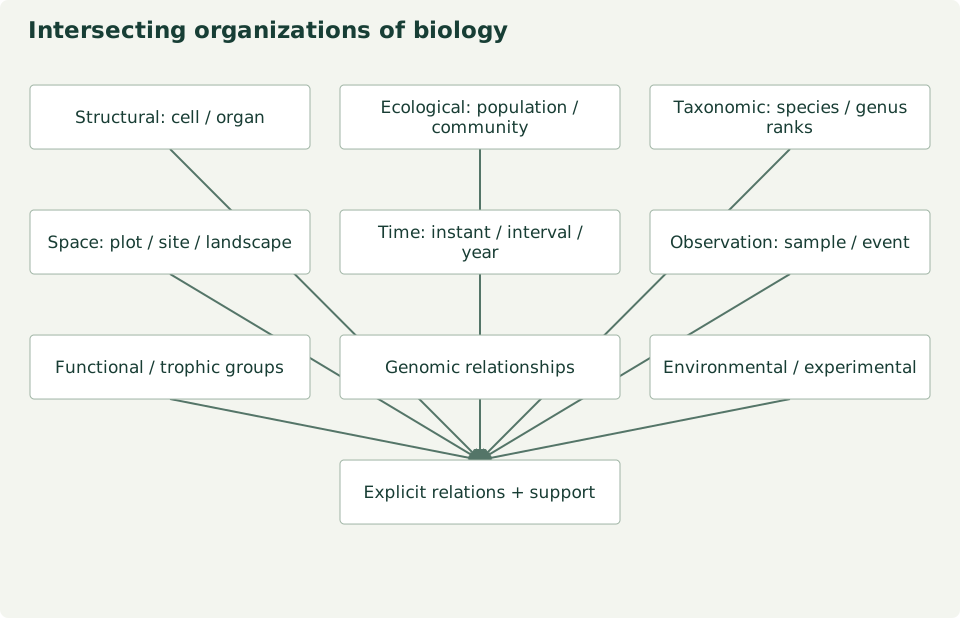
Repository-authored conceptual diagram; maintained source. Analytical hypotheses are not measured results.