Dataset benchmarking: evidence for useful synthesis
WORKING: source-record metadata diagnostics. UNDER ANALYSIS: dataset potential, semantic diversity, leverage, pair suitability and flagship selection. Current rows represent versioned source assets; they do not rank entire networks or collections.
Three questions, three profiles
| Concept | What it asks | Evidence needed |
|---|---|---|
| Explicit ontology use | What semantic infrastructure is already declared? | Concept/taxon IDs, vocabulary annotations, units, standard names and observation standards with source locations |
| Ontology potential | How much meaning could be recovered responsibly? | Definitions, methods, protocols, context, support and rights sufficient for reviewed mappings |
| Semantic diversity | How many distinct kinds of meaning must interact? | Taxa, traits, populations, communities, interactions, environment, sensors, methods, space/time, units and provenance |
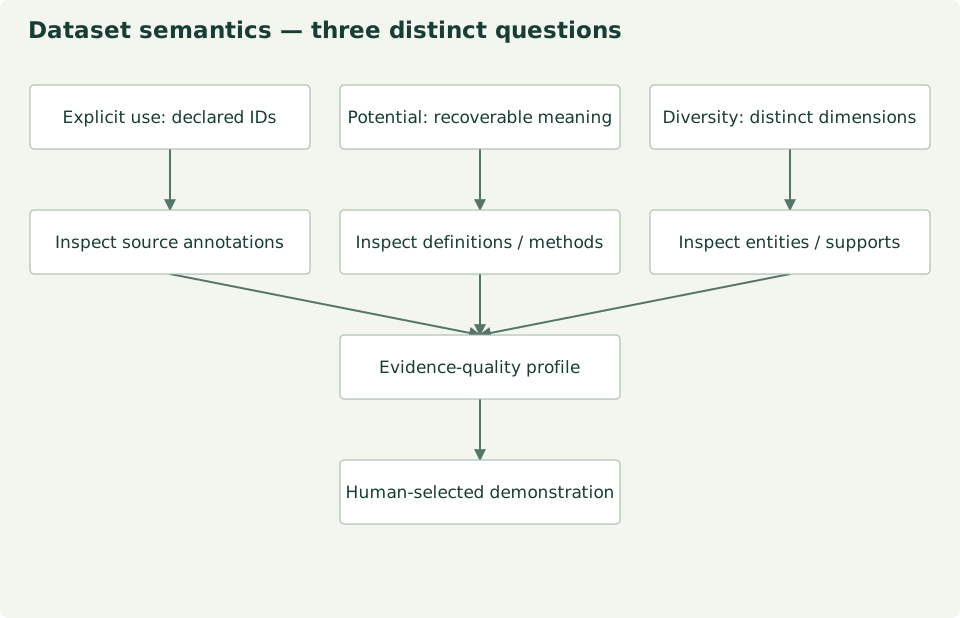
Repository-authored conceptual diagram; maintained source. Analytical hypotheses are not measured results.
A dataset with few ontology IDs can still expose excellent definitions and protocols. Low explicit use plus high potential may be especially valuable: the system has real semantic work to do. Conversely, many IDs cannot compensate for unclear support. Metadata field presence is neither semantic completeness nor scientific validity.
Ontology leverage is a profile
Ontology leverage considers semantic richness × recoverable meaning × ontology connectivity × machine accessibility × evidence quality. This is a conceptual statement of interacting requirements, not an implemented product or calibrated scalar score. Report components and uncertainty separately. An accessible API does not establish rights or correct definitions.
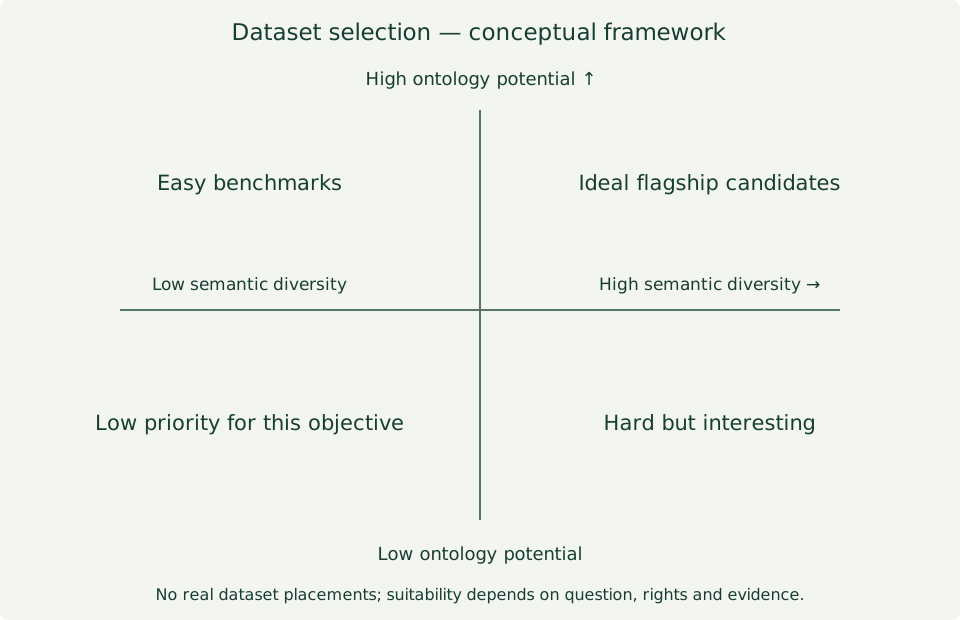
Repository-authored conceptual diagram; maintained source. Analytical hypotheses are not measured results.
No real datasets are positioned in this quadrant. An eventual placement needs a versioned assessment rubric, source evidence, reviewer and uncertainty. The priority labels describe this prototype objective, not the dataset's general scientific value.
Best for which purpose?
Selection can distinguish the best ontology-native, ontology-ready, cross-scale, multimodal, community/ecosystem or interaction dataset; the strongest semantic stress test; the best pair; and the best flagship demonstration. These categories may select different sources. A single documentation leaderboard cannot answer all of them.
Pairs reveal what individual datasets cannot
| Candidate pair — not selected | Questions to review before use |
|---|---|
| NEON + Sentinel-2 | Field quantities versus reflectance; pixel/plot footprint, timing, calibration and quality |
| NEON + TRY | Taxon concepts, individual versus species summaries, trait methods and permissions |
| NEON + AmeriFlux | Measurement definitions, tower footprint, intervals and field sampling |
| NEON + ORNL DAAC | Product-specific quantity, modeled versus observed values, spatial and temporal support |
| Community inventory + trait database | Membership, abundance weights, taxonomic reconciliation and missing traits |
| Biodiversity occurrences + remote sensing | Presence versus abundance, sampling bias, detection and sensor support |
| Flux network + satellite observations | Footprint variability, aggregation, retrieval definitions and uncertainty |
Pairs may expose shared or complementary semantics, ontology conflicts, support
mismatches and opportunities for synthesis. They require explicit scientific
transformations; proximity and common names do not authorize a join. Current
dataset_pairs.parquet compares metadata field presence and namespace references
only. Scientific comparability is not evaluated.
Selecting a flagship: proposed decision process
Choose a scientific question; inspect permitted, versioned metadata; assess the three profiles; review complementary pairs; document unresolved support transformations; then select a bounded case with an independently testable outcome. Freeze the recipe, complete specialist/QA and human review, stream approved windows into MOSAIKS, and verify with held-out data and baselines. Rights or evidence gaps can stop selection.
No flagship has been selected by this benchmark. The existing Sentinel metadata case is a prototype calibration/review example; blocked reviews did not yield an approved real MOSAIKS product. Source status separates implemented access from candidates. Actual output contracts and formulas explain the current project diagnostics and their limits.
Scientific validation update — 22 October 2026
The new scientific validation findings retain real graph measurements, canonical requirement diagnostics, scoped dataset/pair assessments and live model results. Earlier unmeasured/planned statements describe the prior architecture snapshot: depth is now measured for three local graphs, while exact scientific mappings, independent ecological validity and the weaker-model hypothesis remain unvalidated. The real Sentinel and NEON–Sentinel cases still require explicit expert decisions; no scientific execution is approved.