Overlapping histories of semantic infrastructure
The conceptual progression below is a reading guide, not a strict chronology. Communities revisited these needs in parallel and still do. A modern vocabulary can address naming while an older project already explored sophisticated mediation. The inventory preserves known milestones, uncertainty and historical leads.
| Capability | Illustrative resources and contribution | What it did not finish |
|---|---|---|
| Name things | Taxonomic names/identifiers and managed vocabularies | Names alone do not identify taxon circumscriptions or measurement meanings |
| Describe datasets | Dublin Core, EML, later DataCite/DCAT/STAC metadata | Description does not establish scientific equivalence |
| Formalize biological entities | Anatomy, cell, molecular, trait and taxonomic ontologies | One domain's entity model is not every domain's |
| Formalize relationships | RO and explicit relation patterns | A relation still needs correct scientific application |
| Formalize observations | OBOE, SSN/SOSA | Shared observation structure does not eliminate method/support differences |
| Formalize methods and sampling | OBI, BCO, MIAPPE/PPEO, Humboldt | Recorded procedures do not prove equivalent procedures |
| Connect domains | ENVO, SWEET, MarineTLO, domain overlays and explicit alignments | Cross-domain links can be contextual or lossy |
| Compose meaning | Entity-quality patterns and I-ADOPT | Composition needs domain concepts and compatible relations |
| Preserve lineage | PROV-O and scientific-workflow extensions such as ProvONE | A derivation can be recorded but scientifically unjustified |
| Orchestrate many systems | Community profiles, registries and governed pipelines | Discovery must remain separate from interpretation and approval |
Selected documented milestones
Dublin Core's 1995 workshop lineage and EML's ecological metadata precursors illustrate resource description needs. SEEK notes and Ecolingua show that ecological semantic mediation predates recent agent systems.
OBOE's 2007 paper, SKOS's 2009 Recommendation, PROV-O's 2013 Recommendation and SOSA/SSN's 2017 Recommendation mark different capabilities, not replacements for every predecessor. The Bari Manifesto frames EBV interoperability as a coordinated scientific-infrastructure problem; a proposed EBV application ontology is not assumed to be a complete deployed resource.
What we inherit
Reuse identifiers, definitions, models, relations, methods and provenance rather than declaring a new universal biological ontology. Some artifacts remain useful historical precedents even when active maintenance or executable releases have not been verified. MicrO and CARO are marked inactive in the inspected OBO registry; that is a scoped metadata fact, not a claim that every descendant use has ceased.
A blank origin or crosswalk field means this review has not established it. Continued literature review and community input are part of the resource's purpose.
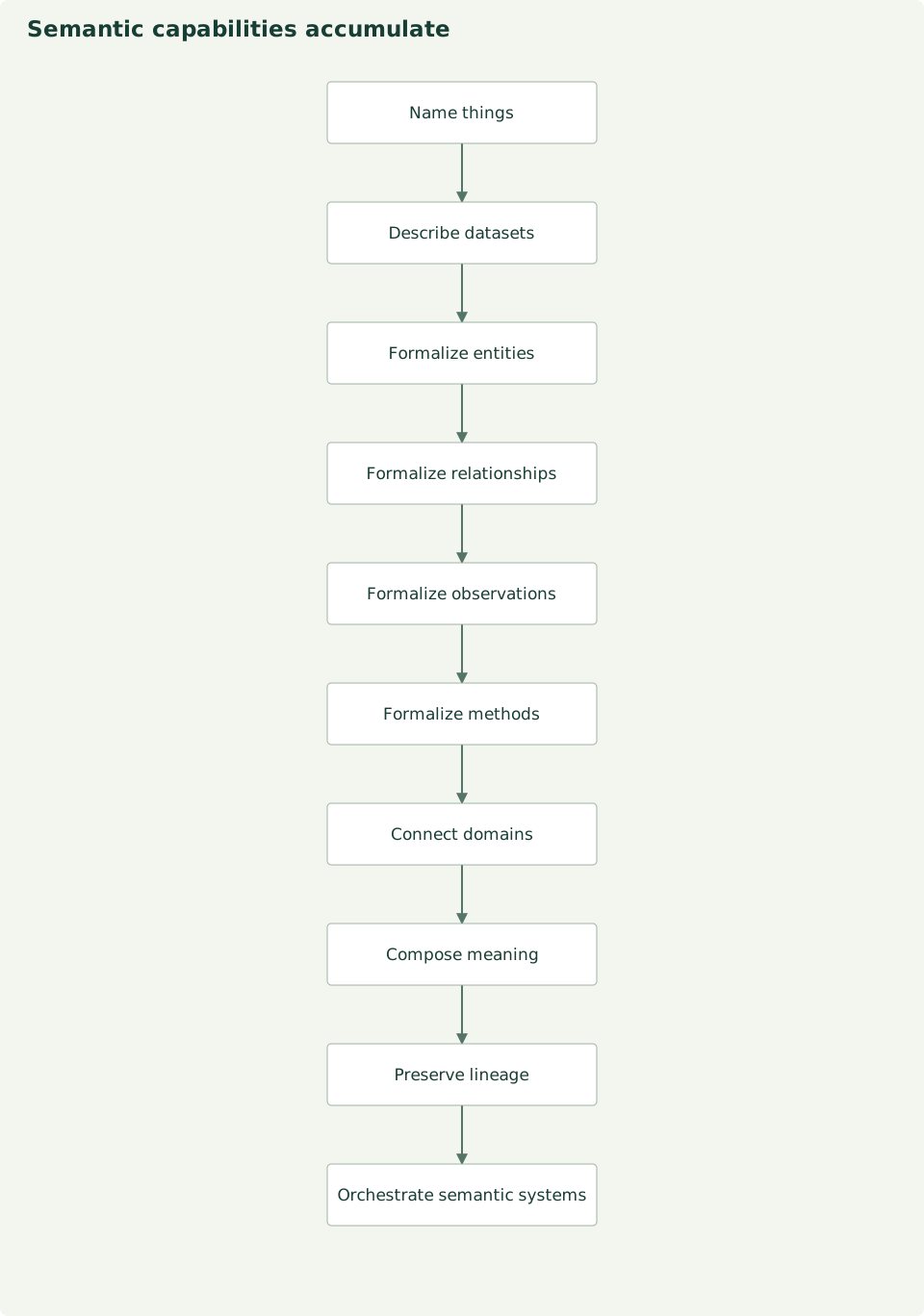
Repository-authored conceptual diagram; maintained source. Analytical hypotheses are not measured results.
Biology has many semantic resources. The current challenge is finding, understanding, selecting and connecting them while preserving distinctions, identifying genuine gaps and determining whether a mapping is scientifically justified.