Harmonization and review
harmonization.run(resources, recipe, records, human=None, parents=()) consumes
standardized contracts independently of MESA. SemanticAgent compares definitions,
methods, entities, ontology identifiers, and units against explicit targets. Exact
curated meaning can produce equivalent_to or convertible_to; otherwise the agent
abstains with unknown. Names alone never justify equivalence.
The relationship vocabulary also represents broader/narrower, derivation, measurement, association, incompatibility, and human-review needs. Those relations do not authorize silently treating one scientific quantity as another.
Recipes and QA
Recipes are JSON-serializable, versioned, attributable scientific artifacts with
formal JSON Schema. Mappings hold scientific interpretation; operations hold
mechanical actions. Every proposal includes rationale, evidence, role, deterministic
agent identity/version, and configuration. States are proposed, needs_review,
approved, and rejected.
prototype schema HarmonizationRecipe --output /tmp/recipe-schema.json
QA checks source and variable existence, explicit semantic evidence, target variable/unit agreement, conversion direction, rights, core/track scope, and join references. The report binds to the exact recipe digest. Execution recomputes QA instead of trusting a supplied approval string. QA supports approve/reject/ request-revision/human-review outcomes in its contract; current deterministic checks emit approve, reject, or human-review.
Human review is required for novel equivalence, confidence below 0.95, disagreement, ambiguous meaning, spatial or temporal support changes, cross-source joins, and uncertain rights/restrictions. Known prohibitions block export even with approval. QA never silently repairs a scientific decision.
Human workflow
- Save the standalone candidate recipe JSON and source-resource list.
- Inspect evidence, operations, and
prototype qa recipe.json sources.json --output qa.json. - Revise the recipe with explicit supported semantics. Set its intended execution
status to
approvedonly after the scientific decision is ready for review. -
Record the decision against that exact file:
prototype review recipe.json --reviewer "Expert name" \ --rationale "Evidence and scientific justification" \ --decision approved --output review.json -
Load
HarmonizationRecipe,SourceResource,RawObservation, andHumanDecisionwith their Pydantic JSON loaders and callharmonization.runwith that decision. Any subsequent recipe edit changes its digest and requires a new decision.
Individual execution and encoding are also available through the CLI:
prototype harmonize recipe.json sources.json records.json --review review.json --output observations.json
prototype encode observations.json --encoder scalar --output vectors.json
For track recipes, supply --parents canonical-observations.json. The default
orchestrator creates only the conservative fixture recipes; reviewed custom
recipes use these independent stage commands/APIs.
This is a local audit mechanism, not authenticated reviewer identity or signatures. The default fixture needs no human scientific decision because it uses curated identity mappings and no support changes. Tests use explicitly labeled synthetic human decisions to exercise gated operations. Unknown semantics must be revised, not overridden with a blanket approval.
Allow-listed execution
| Operation | V0 behavior and boundary |
|---|---|
| Unit conversion | degC ↔ K and cm ↔ m only; explicit source/target units |
| Variable mapping | Explicit target name with semantic evidence |
| Filtering | Inclusive bounds; track scope only |
| Missing values | Explicit sentinel → null; encoders reject remaining nulls |
| Temporal aggregation | Duration-weighted daily mean; complete nonoverlapping daily coverage required; review and track scope |
| Spatial matching | Unique match within explicit coordinate tolerance in WGS84 degrees and exact time; review and track scope |
| Coordinate normalization | Explicit identity validation of already WGS84 coordinates; other CRS transforms unsupported |
| Join | Unique exact coordinates, interval, and equal support; review and track scope; retains related source/record |
| Validation | Explicit numeric bounds |
Original values remain in provenance. Unit conversions scale supplied uncertainty by the fixed unit factor; calibration scales it by the absolute documented coefficient. Daily means drop numeric uncertainty; general uncertainty propagation is not implemented. These narrow operations are not a universal environmental harmonization system. Daily aggregation uses UTC-aligned intervals in the examples; local civil days and daylight-saving calendars need further scientific design.
Semantic alignment and composition: capability boundaries
Module 1 discovers what the source says. Module 2 decides how source concepts relate, and whether a proposed transformation is scientifically defensible.
| Responsibility | Current implementation and boundary |
|---|---|
| Semantic alignment and crosswalks | Typed relationship proposals and curated fixture rules; general ontology alignment/crosswalk generation is PLANNED |
| Ontology comparison, variable decomposition and composition | Human comparison workflow and candidate profile documented; automatic I-ADOPT decomposition/composition is PLANNED |
| Scientific comparability | Explicit entity, method, unit and support checks; no name-based inference or general cross-scale validity engine |
| Units and calibration | Narrow allow-listed conversions and reviewed Sentinel scale/offset; no arbitrary model-generated operations |
| Space, time and cross-scale changes | Narrow reviewed operations above; generalized support transformations remain research work |
| Consensus, QA and human decisions | Deterministic digest/contract checks, legacy four-specialist consensus, additive six-domain reviews and mandatory human review for model proposals |
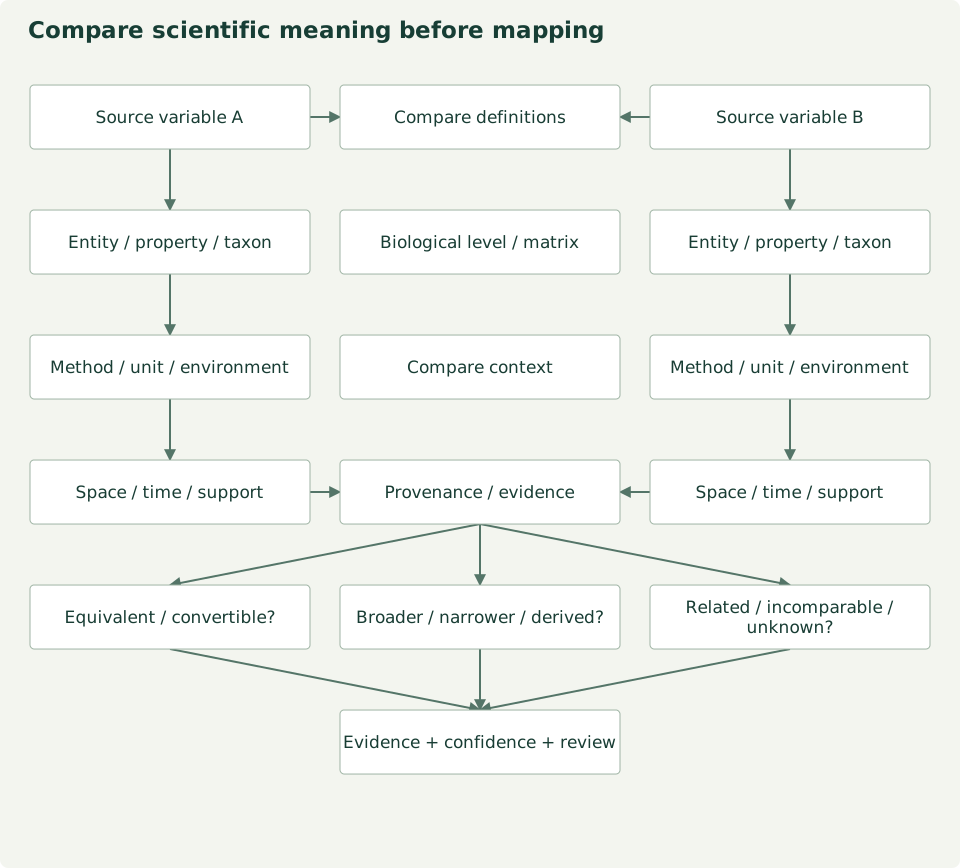
Conceptual comparison workflow; automated semantic decomposition is planned. Figure source.
The candidate relationship can be equivalent, convertible, broader, narrower, derived, related, incomparable or unknown. These conceptual categories do not replace the typed mapping vocabulary or authorize execution.
The recipe as an inspectable intermediate representation
Heterogeneous observations → semantic interpretation → recipe → deterministic execution → harmonized observations. The compiler analogy helps separate scientific judgment from execution: the recipe is inspectable, versioned and validated, and the executor accepts only supported operations.
Current mapping and operation contracts retain source/target meanings, relation, evidence, confidence, proposals, units and supported transformations; review reports and human decisions bind them by digest. A complete research review packet should also describe relevant ontology IDs/versions, entity/property decomposition, spatial and temporal changes, aggregation, method assumptions and potential loss. Not every item is a dedicated executable recipe field today. Use the non-executable semantic comparison template for the richer scientific record; do not imply its free text is executed.
Human concept-review workflow · Cross-support research · Provenance
Same unit does not mean same variable
A trait, variable and measurement are distinct. Standardized structure does not establish harmonized scientific meaning.
Deterministic backbone and model trust
VERDE interprets, selects, parameterizes, compares and proposes. It does not author scientific computation. New model plans select closed, source-bound capabilities; metadata coefficients and mathematical operations are resolved by tested code. Schema validation, scientific checks, existing vetoes and human decisions remain separate gates. Approved recipes execute without a model. See deterministic execution and model trust for the registry, IR contracts, examples, provenance and current limits.
External CubeDynamics execution
The optional CubeDynamics backend supplies seven registered, reference-bound capabilities on trusted xarray/Dask inputs. Models select operations; tested software performs them after scientific validation and exact-recipe human review. Source access remains upstream. The direct MOSAIKS bridge preserves the reviewed raster layout; support-changing aggregation/alignment needs explicit review and does not automatically establish a new representation layout. Real Sentinel vetoes and existing streaming gates remain binding.