Shared observations, independent science
Food security and water security motivate distinct questions. They can reuse immutable source observations and reviewed core transformations without sharing every interpretation. Track-specific rules produce new products carrying track provenance.
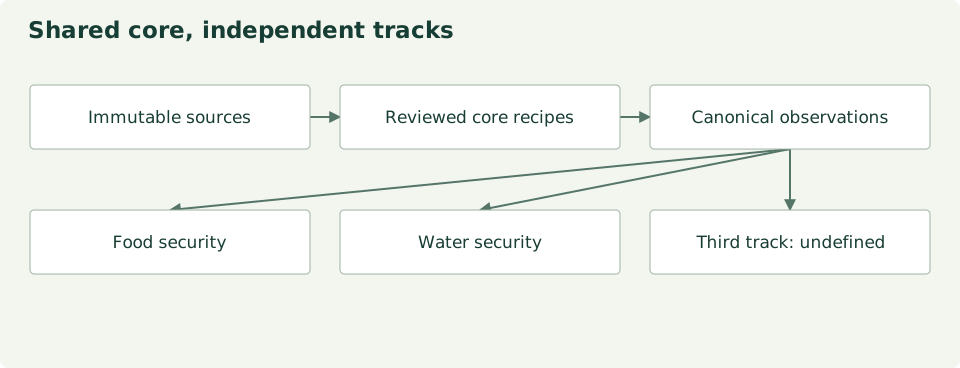
Shared resources do not imply shared scientific assumptions. The third track is disabled. Figure source.
Food security
The current configuration exercises track isolation over small generated examples. It is a place to specify reviewed variables, support and assumptions for future food security research. It does not predict yield, nutrition or food-system resilience.
Water security
The water configuration uses the same core pipeline and separate product identity. Future questions need explicit measurements and validation appropriate to water systems. No validated water-security outcome is supplied by this prototype.
A deliberately open third track
The third configuration remains disabled. Scientists must define its question and rules before any domain assumptions enter the system.
What would count as scientific verification?
A dataset must retain its scientific definitions and units, pass integrity and leakage checks, and support held-out tasks against meaningful baselines. A texture statistic derived from an input raster can verify an encoder’s numeric utility; it cannot independently validate environmental meaning. The next scientific milestone requires independent reference labels and a scientist-defined evaluation protocol.
Track configuration and independence tests · MOSAIKS verification
Semantics serves synthesis science
A question about vegetation change may span individual traits, community membership, ecosystem context, climate, disturbance, field methods and satellite acquisitions. A leaf measurement and reflectance are different quantities; a reviewed relationship may support analysis without declaring them equivalent. The scientific goal is to connect evidence across time, space and biological organization while making those assumptions visible.
The canonical benchmark observations move from a site temperature to multi-source annual change. They are proposed semantic stress tests, not completed synthesis results. Candidate dataset pairs show where support, methods and taxonomic interpretation will need review.
Scientific validation update — 22 October 2026
The new scientific validation findings retain real graph measurements, canonical requirement diagnostics, scoped dataset/pair assessments and live model results. Earlier unmeasured/planned statements describe the prior architecture snapshot: depth is now measured for three local graphs, while exact scientific mappings, independent ecological validity and the weaker-model hypothesis remain unvalidated. The real Sentinel and NEON–Sentinel cases still require explicit expert decisions; no scientific execution is approved.