Semantic evidence in the pipeline
The implemented boundary is discover data + discover semantic evidence → interpret/map/harmonize → represent. Discovery preserves what the source says; Module 2 decides which scientific relationships are supported.
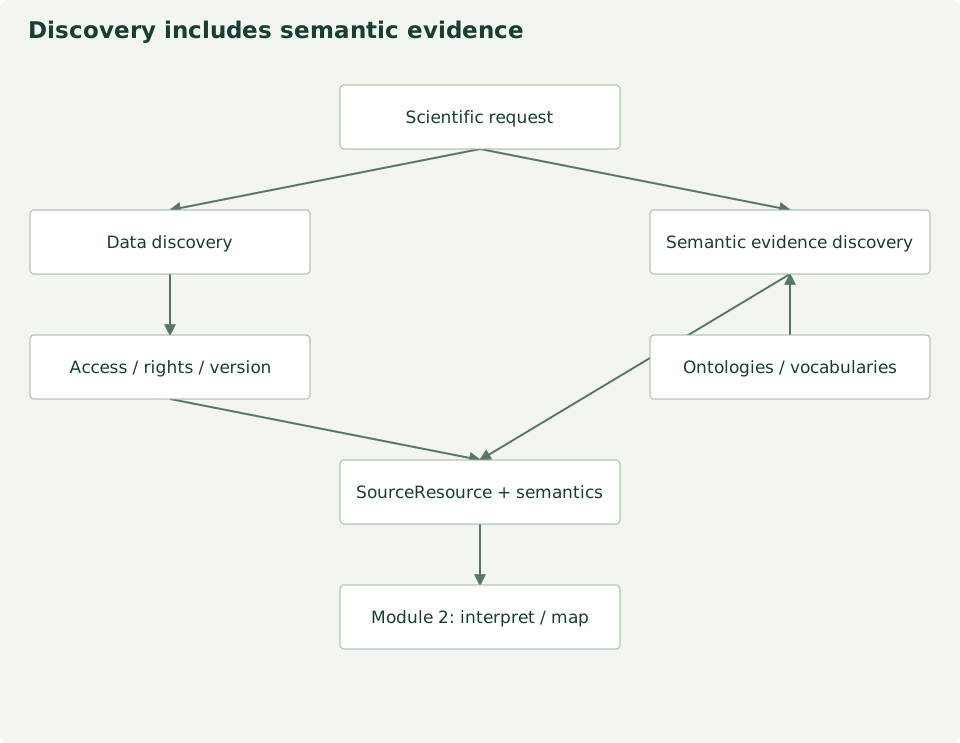
Detailed Module 1 boundary. No raster data is read by semantic discovery. Figure source.
Input and output
discovery.run(request, client, semantic_registry=None) retains the existing
metadata-search interface. It filters candidate sources, rejects conflicting
metadata, and returns new source records enriched with SourceSemantics. The
client's immutable resources remain unchanged. A catalog match or a retrieved
concept is not an approved SemanticMapping.
The existing SourceResource identity/access/version/integrity fields remain,
alongside typed Rights, Support, Metadata and Variable records. Its new
optional semantics field contains:
SemanticEvidence: optional source definitions, identifiers, vocabulary, units, quantity/entity/property/matrix/context hints, taxa, methods, protocols, sensor, platform and spatial/temporal metadata, plus type/location/documentation/confidence.ConceptCandidate: identifier, label, resource, optional definition, retrieval basis, evidence and confidence. There is no approval or equivalence field.- Extractor identity and a digest of the complete source record before enrichment.
Absent semantics is omitted from serialized output, preserving old source and plan identities. Enriched sources get a different identity and cannot silently reuse products under old identities. Existing annotations are preserved and stale source/evidence bindings are rejected. Full source records already survive in provenance; streaming products retain metadata and compact observation/window lineage.
Evidence types and candidate bases
The shared vocabulary is SOURCE_DOCUMENTED, OBSERVED_IN_DATA,
DERIVED_DETERMINISTICALLY, MODEL_JUDGMENT, HUMAN_DECISION, MISSING_EVIDENCE.
Discovery currently parses metadata without model calls. Normalized adapter fields
are marked deterministic, because their prose may not be a literal native statement.
Native STAC fields have explicit source locations. Model hints, if supplied by an
adapter, remain model judgments and cannot be relabeled as deterministic matches.
Candidate bases distinguish an exact source annotation, a normalized metadata identifier, exact vocabulary-label retrieval, lexical retrieval and model inference. Even an exact identifier retrieval is only a candidate for Module 2's intended scientific relationship. No label match establishes equivalence.
Semantic-resource access
SemanticResourceRegistry indexes the local inventory and declared concept records.
It implements search, lookup, describe, relationships and source, plus
resource-level search. Configured resolver adapters follow SemanticResolver.
No external portal is silently contacted and no ontology graph is downloaded.
Failures propagate; there is no live-to-fixture fallback.
The shipped concept records use explicitly synthetic URNs. OBO Foundry, OLS, BioPortal, EcoPortal, AgroPortal and TDWG are potential adapter providers, not newly implemented live services. The small namespace index identifies declared resource references; it does not establish concept existence, crosswalks or equivalence.
Sentinel regression
data/fixtures/semantics/sentinel_source.json is an explicitly generated metadata
fixture, using the historical item S2B_13TDE_20230715_0_L2A for context. Its native
metadata supplies platform sentinel-2b, instrument msi, band B08, common name
nir, scale 0.0001, offset −0.1, documented unit 1, 10 m resolution, native
EPSG:32613, processing type S2MSI2A, baseline 05.09, SCL asset metadata and a
license link. Access URIs are intentionally nonresolving. No pixels were retrieved.
The stored variable stays B08_DN with unit DN. The documented band unit belongs
to the calibrated quantity; extraction never applies the coefficients. STAC common
name nir is not invented into a CF standard name. The fixture's license does not
license real Sentinel data. Missing temporal resolution remains missing; the source
acquisition stays instantaneous.
prototype discover-semantics data/fixtures/semantics/sentinel_source.json \
  --output run/sentinel-semantic-evidence.json
The actual Sentinel planning path now enriches metadata in the same way, without changing the scientific target, deterministic calibration, model vetoes or human gates. MESA remains an unverified adapter boundary. Legacy snapshots remain historical.
Module 2 and Module 3 remain separate
Human/scientific comparison produces a proposed relationship and supporting evidence. Approved scientific transformations belong in versioned recipes, with deterministic QA and human decisions as required. The discovery layer does not create those approvals. MOSAIKS still consumes harmonized raster outputs only and preserves canonical meaning, encoder identity and source/recipe/review lineage.
Contract schemas · Discovery module · Review workflow · Tests
Deterministic backbone and model trust
VERDE interprets, selects, parameterizes, compares and proposes. It does not author scientific computation. New model plans select closed, source-bound capabilities; metadata coefficients and mathematical operations are resolved by tested code. Schema validation, scientific checks, existing vetoes and human decisions remain separate gates. Approved recipes execute without a model. See deterministic execution and model trust for the registry, IR contracts, examples, provenance and current limits.