Architecture
The existing template contained MkDocs Material, static assets, styling, and Pages
workflows. It had no src/, tests/, or data/ implementation. The prototype adds
one standard Python package under src/dataset_prototype/, without repurposing
website sources as package files.
Module boundaries
The local management workbench composes existing
scientific contracts and datasets with operational metadata, without moving the
scientific stages into a registry. management_contracts.py defines interfaces;
asset_registry.py supplies SQLite/CAS; management.py handles bounded imports,
resource plans, exports and recovery; workbench.py supplies the local UI/API.
Only version-bound feedback mutates through HTTP. No scientific approval or job
execution endpoint exists; remote partner integrations remain planned.
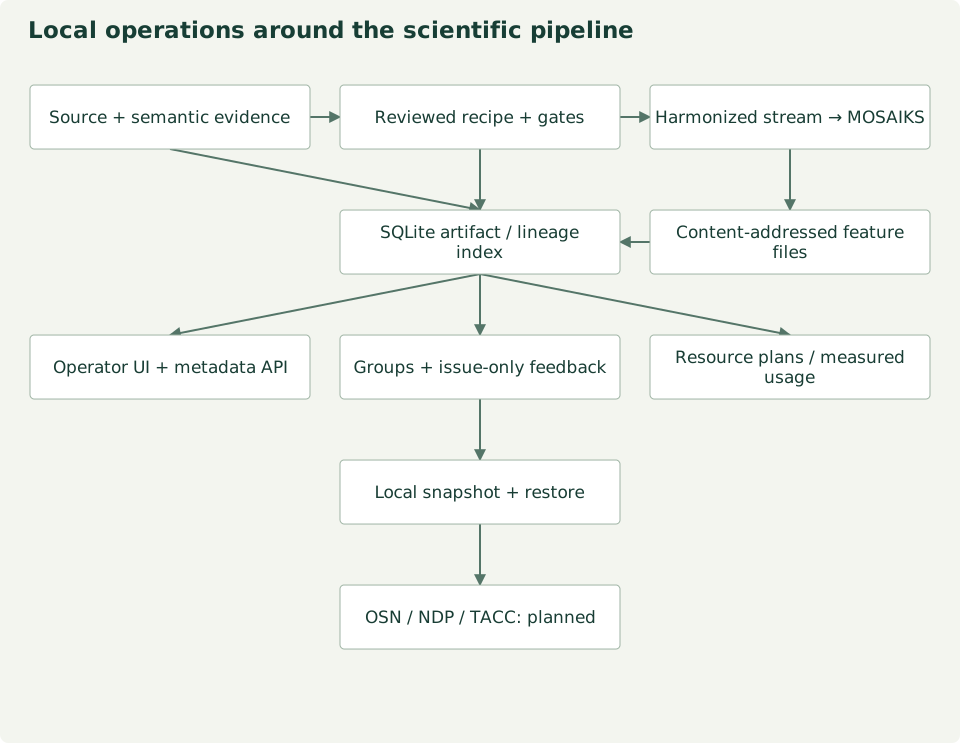
Project-authored diagram; maintained source.
| Module | Inputs | Outputs | Exclusions |
|---|---|---|---|
| Discovery and Access | ScientificRequest, access client |
DiscoveryResult with SourceResource candidates |
No encoders or scientific equivalence decisions |
| Harmonization | Resources, recipe, records, optional review/core parents | Iterator of HarmonizedObservation |
No MESA dependency or generated-code execution |
| Representation | Validated observation iterator, encoder name | Iterator of Representation |
No discovery or hidden scientific harmonization |
contracts.py defines immutable Pydantic models, rejects extra fields, and exports
JSON Schema. agents.py contains deterministic fixture roles; model_agents.py supplies four
bounded real inference roles using Ollama without tools or data-write capabilities.
orchestration.py composes the stages and writes inspectable JSON artifacts.
provenance.py exports PROV-inspired JSON-LD without a graph database.
Infrastructure boundaries
MESA is intended to supply distributed data access, iRODS tools, ontology metadata, and metadata history. It is infrastructure, not the harmonization recipe or the representation module. See the verified integration notes.
STAC is a spatiotemporal catalog/metadata standard, one part of discovery. real_data.py now
implements bounded live Sentinel STAC search and raster-window access, retains
native Items/collection/license evidence, and supplies verified offline snapshots.
Raw DN, calibration metadata, pixel support and instantaneous time stay explicit.
OpenClaw container supplies the installed
agent runtime. Local role objects exchange structured contracts; later workers
can return the same proposal artifacts. No runtime is copied. The optional OpenClaw/Verde adapter invokes the installed
llm-task plugin in an isolated container; fixture and Ollama modes remain independent.
Storage and streaming
Source descriptions, raw records, and observations are frozen models containing immutable nested contracts and tuples. Source checksum verification detects fixture changes. Content-addressed cache entries include source/version/metadata/rights, raw records, recipes, executor version, and resulting canonical observations. A source or recipe change produces a different key; obsolete entries are retained, not served under a new identity. Corrupted existing entries fail validation.
Food and water outputs have separate directories and track-bearing identifiers. Existing output directories fail rather than overwrite. Source and canonical entries use an integrity-checked read-through cache, so a second track reuses inputs and core products without fetching or executing again. Entries are published atomically without overwriting existing keys. Filesystem permissions are not an access-control or adversarial security boundary in V0.
Representation and batch interfaces consume iterators. Harmonization currently buffers the small input fixture; joins and daily aggregation need grouped inputs. General partitioned execution for joins and aggregation remains a gap; the separate bounded Sentinel path below already streams windows directly into encoders. No Kafka, graph database, or distributed scheduler is introduced.
Metadata consensus and direct streaming
The streaming harmonization module adds metadata-only specialist dialogue, digest-bound unanimous review, documented Sentinel-2 scale/offset calibration, and bounded window-to-encoder execution without raw or harmonized data files. The existing fixture/snapshot commands retain their historical materialization behavior. Current streamed vectors are reference numeric features; model consensus still requires an actual human decision before execution.
MOSAIKS over harmonized outputs
The MOSAIKS module consumes bounded harmonized raster tiles, freezes train-only empirical convolution filters, writes dense feature datasets with scientific lineage, and verifies held-out ridge-model consumption against baselines. It does not encode raw source assets. Generated diagnostics exercise the complete mechanism; independent scientific validation and real-data review remain separate requirements.
Evidence-bound review boundary
The current-state audit records the inspected implementation and observed role leakage. The additive scoped review module accepts a frozen recipe and curated evidence ledger, then returns a typed report without source-data access or execution authority. It does not rewrite historical free-text consensus results. Generated contracts and module reference describe the current code.
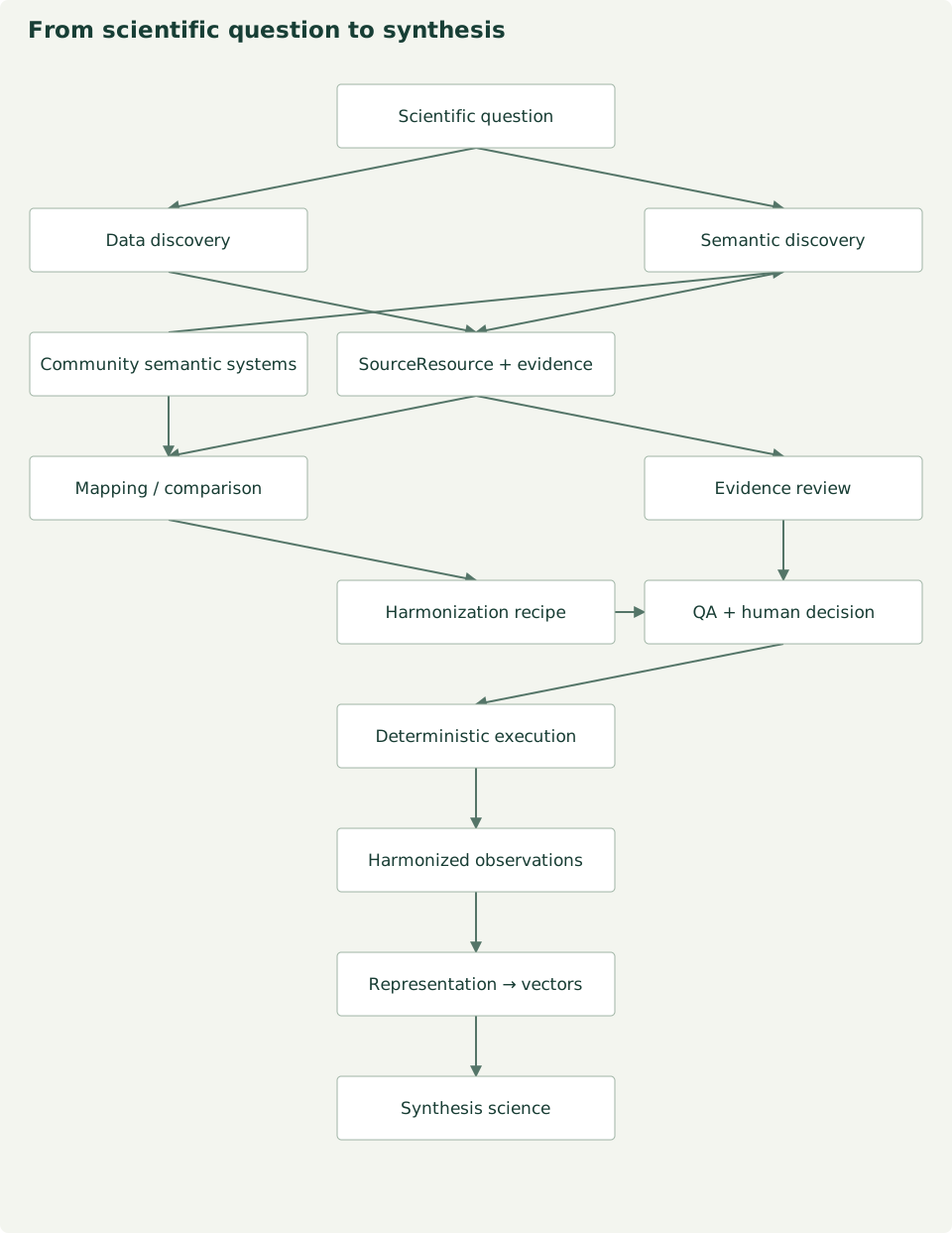
Current stage boundaries. Maintained figure source.
Data and semantic-evidence discovery
Module 1 now discovers data + metadata + semantic evidence. Optional nested
SourceSemantics preserves explicit source annotations, definitions, methods and
support with evidence kinds and source bindings. SemanticResourceRegistry is a
small semantic-resource lookup boundary, not a name for the whole architecture.
Concept candidates remain candidates. Module 2 owns mappings, reviewed recipes
and scientific interpretation; Module 3 continues to consume harmonized outputs.
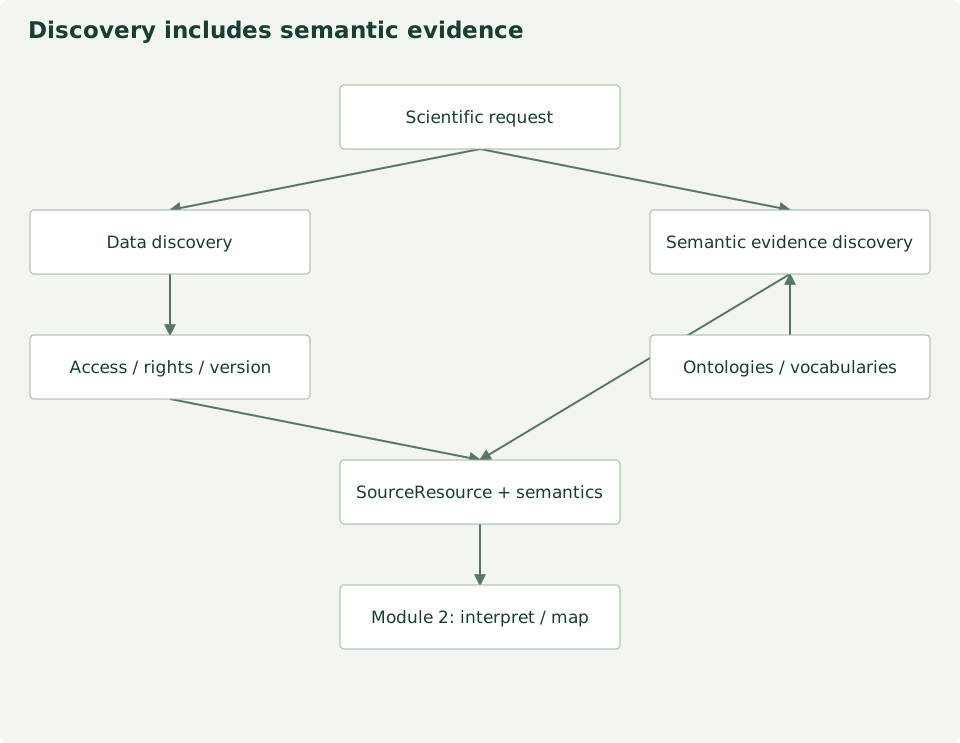
Semantic resources support discovery; they are not source observations or automatic mappings. Maintained source.
Audit · Semantics · Pipeline contracts
Deterministic backbone and model trust
VERDE interprets, selects, parameterizes, compares and proposes. It does not author scientific computation. New model plans select closed, source-bound capabilities; metadata coefficients and mathematical operations are resolved by tested code. Schema validation, scientific checks, existing vetoes and human decisions remain separate gates. Approved recipes execute without a model. See deterministic execution and model trust for the registry, IR contracts, examples, provenance and current limits.
External CubeDynamics execution
The optional CubeDynamics backend supplies seven registered, reference-bound capabilities on trusted xarray/Dask inputs. Models select operations; tested software performs them after scientific validation and exact-recipe human review. Source access remains upstream. The direct MOSAIKS bridge preserves the reviewed raster layout; support-changing aggregation/alignment needs explicit review and does not automatically establish a new representation layout. Real Sentinel vetoes and existing streaming gates remain binding.
Scientific validation update — 22 October 2026
The new scientific validation findings retain real graph measurements, canonical requirement diagnostics, scoped dataset/pair assessments and live model results. Earlier unmeasured/planned statements describe the prior architecture snapshot: depth is now measured for three local graphs, while exact scientific mappings, independent ecological validity and the weaker-model hypothesis remain unvalidated. The real Sentinel and NEON–Sentinel cases still require explicit expert decisions; no scientific execution is approved.