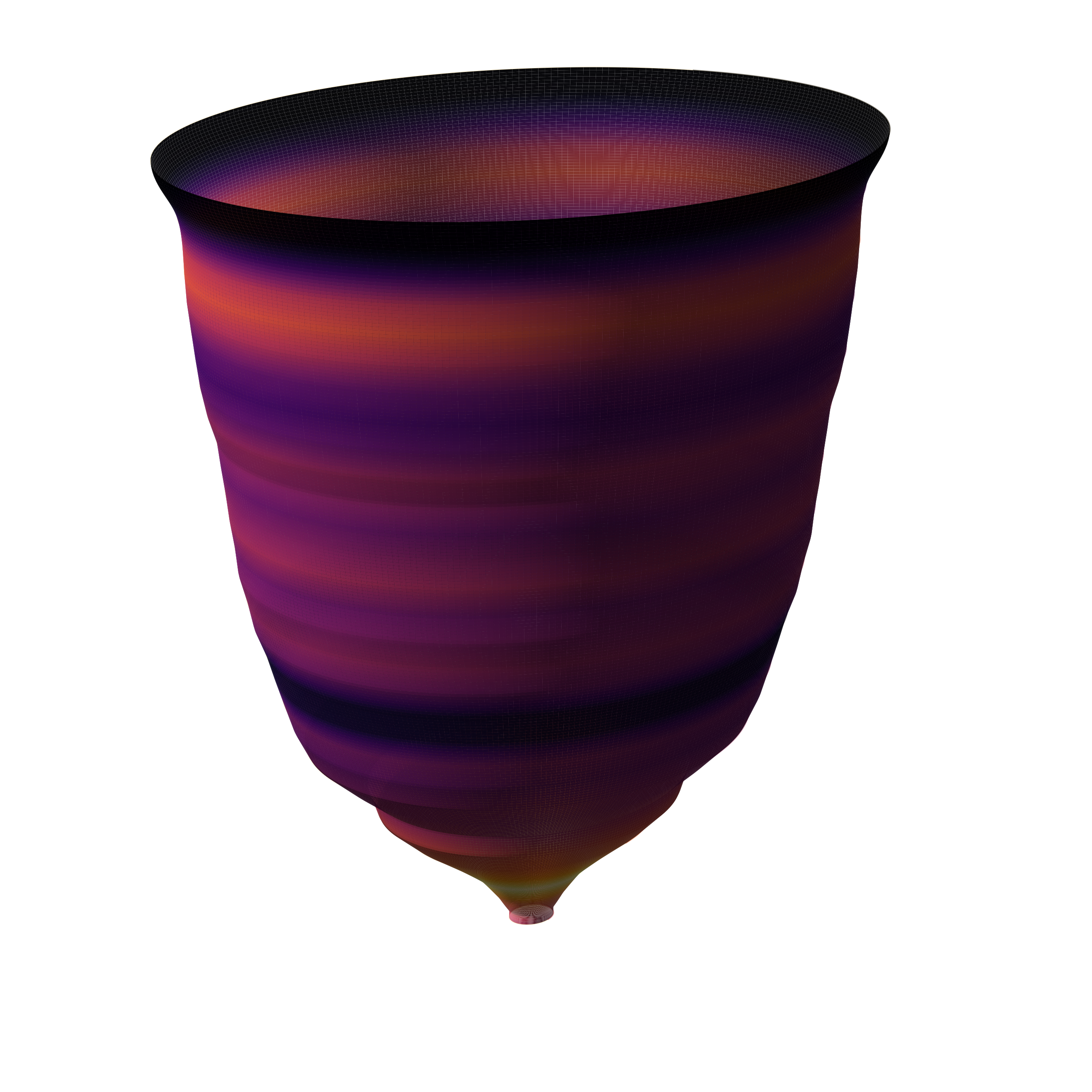
Developmental wildfire morphology
Fires have developmental histories.
Final size tells us how big a fire became. Fire VASE captures how it got there.
Fire VASE turns ordered, dated growth observations into comparable developmental trajectories. It reconstructs the observed history first, then tests weather and other possible explanations against that common response.
See how it works Explore the findings Reproduce the research
278,569 FIRED events in the reanalyzed source archive
10,246 histories with ≥3 consecutive daily observations in the primary morphospace
87,944 exact next-calendar-day transitions used in the recent-state analysis
The problem
The endpoint hides the pathway
Two fires can finish at a similar size after a similar span of time while allocating growth very differently—early, steadily, late, or in repeated pulses. Endpoint summaries collapse those sequences. Fire VASE keeps the order visible so that the developmental pathway itself becomes something scientists can compare and explain.
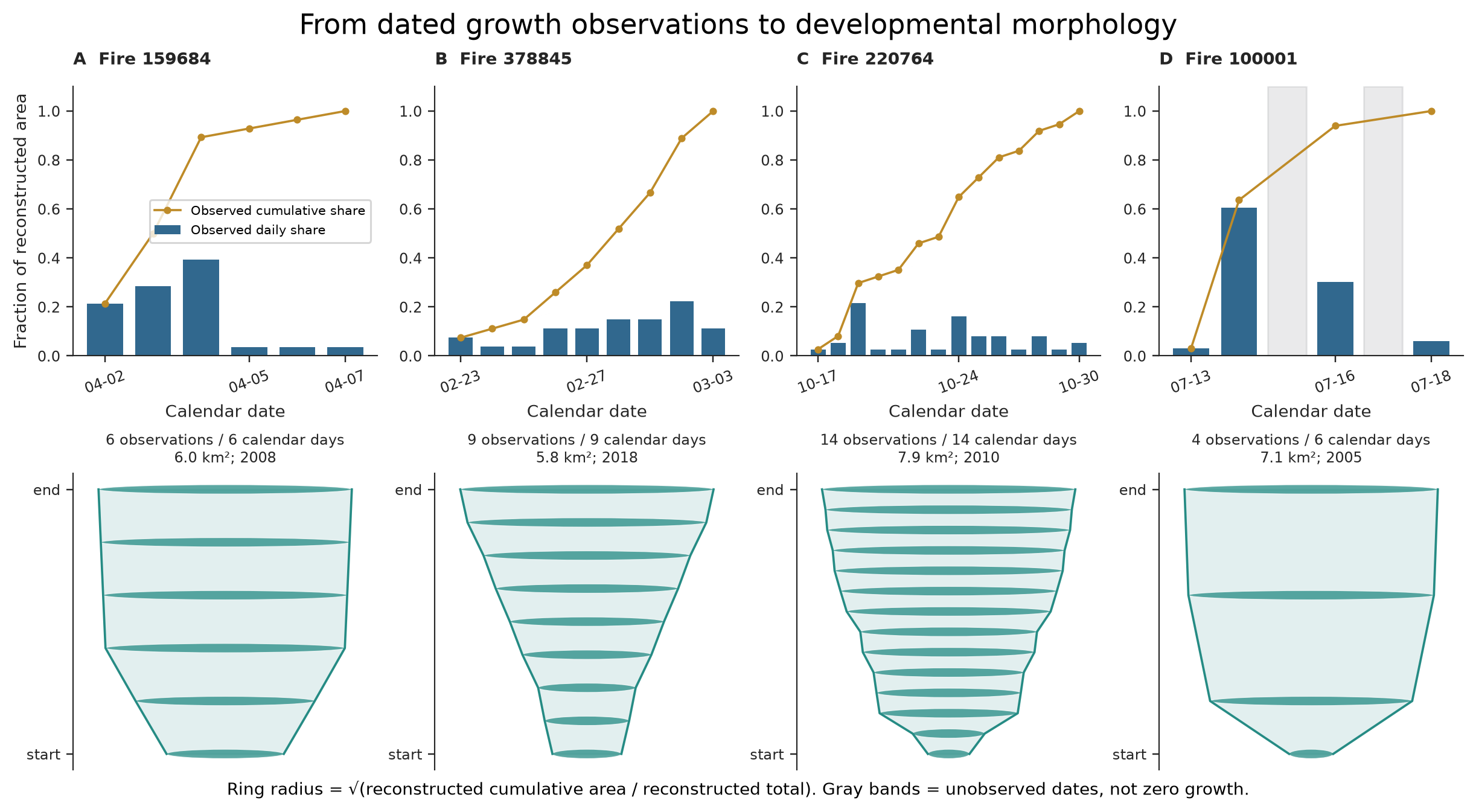
What to notice. The top row records when observed growth was added; the lower row translates that cumulative sequence into a VASE. Gray bands are unobserved dates, not zero-growth days. The primary comparative analysis therefore uses only consecutive histories. N = 10,246 for the primary morphospace; the four fires shown here are examples.
The idea
Reconstruct first. Explain second.
Weather, final area, duration, and observation count do not define the primary shape coordinates. Fire VASE first standardizes the allocation of observed growth through relative developmental time. External variables are added only afterward, making representation and explanation separate, testable steps.
→
→
→
The findings
What the evidence supports
Fires follow different developmental pathways.
Broad gradients distinguish earlier from later allocation and concentrated from more distributed growth. They are continuous coordinates, not established fire types.
5 axes · 89.4% of standardized shape variance 02 · OrderingThe order of growth contains information.
Shuffling each fire’s same observed increments changes front-loading, detected pulses, reactivations, and morphospace coverage.
0.541 vs 0.500 mean first-half allocation 03 · PredictionRecent state explains much more than weather alone.
Weather matters, but in these held-out analyses it adds little next-day predictive skill beyond recent observed fire state.
0.448 R² state baseline · +0.005 weather 04 · Open questionsSimilar weather can accompany different histories.
Matched mismatches are study candidates for fuels, terrain, active-edge conditions, ignition, suppression, and observation uncertainty—not proof of a missing causal mechanism.
49.7% vs 50.4% observed vs conditional-null mismatchConfidence
We tried to break the result.
The analysis was challenged with stricter observation thresholds, shuffled and synthetic null histories, alternative compositional geometry, blocked prediction, day-specific climate attribution, subgroup tests, independent data checks, deliberate corruptions, and a full software test suite. Broad developmental gradients and informative ordering persist; exact neighborhoods, dimensionality, weather associations, and mechanistic interpretation remain qualified.
Choose your evidence route
Go from the claim to the record
Meaning
A common response for the next layer of wildfire science
Fire VASE does not replace weather, fire-behavior physics, or endpoint summaries. It supplies a transparent response against which those explanations can be tested. The next scientific step is to align dated growth with process-specific measurements—especially fuel continuity, terrain, active-edge conditions, ignition context, and suppression—while improving observation-depth and burn-date uncertainty.
Open evidence
Inspect every layer
Data, schemas, four Jupyter notebooks, analysis and figure scripts, validation outputs, tests, provenance records, manuscript sources, and historical corrections remain available beneath this narrative.
Reproduce this research → Read the paper Read the AI accountability record