The order of growth contains information
Finding 02 · Temporal-order null model
Keeping every observed increment but changing its position changes the developmental signal.
Question
Does Fire VASE retain information about sequence, or does only the total and multiset of growth increments matter?
Answer
Sequence matters. In a separately recorded 4,000-fire sample, observed histories are more front-loaded, less pulsed, and less frequently reactivated than within-fire permutations of exactly the same increments.
shuffle the same increments
If only total growth mattered, rearranging the same increments would not systematically change order-sensitive developmental traits. Each permutation preserves the fire’s observation count, reconstructed total, and full increment multiset.
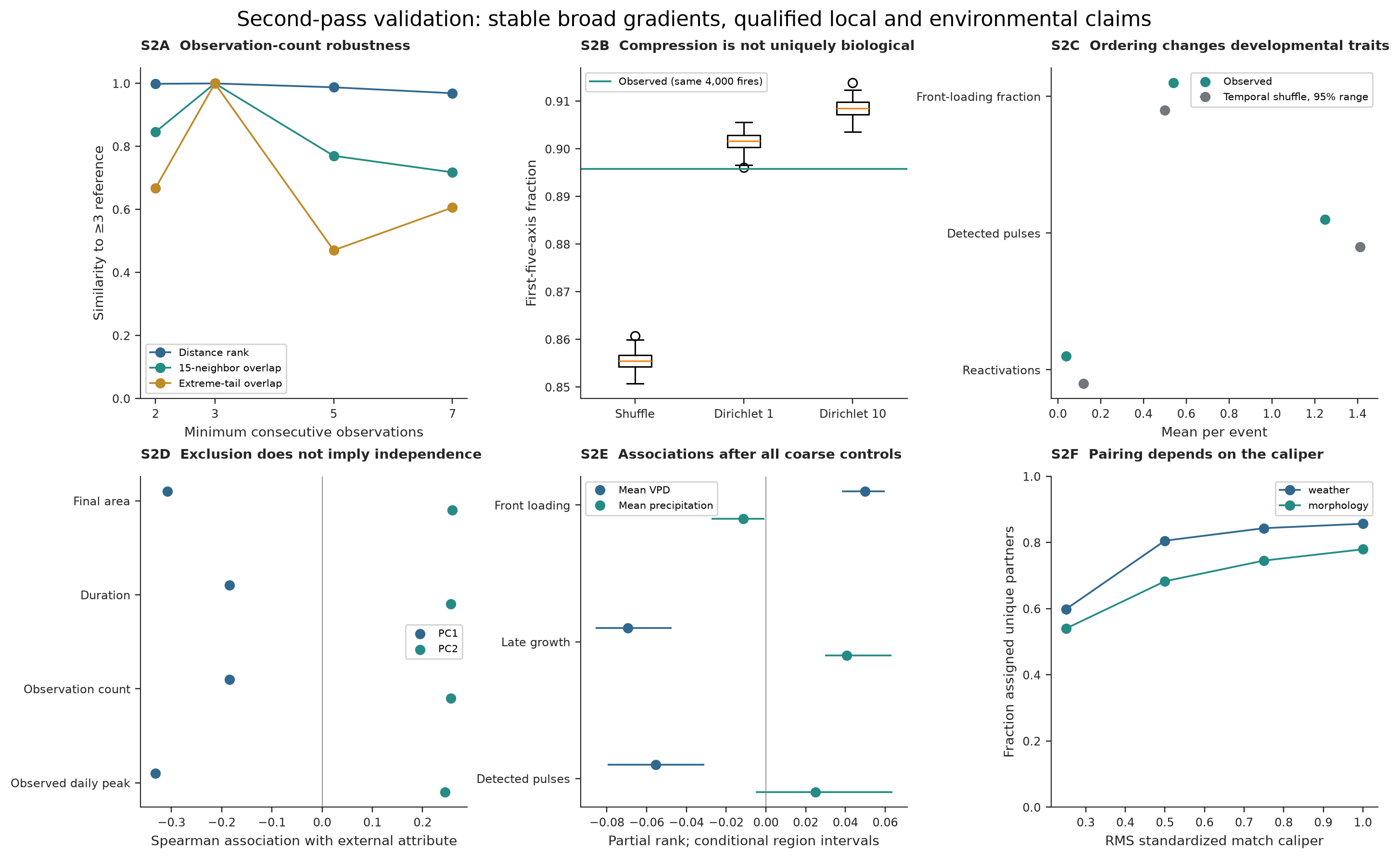
What to notice. Panel S2C compares observed trait means with the 95% range from temporal shuffles. Panel S2B shows an equally important boundary: other positive, mass-conserving allocation nulls compress as much as or more than the observed space. Ordering is informative; compression alone does not prove biological restriction. Technical caption
How to read this figure
Challenge this result. If shuffling the same increments left every order-sensitive trait unchanged, Fire VASE would be encoding little beyond totals and increment distributions. Inspect the temporal-order challenge →
Evidence trail
How well does it hold up?
One hundred replicates compare profile distances, trait distributions, landmark occupancy, and PCA summaries. Entropy remains unchanged by shuffling—as it should, because entropy ignores order. That invariant is a useful internal control on what the permutation changes.
What this does not show
The result does not prove that morphology is caused by biology, fuels, weather, suppression, or any other mechanism. The empirical tail tests are descriptive, have resolution 1/101, and are not multiplicity-adjusted. Positive normalized curves are constrained objects, so compression cannot carry the argument by itself.
Technical details
Read the null-model methods and frozen reanalysis evidence.