FIRED Geometry And Hull Sensitivity
The geometry module makes the polygon-to-hull steps visible:
- Select all daily FIRED polygons for one event.
- Reproject them to the CONUS Albers equal-area CRS (EPSG:5070).
- Simplify each daily polygon while preserving topology.
- Sample each exterior at equal arc-length steps.
- Calculate directional support radii around the centered polygon.
- Join adjacent daily support profiles with a triangulated ruled surface.
The operational simplification range is 0–125 m. The 500 m and 1000 m values are intentional stress tests that show when boundary detail and area begin to be discarded too aggressively.
from cubedynamics.validation import ValidationPaths
from cubedynamics.validation.geometry import run_geometry_validation

paths = ValidationPaths.discover()
result = run_geometry_validation(
    paths,
    fire_id=20657,
    tolerances_m=(0, 125, 500, 1000),
    operational_max_tolerance_m=125,
    n_theta=96,
)
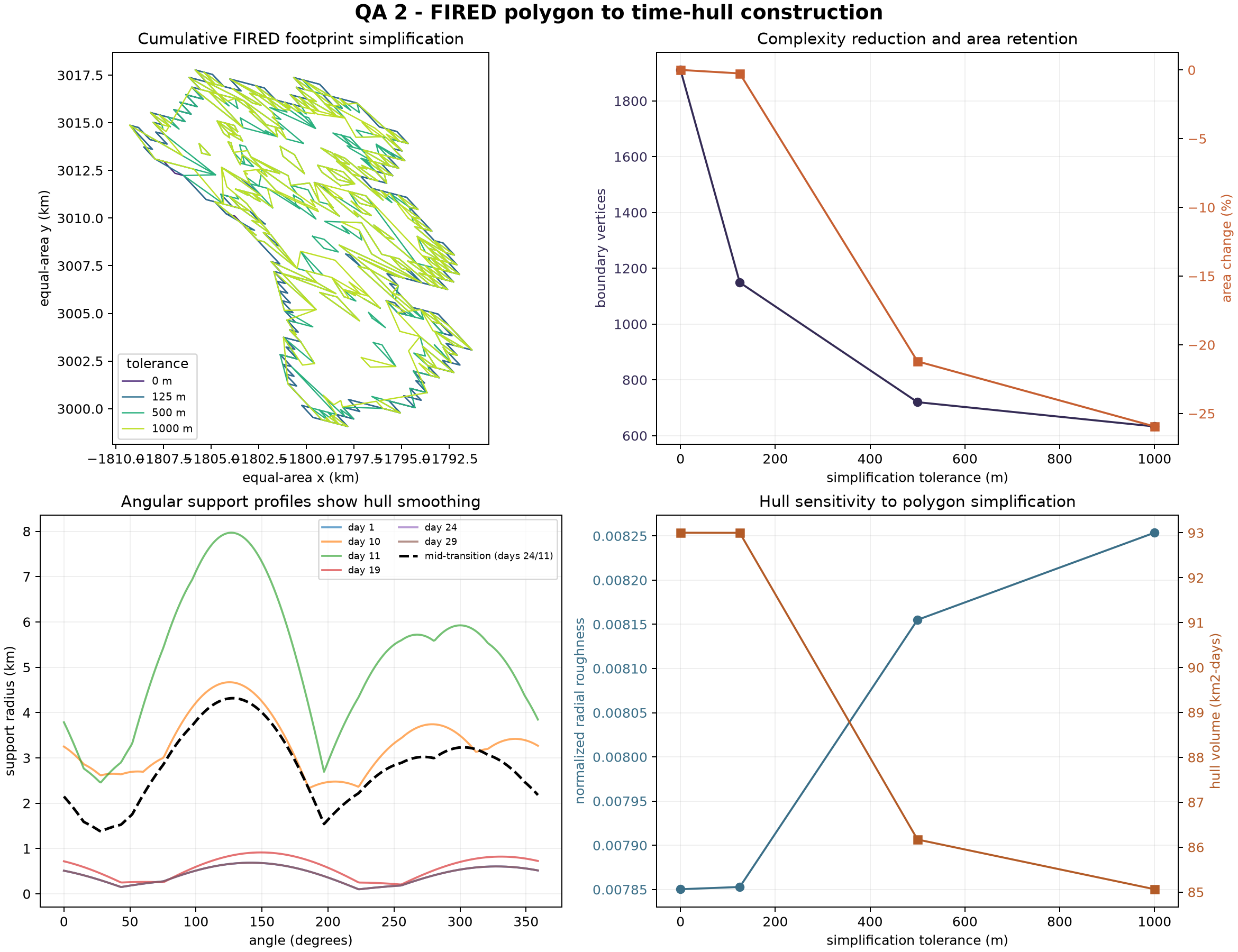
At 125 m, the sampled event changes cumulative area by only 0.254%. The two aggressive stress tests visibly change area by much more. The angular support panel shows the precise averaging performed by the hull: concavities and high-frequency boundary teeth are reduced to a directional support function, then the transition between daily profiles is linear along each hull wall.
The module writes both polygon_simplification_metrics.csv and
hull_sensitivity_metrics.csv, so tolerance and angular-resolution decisions
can be reviewed numerically as well as visually.
Continue to the three-dimensional hull audit to see these stages stacked in time and compare alternative temporal averaging decisions.