Second-generation analysis
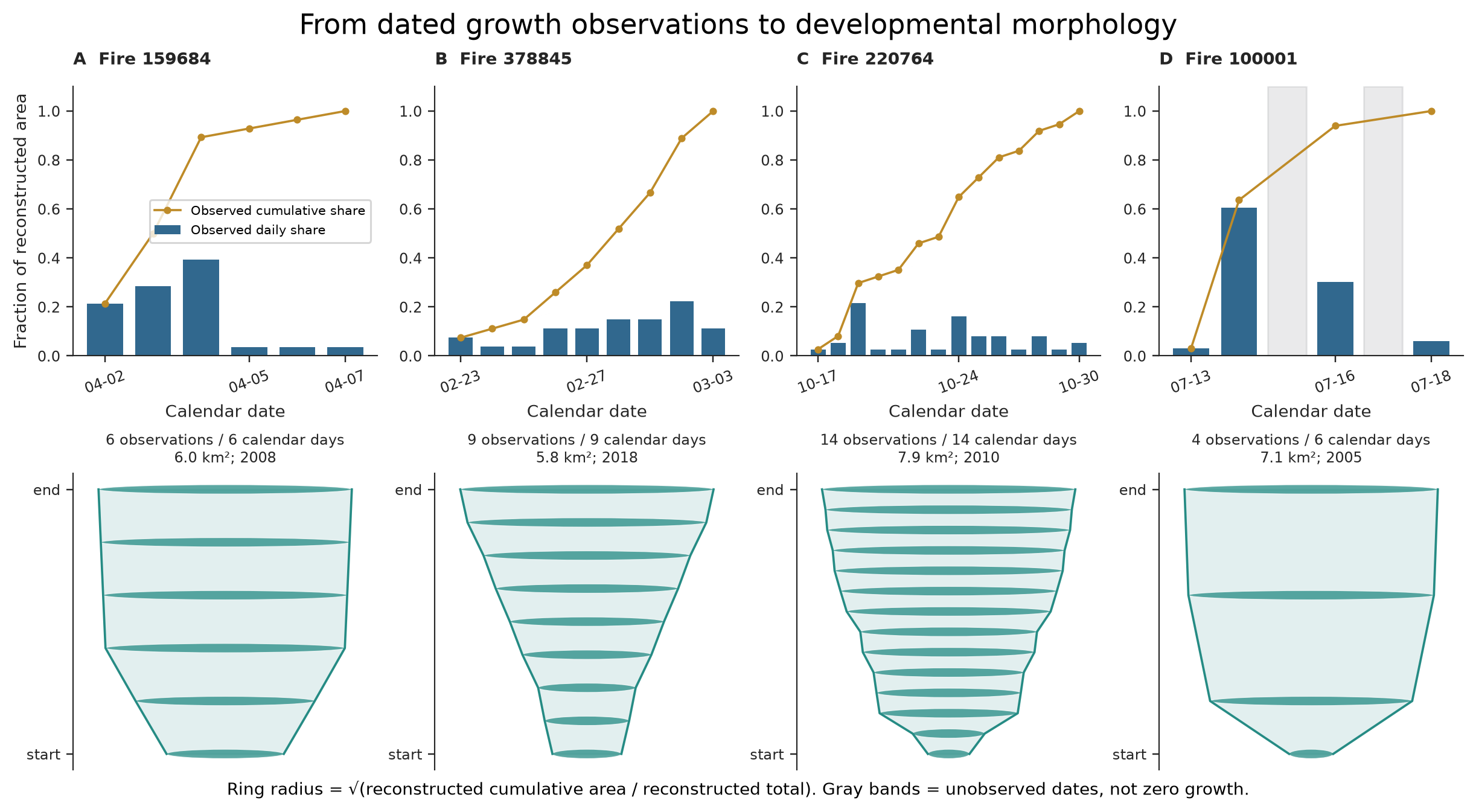
Fire VASE changes the response being explained: ordered wildfire development, not only final area, duration, or peak growth. The manuscript narrative develops that project-level argument. This page documents the corrected empirical implementation: developmental morphology is constructed before weather is considered, and weather remains an external, non-causal explanatory layer. The v2 technical manuscript supersedes the climate-centered v1 generation for quantitative claims.
The second-pass validation freezes a bounded scientific story: broad shape
gradients and nonrandom temporal ordering are supported, but event-weather
predictability is weak and heterogeneous. The supplied main-22.pdf and
supplementary-4.pdf define the current narrative; the assembled submission
PDFs and analysis/submission_freeze/ control the figures, claim sources, and
release-readiness checks.
What changed
- True observed daily peak replaces catalog area divided by duration. Entropy uses normalized reconstructed growth; it is undefined for incomplete or zero-total histories. Current catalog and reconstructed totals happen to agree.
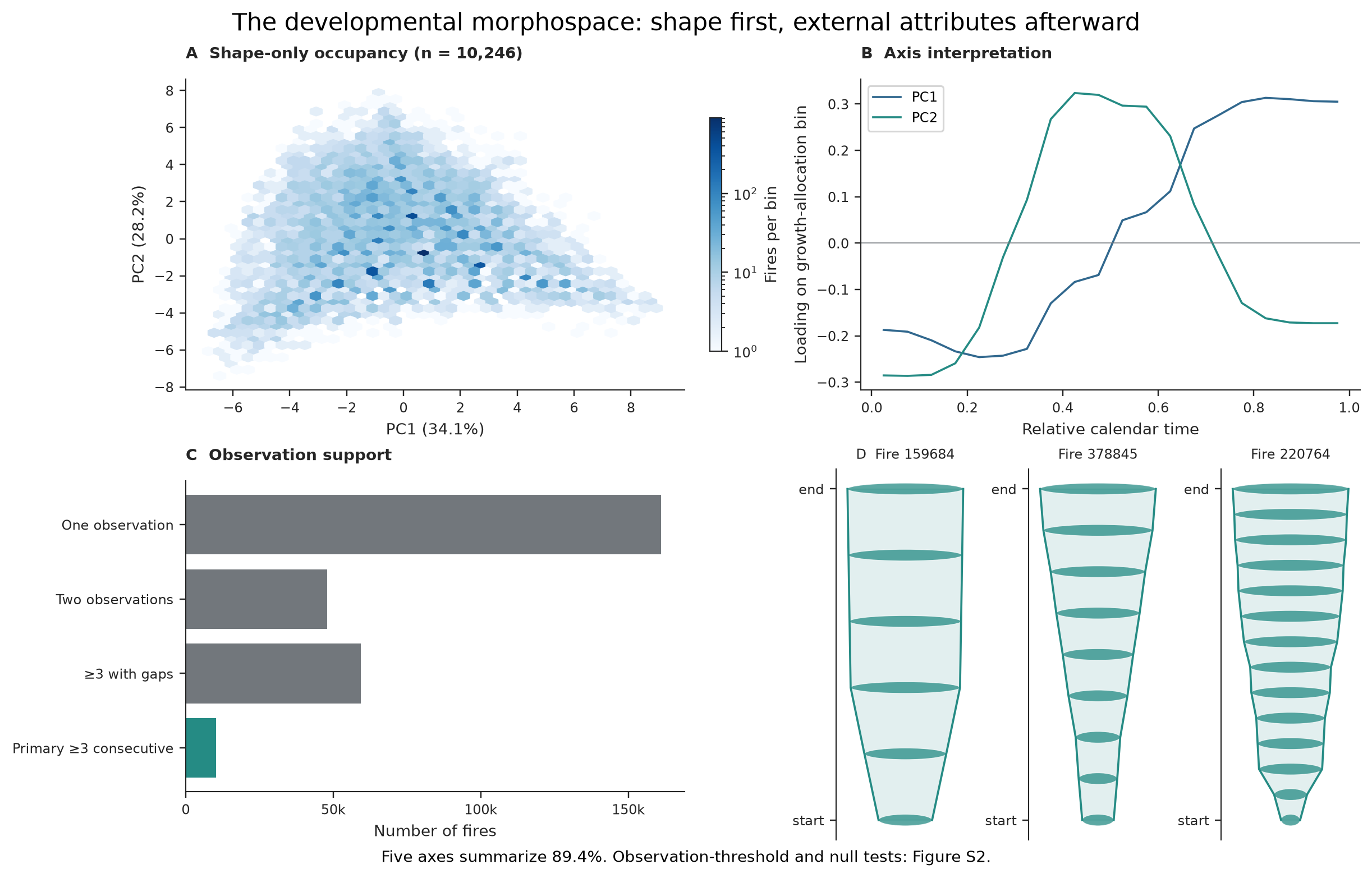
- The primary morphospace uses only normalized growth-allocation bins for 10,246 fires with at least three consecutive observations. Area, duration, observation count and weather are external attributes. PC1 explains 34.1%; five axes explain 89.4%. Neither compression nor a wedge proves biological constraint: duration/count-preserving nulls also compress strongly.
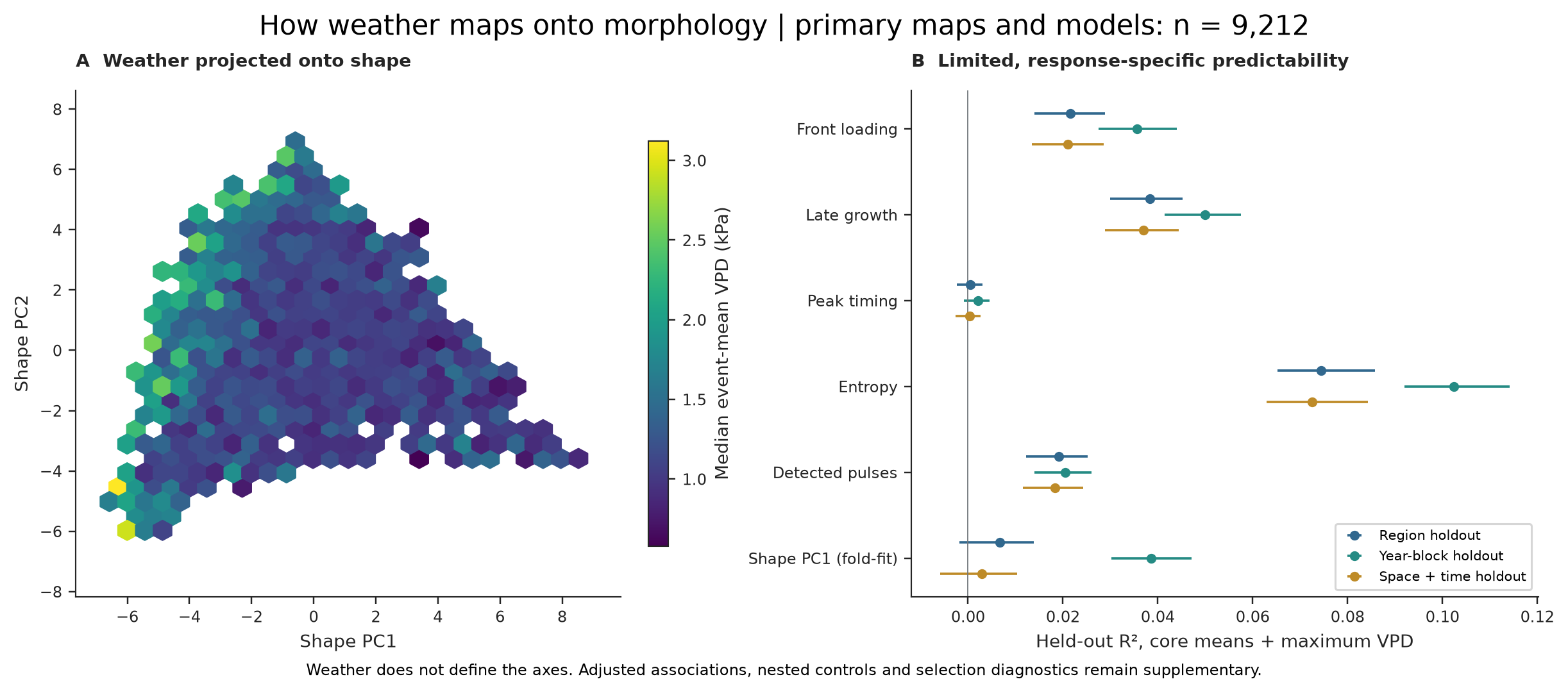
- Nested event-weather models share 9,212 complete primary fires and use region, year-block and strict crossed spatiotemporal holdouts. The old 0.349 cross-response median is withdrawn; each response is reported separately.
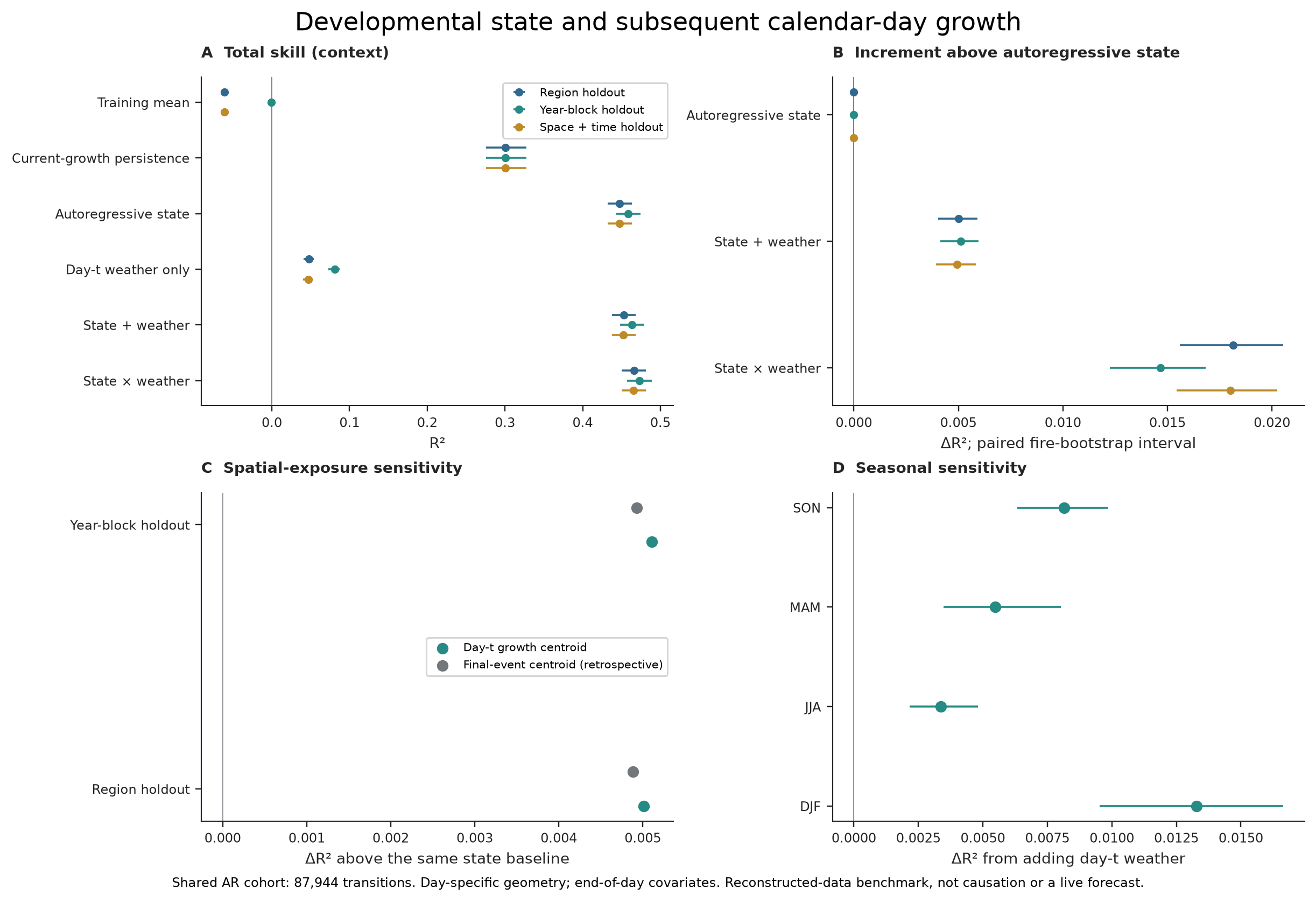
- Only exact calendar-day transitions are used for subsequent growth. Weather is sampled at day-t newly burned-area centroids, not final-event centroids. The shared autoregressive cohort has 87,944 transitions from 31,700 fires. Additive weather gives a small regional increment (~0.005 R²); interactions give ~0.018 above state. These are reconstructed-data associations/predictions, not proof of causation or information availability in an operational system.
- Matching uses unique partners, declared calipers and nuisance strata. Representative median-mismatch examples replace adversarial maxima. Observed mismatch rates are compatible with conditional permutation ranges; mechanistic interpretations remain hypothesis-generating.
What survived scientific validation
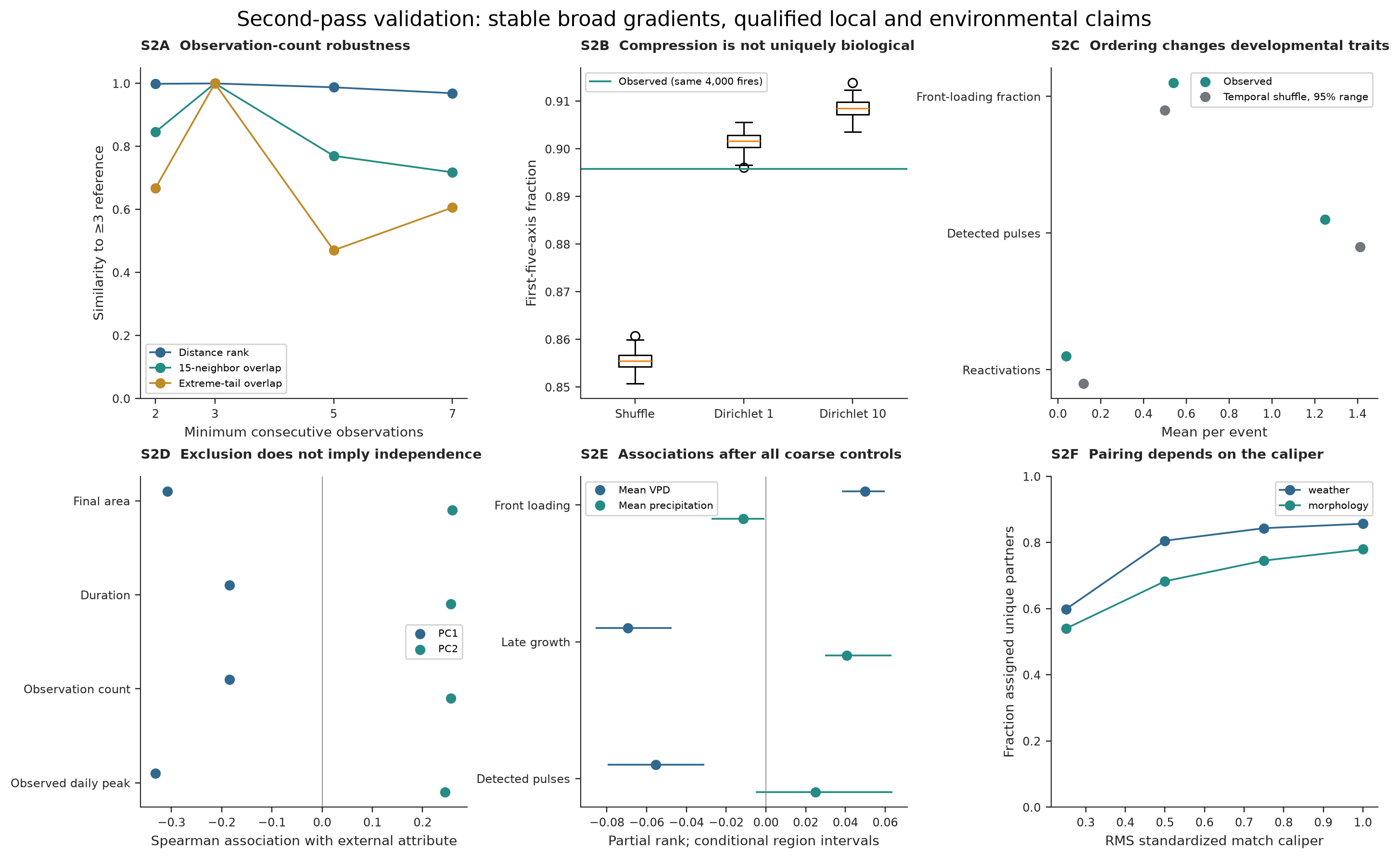
At least seven consecutive observations leaves 1,171 fires. Relative to the primary fit, five-axis distance ranks on shared anchors correlate 0.969, but 15-neighbor overlap is 71.8% and five-axis coverage falls to 74.2%. Broad gradients are more stable than exact local neighbors or extreme exemplars.
In a recorded 4,000-fire sample, first-half growth allocation averages 0.541 versus 0.500 after shuffling the same increments, and detected pulses average 1.249 versus 1.413. This supports nonrandom observed ordering, not a uniquely biological low-dimensional wedge. Excluded endpoint attributes remain moderately associated with shape. No formal test establishes the absence of latent classes.
Adding year to duration/count/area/region/month controls leaves small weather associations: mean VPD versus late allocation has partial rank correlation -0.069; precipitation versus pulses is only 0.025, with a regional interval including zero. The weather-complete population is CONUS-only in these inputs.
VPD-by-current/prior growth products add about 0.006-0.012 R² above the other weather interactions across holdouts. This is supported with caveats: coefficients vary by region, fire size and partial edge years; all exposures are reconstructed end-of-day observations. Matching caliper sensitivity confirms design-dependent coverage, not ecological mismatch prevalence.
The repository's analysis/scientific_validation/ contains the 26-point final
report, correction audit, complete A-M claim matrix, scientific story, and
PRISM_HANDOFF.md. Those files control manuscript interpretation; the original
analysis/v2/ remains the separately identified candidate baseline.
Reproduce
Use the existing real data lake; absent required inputs raise an error. No new external data download or synthetic fallback is part of this workflow.
PYTHONPATH=src:scripts OPENBLAS_NUM_THREADS=1 MPLCONFIGDIR=/tmp/fire-vase-v2-mpl .venv/bin/python manuscript_figures/00_run_all.py --generation v2 --data-lake data_lake/fire-vase-data-lake-v0.1
.venv/bin/python -m pytest tests/test_analysis_v2.py -q
The configuration is config/analysis_v2.json, seed 20260828. Use
--render-only with the figure command after successful statistics generation.
The full pipeline also runs the bounded scientific-validation stage. To rerun
only that stage or verify its artifacts:
PYTHONPATH=src:scripts MPLBACKEND=Agg MPLCONFIGDIR=/tmp/fire-vase-v2-mpl OPENBLAS_NUM_THREADS=1 .venv/bin/python scripts/validate_fire_vase_science.py
PYTHONPATH=src:scripts MPLBACKEND=Agg MPLCONFIGDIR=/tmp/fire-vase-v2-mpl .venv/bin/python scripts/verify_fire_vase_science.py
The missing shared cube-contract helper has been restored. Full test collection passes: 152 tests passed and 2 were intentionally skipped; no modules are excluded. Dedicated v2, scientific-validation, compositional, and adversarial tests are included. The v1 comparison is deliberately separate:
PYTHONPATH=scripts/figures:scripts:src .venv/bin/python scripts/reproduce_v1_comparison.py
Outputs and provenance
| Output | Repository location |
|---|---|
| Audit and old/new conclusions | analysis/v2/audit_report.md, issue_audit.csv |
| Per-event growth/entropy/date audit | analysis/v2/event_semantic_audit.csv.gz |
| PCA, nulls, stability and every model comparison | analysis/v2/*.csv |
| Source and exposure provenance | input_audit.json, input_hashes.json, day_t_weather_manifest.json in analysis/v2/ |
| Code/configuration/output hashes | analysis/v2/run_manifest.json, publication_manifest.json |
| Five main figures and four supplements, PDF/PNG/SVG | figures/submission/ |
| Second-pass audit, claims, stress tests, handoff and frozen hashes | analysis/scientific_validation/ |
| Final adversarial null/depth/boundary package | analysis/scientific_validation/final_adversarial_pass/ |
| Submission PDFs and assembly manifest | output/submission/ |
| Claim registry, consistency audit, final matrix and readiness | analysis/submission_freeze/ |
| Preserved references and reproduced v1 outputs | archive/comparison_v1/ |
Large regenerable Parquet tables remain local and ignored by Git. The source package retains its FIRED/gridMET citation and reuse terms. No data are relicensed by this analysis. The full manuscript describes the strict cohort's selection limits, conditional rather than refitted-model uncertainty, the small number of region clusters, satellite/date uncertainty and matching assumptions.
Figures
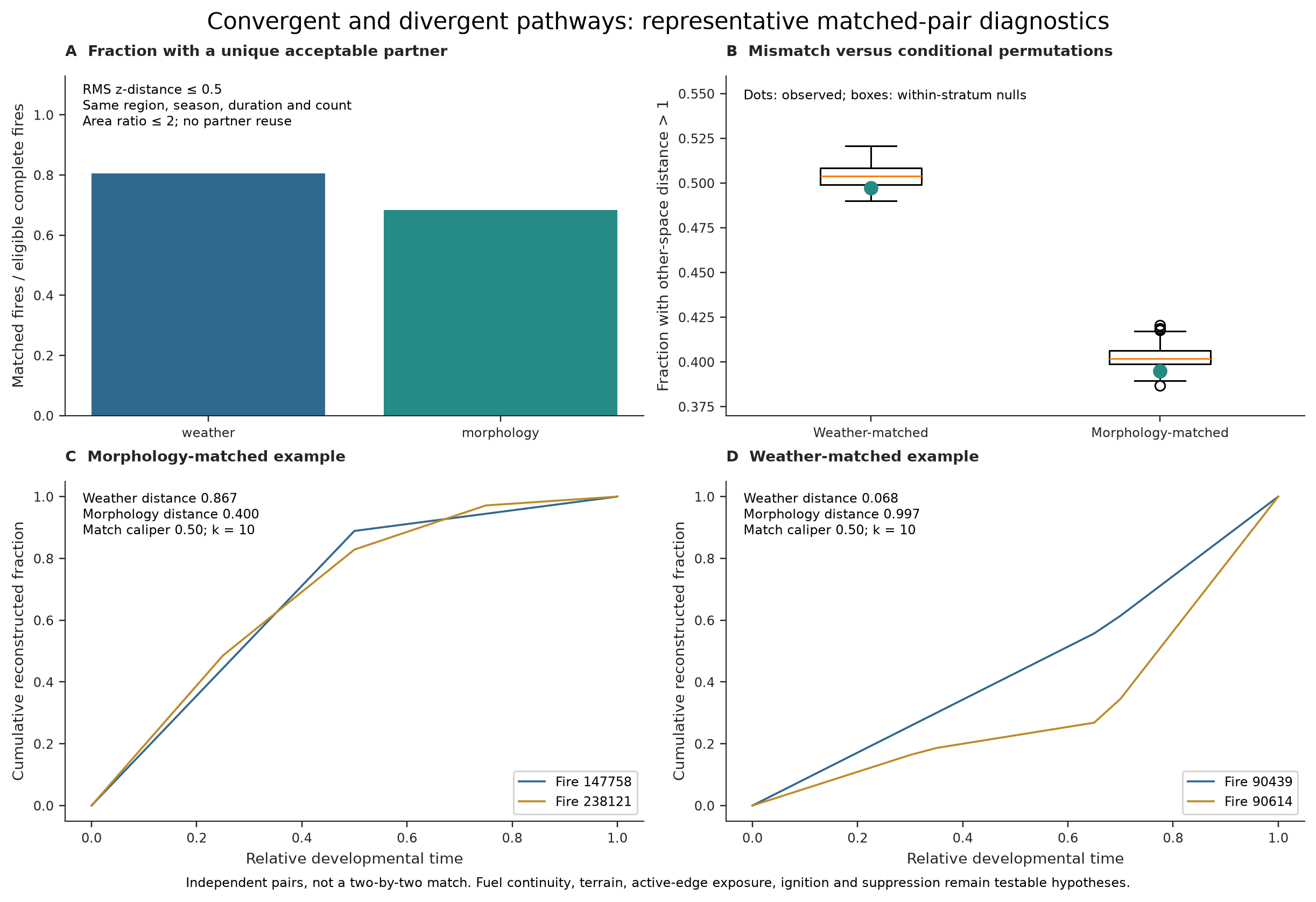
Second-pass supplements
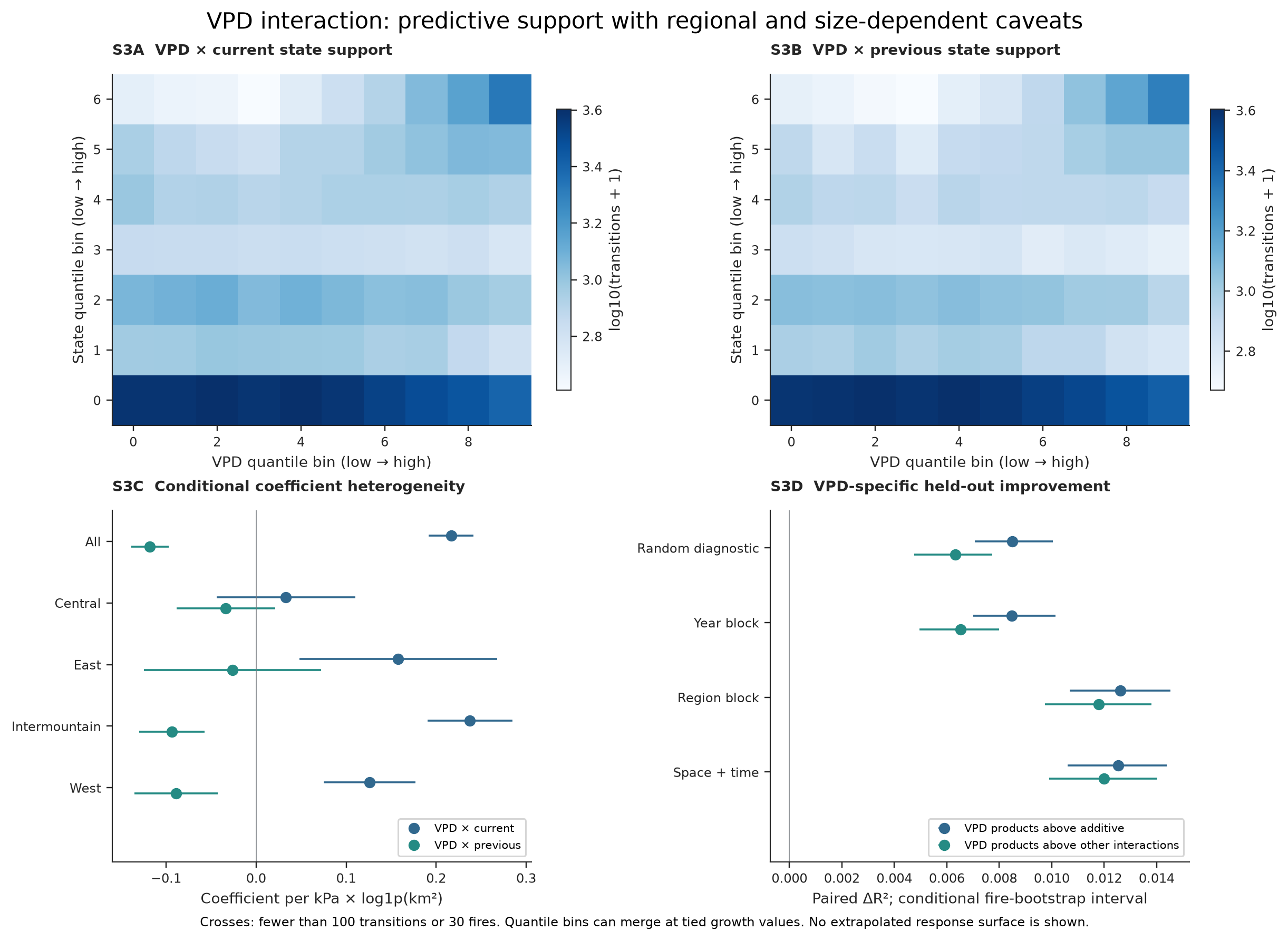
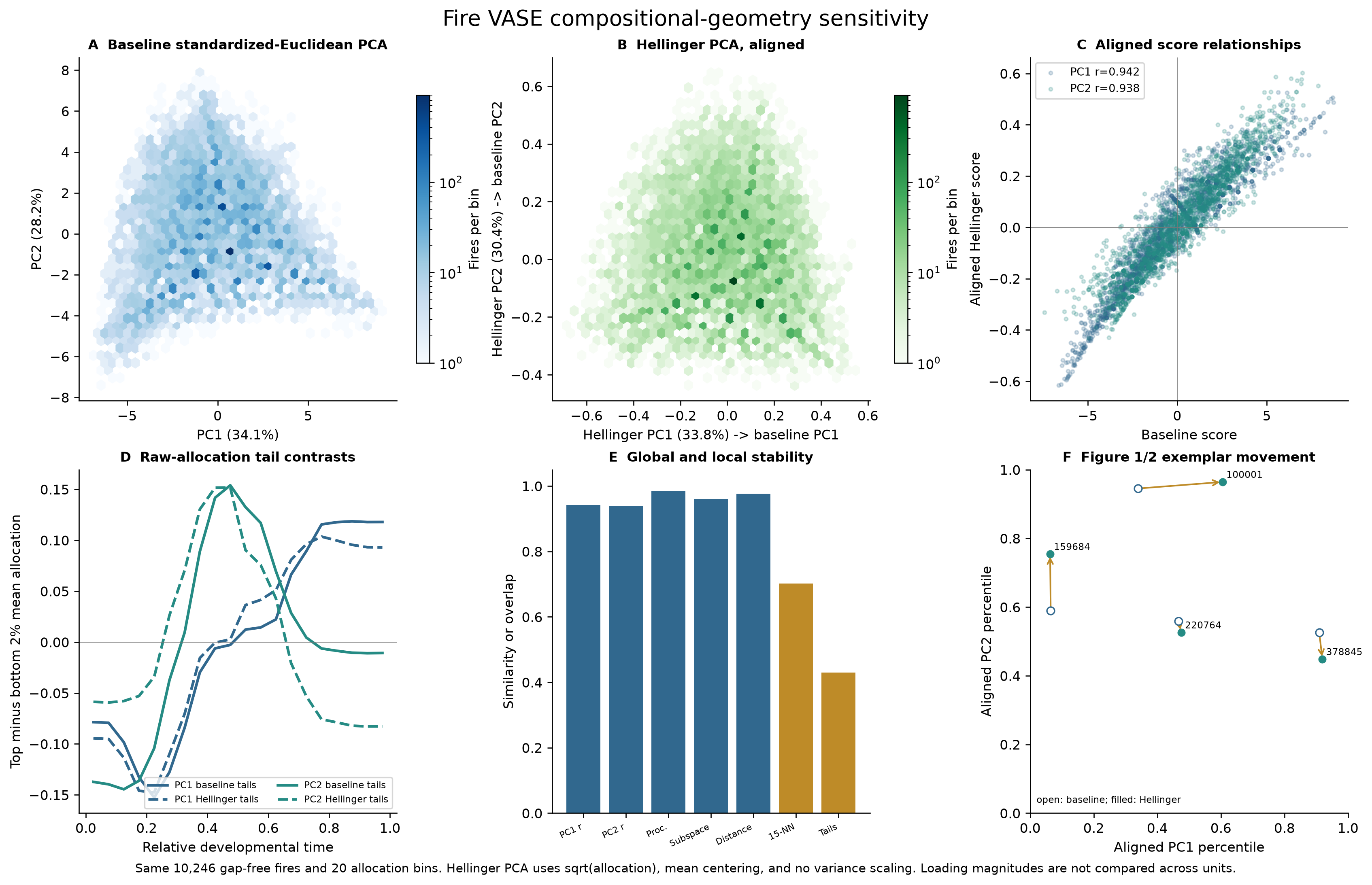
Final adversarial pass
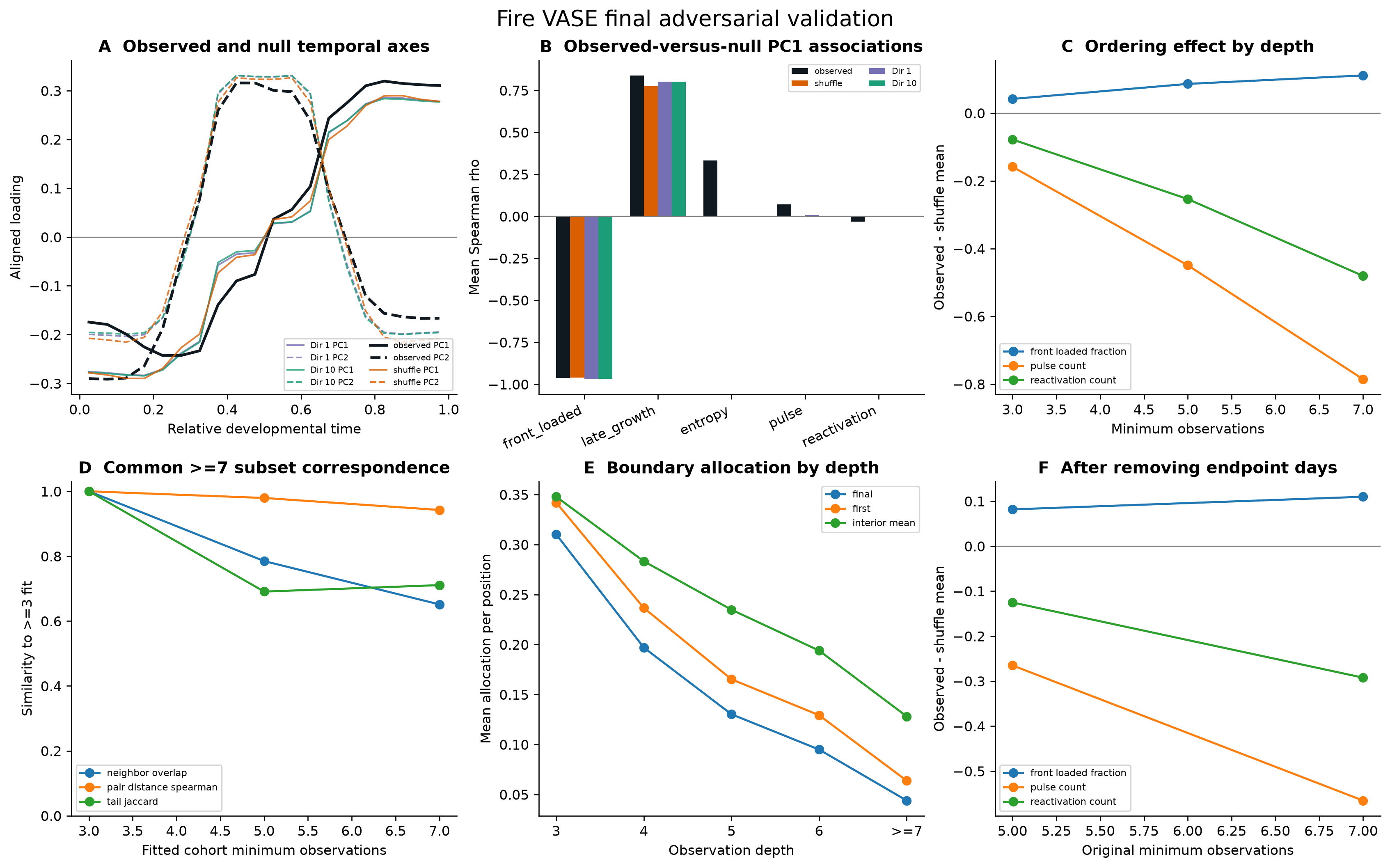
Positive, mass-conserving null histories also form compressed score spaces, so low dimensionality alone is not evidence of biological restriction. The observed early/late axis has near-zero same-fire alignment to null axes, and the ordering effects retain direction at minimum depths of 3, 5, and 7 observations and after removing both endpoint days. The >=3 cohort remains primary; >=5 and
=7 are stronger-support sensitivities.