Fires follow different developmental pathways
Finding 01 · Developmental morphology
The primary morphospace reveals broad, reproducible gradients in when observed growth is allocated—not a catalog of discrete fire types.
Question
Can observed wildfire histories be compared on common developmental coordinates without defining those coordinates by final size, duration, or weather?
Answer
Yes. A 20-bin shape-only representation places 10,246 consecutively observed fires in a shared space. Its leading gradients contrast earlier with later allocation and concentrated with more distributed growth. Five axes summarize 89.4% of standardized variance.
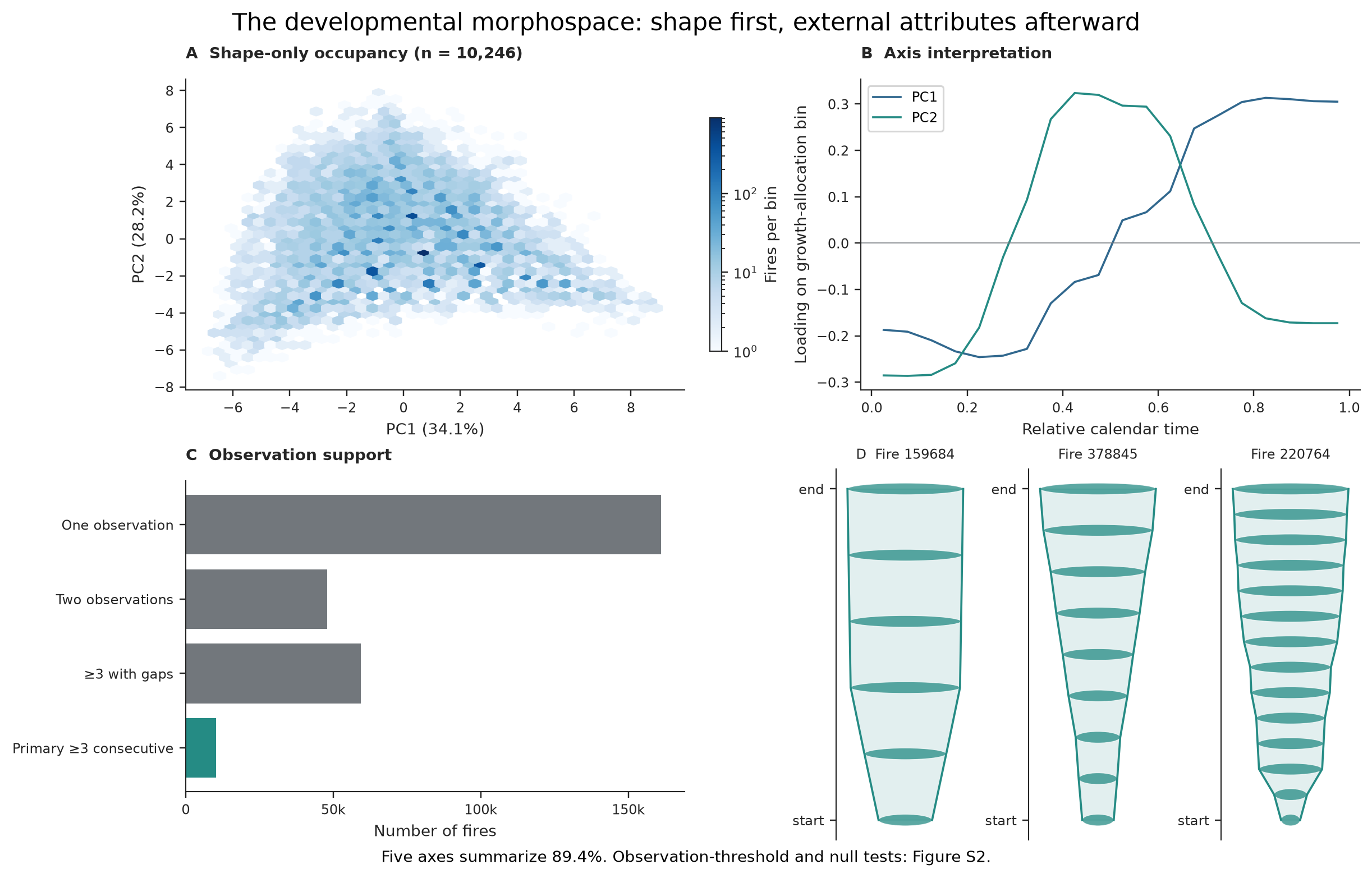
What to notice. The occupied space is broad and continuous. PC1 (34.1%) separates earlier from later allocation; PC2 (28.2%) contrasts middle-concentrated with more endpoint-weighted allocation. The example VASEs are landmarks along gradients, not named natural classes. The lower-left census shows why the strict cohort must not be presented as all fires. Technical caption
How to read this figure
Challenge this result. If the gradients vanished under stricter observation requirements or another valid compositional geometry, they could be artifacts of short records or an analysis choice. See what those tests found →
Evidence trail
analysis/v2/ PCA scores, loadings, variance, and sensitivity tablesWhat we measured
Each consecutive history was transformed into 20 nonnegative relative-time allocation bins summing to one. The PCA used those bins only. Final area, duration, observation count, absolute peak, mean growth, slenderness, and weather were projected later rather than used to define the axes.
How well does it hold up?
- At ≥7 consecutive observations, 1,171 fires remain. Distance ranks on shared anchors correlate 0.969 with the primary space, although 15-neighbor overlap falls to 71.8% and five-axis coverage to 74.2%.
- Five-dimensional bootstrap subspace overlap has median 0.999 with a 2.5–97.5% range of 0.998–1.000.
- Hellinger compositional geometry preserves the broad structure but changes some local neighborhoods and extreme exemplars.
- Null allocations also compress, so low dimensionality alone is not evidence of a uniquely biological constraint.
What this does not show
This analysis does not establish natural fire classes, independence from endpoint attributes, transfer to long or intermittently observed fires, or a universal restricted wedge. PC1 remains moderately associated with final area, duration/count, and observed daily peak even though those quantities were excluded from fitting.
Technical details
See growth and shape coordinates, second-pass validation, and the complete figure gallery.