Expanded AI Transparency Report
Date generated: 2026-08-12
This document expands the short manuscript AI transparency statement into a
repository-auditable report. It is generated by
scripts/generate_ai_transparency_report.py
from the project record: the existing prompt-log-basis statement, archived
formal reviews, citation/compliance audits, analysis reports, tests, schemas,
figure outputs, notebooks, and reproducibility metadata.
Scope And Limitation
The repository currently preserves a prompt-log-derived project record, but it does not include a raw, line-by-line private chat transcript as a standalone file. The statistics below therefore quantify documented AI-assisted work preserved in the repository, not every private prompt ever typed during the project. If a raw prompt log is added later, rerun the generator and extend its source list so these counts can become transcript-level rather than artifact-level.
Manuscript-Ready Statement
OpenAI Codex/ChatGPT was used as an AI-assisted coding, analysis, visualization, documentation, and editorial tool during development of Fire VASE. AI assistance included data-lake and lakehouse scripting, climate attribution workflows, morphospace and validation analyses, figure rendering, website and notebook documentation, manuscript drafting and revision, simulated review, citation auditing, and reproducibility checks. The AI system did not originate the underlying FIRED, MODIS burned-area, gridMET, PRISM, or other observational data; did not make final scientific judgments independently; and is not listed as an author. Human investigators directed the analyses, selected the scientific claims, reviewed code and outputs, verified calculations and citations where reported, and remain responsible for the integrity, interpretation, and final manuscript.
What AI Was Used To Do
The current prompt-log basis contains 9 documented assistance items. Items can map to more than one category, because a single prompt may combine, for example, figure generation, testing, and manuscript revision.
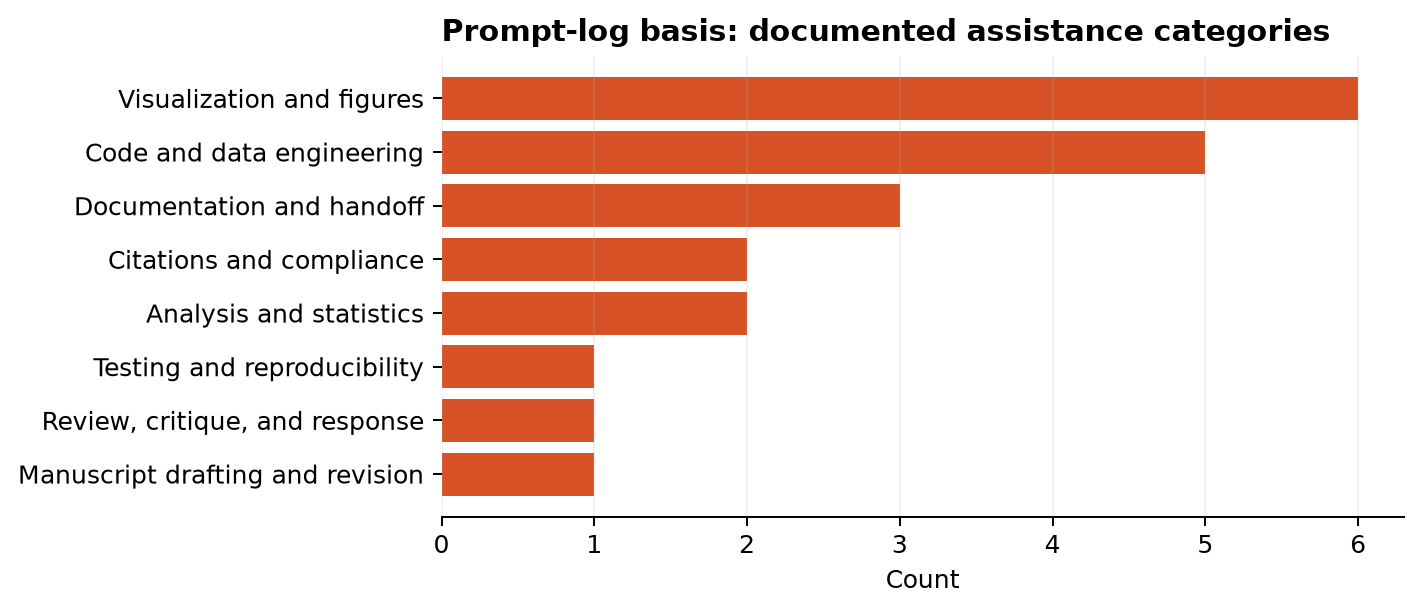
| category | count |
|---|---|
| Visualization and figures | 6 |
| Code and data engineering | 5 |
| Documentation and handoff | 3 |
| Analysis and statistics | 2 |
| Citations and compliance | 2 |
| Manuscript drafting and revision | 1 |
| Review, critique, and response | 1 |
| Testing and reproducibility | 1 |
What The Work Produced
AI-assisted work is visible in repository artifacts rather than only in prose. The inventory below counts current tracked project products by broad type. Some artifacts were created directly with AI assistance; others were generated or organized through AI-assisted scripts and documentation workflows.
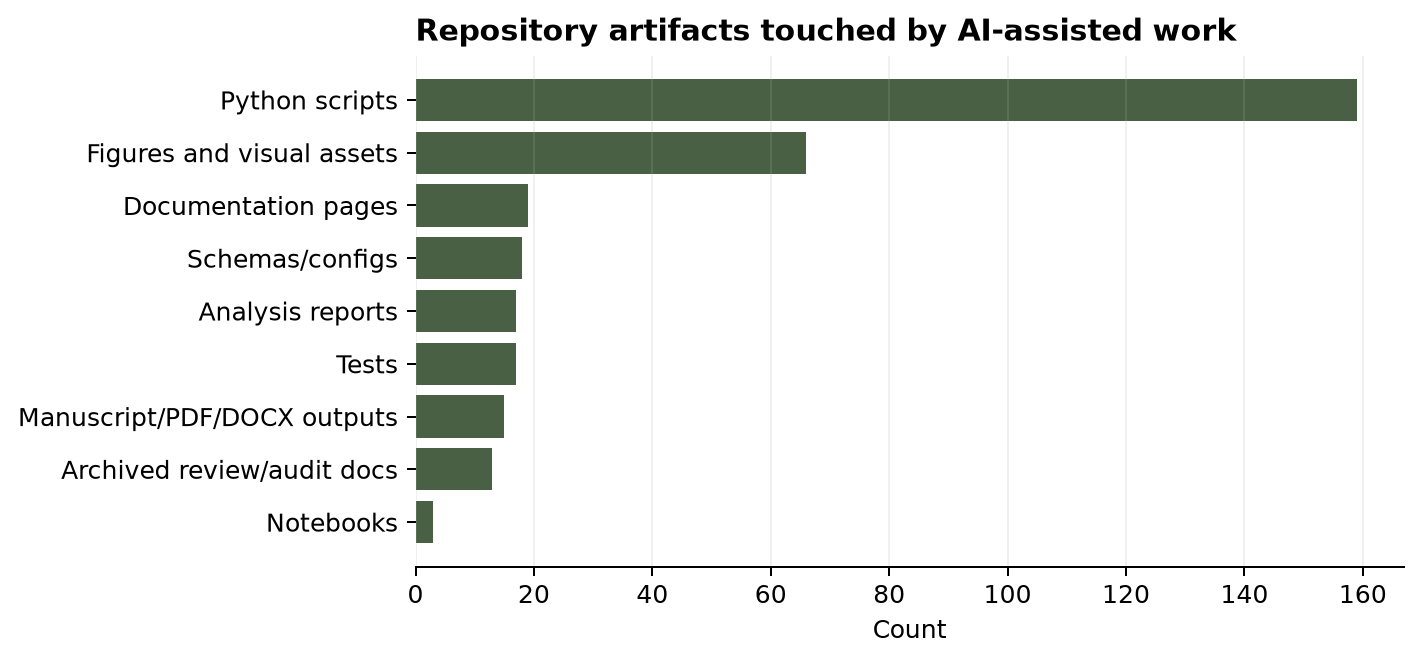
| artifact_group | count |
|---|---|
| Python scripts | 159 |
| Figures and visual assets | 66 |
| Documentation pages | 19 |
| Schemas/configs | 18 |
| Tests | 17 |
| Analysis reports | 17 |
| Manuscript/PDF/DOCX outputs | 15 |
| Archived review/audit docs | 13 |
| Notebooks | 3 |
How AI Use Was Vetted
The project record includes review, audit, reproducibility, and validation artifacts that constrain what AI-generated or AI-assisted work could be used for. These records include formal simulated review rounds, citation audits, author-guideline checks, claim audits, reproducibility reports, and figure validation tables.
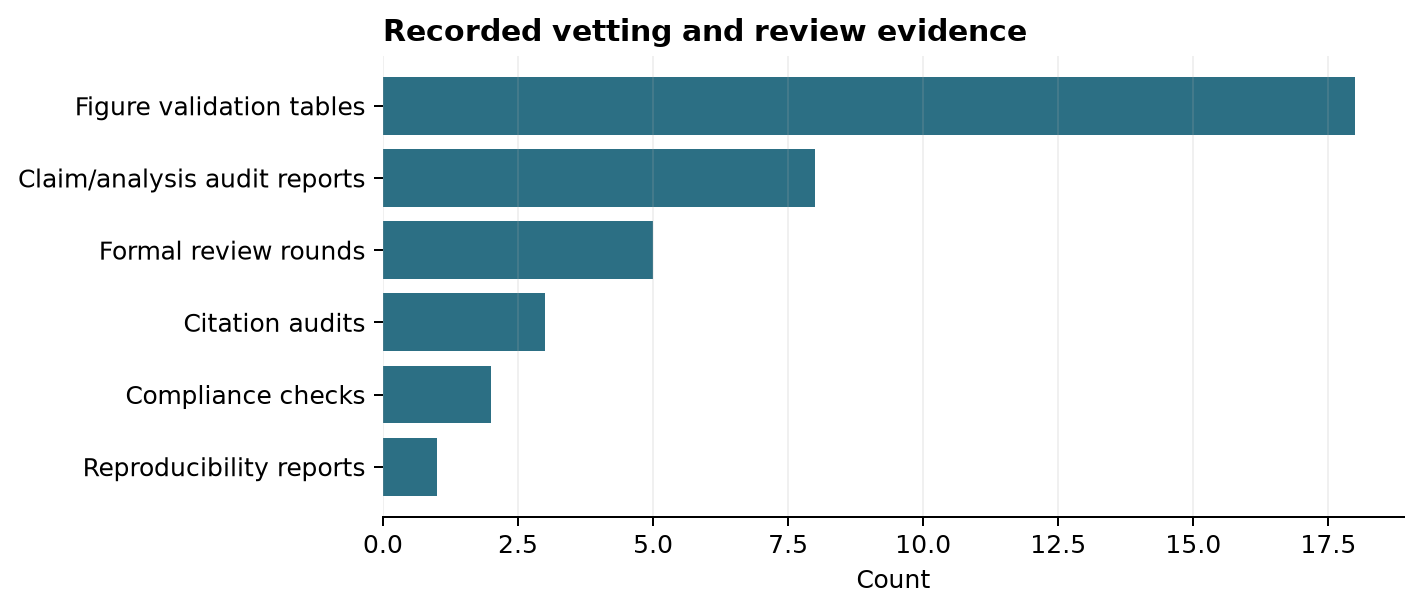
| vetting_record | count |
|---|---|
| Figure validation tables | 18 |
| Claim/analysis audit reports | 8 |
| Formal review rounds | 5 |
| Citation audits | 3 |
| Compliance checks | 2 |
| Reproducibility reports | 1 |
Latest recorded checks: data lake pass, derived statistics pass, figure pixels fail.
Tests Implemented
The repository currently contains 81 test functions across 17 test files. The tests emphasize the Fire VASE geometry/API surface, rendering behavior, lakehouse/cache contracts, and real-data smoke checks.
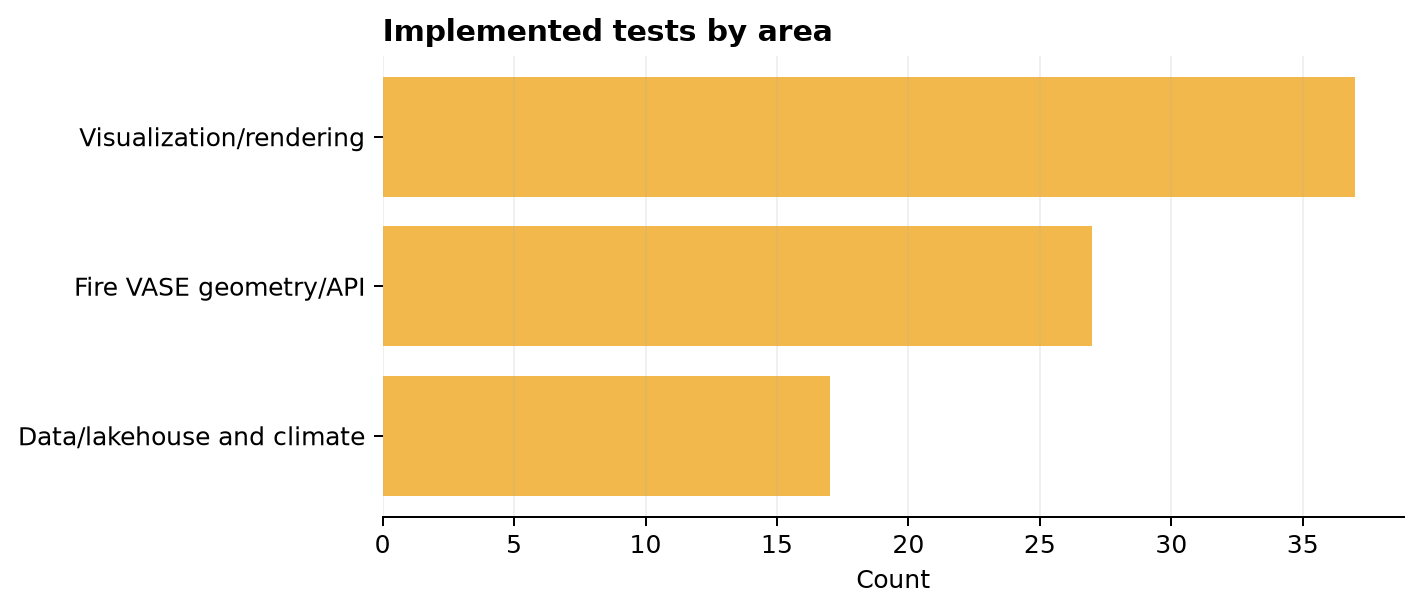
| area | test_count |
|---|---|
| Visualization/rendering | 37 |
| Fire VASE geometry/API | 27 |
| Data/lakehouse and climate | 17 |
Evidence Categories In Repository Text
The generator classified 54 Markdown/TXT evidence files by dominant keyword category. This is a coarse but reproducible proxy for where the AI-assisted record is concentrated.
| category | files | words |
|---|---|---|
| Code and data engineering | 17 | 12157 |
| Visualization and figures | 16 | 15449 |
| Analysis and statistics | 12 | 9247 |
| Citations and compliance | 4 | 2322 |
| Manuscript drafting and revision | 3 | 2464 |
| Documentation and handoff | 2 | 156 |
Prompt-Log Basis Items
The existing AI transparency statement preserved the following documented prompt-log basis items:
- Real-data Fire VASE panel generation, including static PDF panels for non-prescribed fires and climate-colored panels for maximum temperature, minimum temperature, vapor pressure deficit, and wind.
- Debugging and correcting climate-color mapping so daily or hourly climate values were represented as developmental rings rather than misleading triangle-wise color variation.
- Building exploratory reports and atlases from real FIRED/gridMET data, including death/ending diagnostics, developmental atlases, size-stratified samples, population summaries, morphology atlases, and climate-vs-shape comparisons.
- Developing Fire VASE data infrastructure, including lakehouse-style tables, schemas, durable climate fields on vase slices, full multi-year gridMET caches, processing manifests, validation reports, and perimeter/extension climate-exposure pilots.
- Writing and revising analysis scripts for morphospace construction, feature extraction, PCA, medoids, null-model audits, climate coupling summaries, leakage-safe prediction baselines, and state-dependent climate analyses.
- Producing figures, figure legends, data dictionaries, manifests, and PDF manuscripts; rendering PDFs to images for visual quality checks; and revising figures to improve readability and remove overlapping labels.
- Drafting manuscript narratives, Science-style manuscript formats, author-guideline compliance notes, response-to-review material, and multiple rounds of simulated editor/reviewer critique followed by manuscript edits.
- Searching for, organizing, and auditing citations, including checking that cited references were real and that claims matched the cited literature where reported.
- Writing repository documentation, tests, examples, and development notes for CubeDynamics and Fire VASE workflows.
Responsibility Boundary
AI assistance was used to accelerate implementation, synthesis, drafting, review, and quality control. It was not used as an autonomous author, data source, or final scientific authority. Human investigators remain responsible for study design, data selection, analytic choices, interpretation, citation accuracy, and all claims in the final manuscript.
Refresh Instructions
Regenerate this report after major prompt-log, manuscript, analysis, figure, or testing updates:
uv run python scripts/generate_ai_transparency_report.py
Machine-readable outputs:
- Summary JSON:
docs/assets/ai_transparency/ai_transparency_summary.json - Prompt category table:
docs/assets/ai_transparency/prompt_type_breakdown.csv - Evidence classification table:
docs/assets/ai_transparency/evidence_file_classification.csv - Artifact inventory:
docs/assets/ai_transparency/artifact_inventory.csv - Vetting records:
docs/assets/ai_transparency/vetting_records.csv - Test inventory:
docs/assets/ai_transparency/tests_by_area.csv