Pipe Grammar And Streaming Backend
This module opens a small (time, lat, lon) view from the packaged annual
GridMET NetCDF without loading the full year. It applies the same CubeDynamics
z-score verb two ways:
from cubedynamics import pipe
from cubedynamics import verbs as v

direct = v.zscore(dim="time")(cube)
piped = (pipe(cube) | v.zscore(dim="time")).unwrap()
residual = direct - piped
Only the small QA subset is computed. The module records chunk metadata before
and after the verb, verifies that a no-op pipe(cube).unwrap() returns the same
object, and requires a zero maximum absolute residual.
from cubedynamics.validation import ValidationPaths
from cubedynamics.validation.pipeline import run_pipeline_validation

paths = ValidationPaths.discover()
result = run_pipeline_validation(paths, fire_id=20657, variable="tmmx")
result.metrics
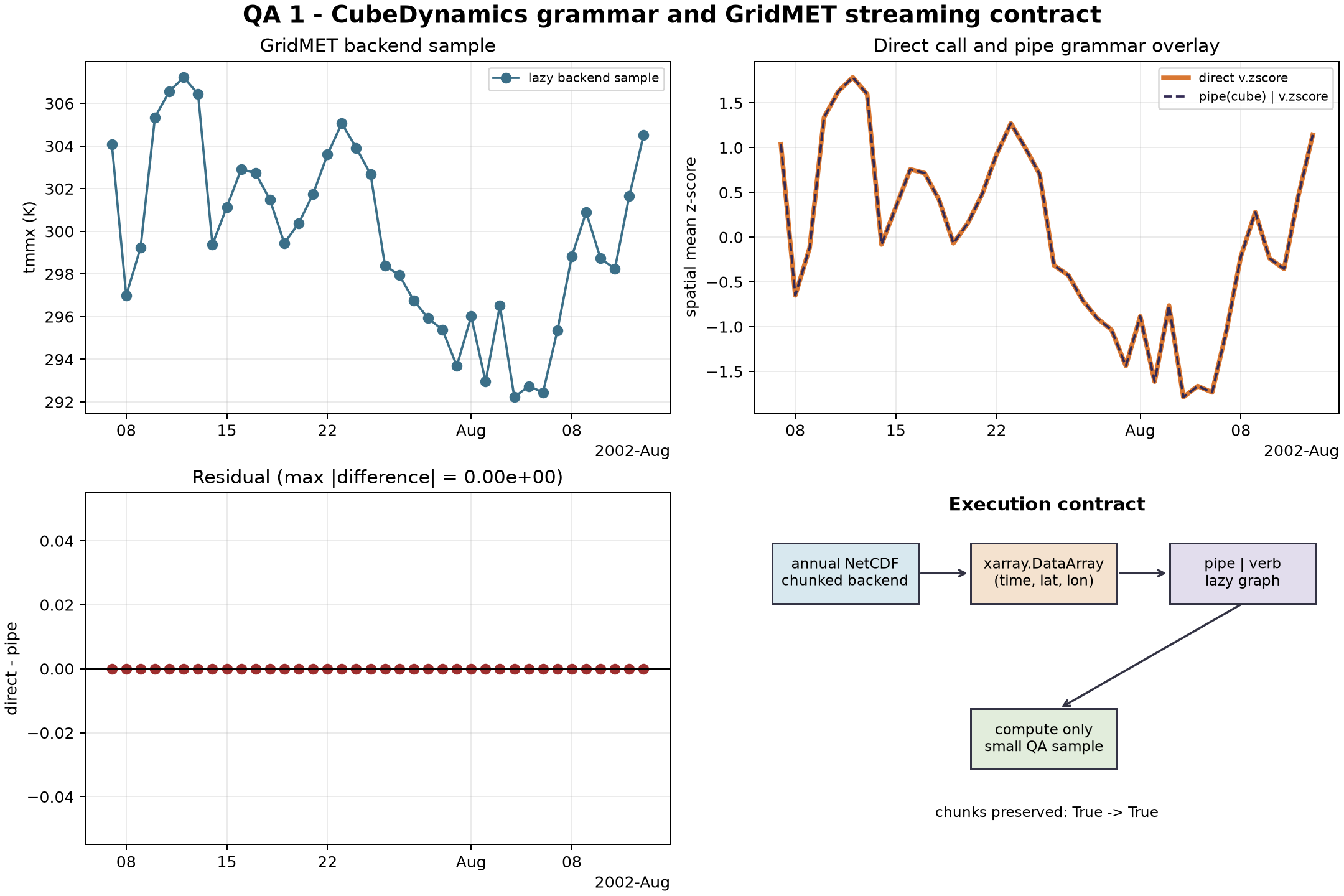
For this published run, the sampled cube has 38 daily steps over 10 by 13
GridMET cells. Direct and pipe graphs were identical (max |residual| = 0),
and both remained Dask-backed until the comparison was requested.
The backend shown here is the one used to build the lake tables: chunked annual GridMET NetCDF. The separate external module then checks its raw packed values against the NCAR/GDEX mirror.
The data cube and HTML integrity audit separately traces this real cube through the viewer, checks every rendered plane, and verifies that dates and spatial indices were not omitted or permuted.