Similar weather can accompany different histories
Finding 04 · Matched-pair diagnostics
The mismatches are scientifically useful because they identify cases where the current explanatory layer is insufficient—and where new measurements can be most informative.
Question
When fires are closely matched on weather and declared nuisance variables, do they necessarily share a developmental history? And do similar histories necessarily share weather?
Answer
No. Unique matched pairs include both convergence and divergence. But the observed mismatch fractions are compatible with conditional permutation references, so this analysis does not establish excess mismatch or its ecological prevalence.
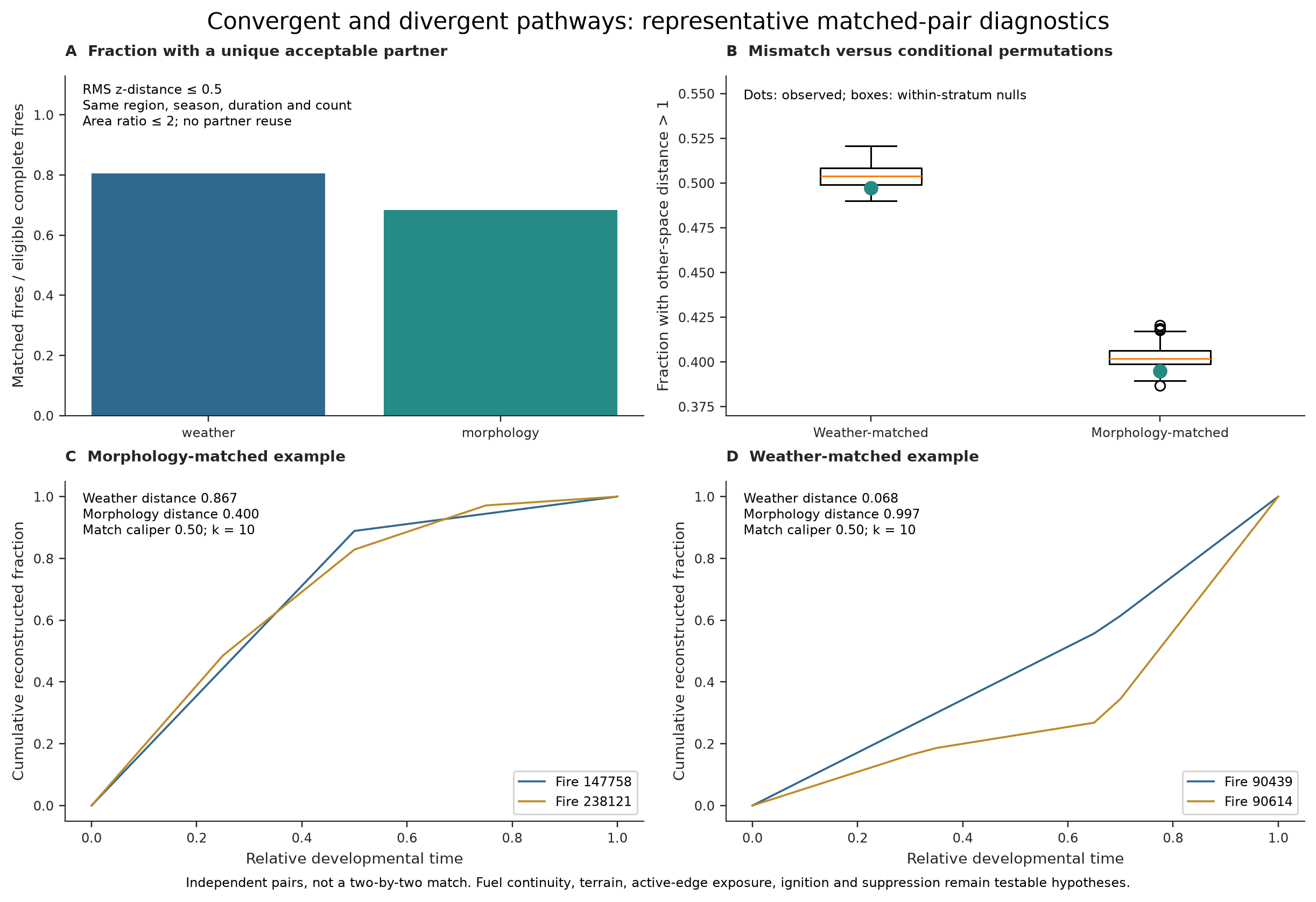
What to notice. The weather-matched example reaches the same endpoint through visibly different allocations. The plotted examples are near the population median mismatch, not adversarial extremes. They are two independent pairs—not a two-by-two matching design. Technical caption
How to read this figure
Challenge this result. If the examples depended entirely on one caliper or on poor partner coverage, they would be weak study candidates. Sensitivity changes coverage, and the null comparison prevents an excess-mismatch claim. See the matching-caliper test →
Evidence trail
What we measured
Matching starts with 9,212 complete primary fires. Candidate partners share region, season, duration, and observation count, differ in area by no more than a factor of two, and fall within a declared standardized-distance caliper. Partners cannot be reused. Mismatch outcomes never influence pair selection.
How well does it hold up?
Coverage changes when the caliper, candidate-neighbor count, or distance metric changes. At the declared design, morphology-matched mismatch is 39.5% compared with a 40.2% conditional-permutation mean. These agreements make the pairs useful as representative study candidates while preventing a claim that observed mismatch is unusually common.
These mismatches tell us what to measure next
- fuel load and continuity along the active edge
- terrain and slope aligned to dated progression
- directional wind and sub-grid weather heterogeneity
- ignition context and suppression history
- active-edge geometry and independent operational observations
- uncertainty in satellite burn date and event reconstruction
These are hypotheses named in the manuscript, not mechanisms established by the current pair analysis. Fire VASE supplies the common response against which those next layers can be tested.
What this does not show
The matching is observational, greedy rather than globally optimal, constrained by candidate search and exact nuisance strata, and sensitive to the declared caliper. A diagnostic threshold of standardized other-space distance greater than one is not a natural class boundary.
Technical details
See matching and reproducibility and the matching outputs.